Renzō Sawada
| Name | Renzō Sawada |
| Title | (1888-1970) |
| Gender | Male |
| Birthday | 1888-10-17 |
| nationality | Japan |
| Source | https://www.wikidata.org/wiki/Q6143799 |
| pptrace | View Family Tree |
| LastUpdate | 2025-11-17T10:08:35.409Z |
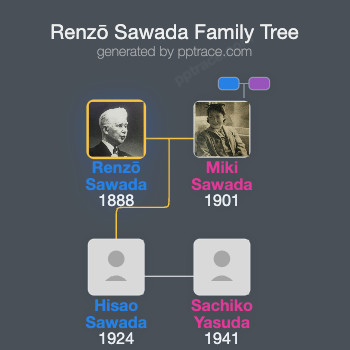
Family Tree
Tap  to expand more relatives
Introduction
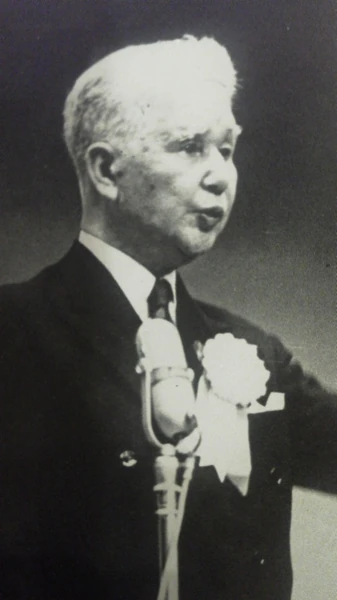
Renzō Warizawa (October 17, 1888 – December 8, 1970) was a Japanese diplomat. He was born in Uranomichi, Iwami Town, Iwami District, Tottori Prefecture. His father was Nobuo Sawada, and his mother was Hisako. After attending the former Tottori Prefectural First Junior High School and the former First High School, he graduated from the Faculty of Law, Department of French Law, at Tokyo Imperial University. In 1914, he excelled in the diplomatic and consular officer examinations and entered the Ministry of Foreign Affairs.
While at the Ministry of Foreign Affairs, he was proficient in French and English. Before the war, he concurrently served in the Imperial Household Ministry as an aide and acted as an interpreter for Emperor Shōwa (Hirohito). After the war, he continued his role as an interpreter for members of the Imperial family. During his tenure at the Ministry, he worked at the Japanese embassy in France and was involved in the post-World War I peace conference and the establishment of the League of Nations. In 1921, he accompanied Crown Prince Hirohito (later Emperor Shōwa) on his European tour, serving as interpreter and guide.
In 1922, he married Miki, the eldest daughter of the Mitsubishi conglomerate’s founder, Iwasaki Hisaya. They had two sons, Shinnichi and Hisao; Hisao became a vocal music artist. In 1923, he was transferred to Buenos Aires, Argentina, and later served in Beijing, China.
He served as an interpreter for Emperor Shōwa and helped with the Imperial Household Ministry, translating for royalty and heads of state. He was also the chairman of Takino River Gakuen, a foundation. His older brother, Setsuzō Sawada, was also a diplomat.
Immediately after World War II, he acted as an intermediary between the Allied forces and prisoners of war. On December 2, 1945, he visited the Deoli detention camp in northwestern India to explain Japan's surrender and read Emperor Shōwa’s war end decree. Reports at the time also noted conflicts between those identified as "winners" and "losers" within the camp. During the American occupation, he was formally purged from public office by GHQ.
After the war, he provided his private residence in Kōjimachi to Paul Rusch (then with GHQ’s Civil Information Section), which was used as "CIS House." This building was also a base for creating lists of war criminal suspects. He served as a contact point for government officials.
Following the ratification of the San Francisco Peace Treaty, he was dispatched to New York as Japan’s first ambassador to the United Nations in 1952. At that time, Japan was not yet a full member but only had observer status. He dedicated himself to Japan’s admission to the UN, which was achieved in 1956. During Japan’s accession, Foreign Minister Shigemitsu Mamoru delivered a speech in the assembly. While in New York, he developed personal relations with Rockefeller III and UN Secretary-General Hammarskjöld.
After retiring as UN ambassador, he became an advisor to the Ministry of Foreign Affairs. Residing in Ōiso, Kanagawa, he worked alongside his wife Miki to support the Elizabeth Sanders Home project.
Materials related to him are held at the Diplomatic Records Museum of the Ministry of Foreign Affairs and the Tottori Prefectural Public Document Archives. A collection titled "The Era of Renzō Warizawa and Miki" was published in 2010.
Chronology:
- 1888: Born in Uranomichi, Iwami Town, Iwami District, Tottori Prefecture, as the second son of Nobuo Sawada and Hisako.
- 1900s: Attended the old Tottori First Junior High School and First High School; then graduated from Tokyo Imperial University, Faculty of Law, Department of French Law.
- 1914: Passed the diplomatic and consular officer examination as the top candidate and joined the Ministry of Foreign Affairs.
- 1916: Posted to the French embassy.
- 1921: Accompanied Crown Prince Hirohito on his European visit, serving as interpreter and guide.
- 1922: Married Miki.
- 1923: Transferred to Buenos Aires, Argentina.
- 1924: Served in Beijing, China.
- 1945: After Japan’s defeat, visited a camp in northwestern India to communicate Japan's surrender and read the Emperor’s war end decree.
Additional details cover his extensive career, connections, and activities, but the above summarizes the main points.