Catherine Wellesley, Duchess Of Wellington
| Name | Catherine Wellesley, Duchess Of Wellington |
| Title | Wife of the Duke of Wellington (1773–1831) |
| Gender | Female |
| Birthday | 1773-01-14 |
| nationality | United Kingdom of Great Britain and Ireland |
| Source | https://www.wikidata.org/wiki/Q540048 |
| pptrace | View Family Tree |
| LastUpdate | 2025-11-26T23:27:22.772Z |
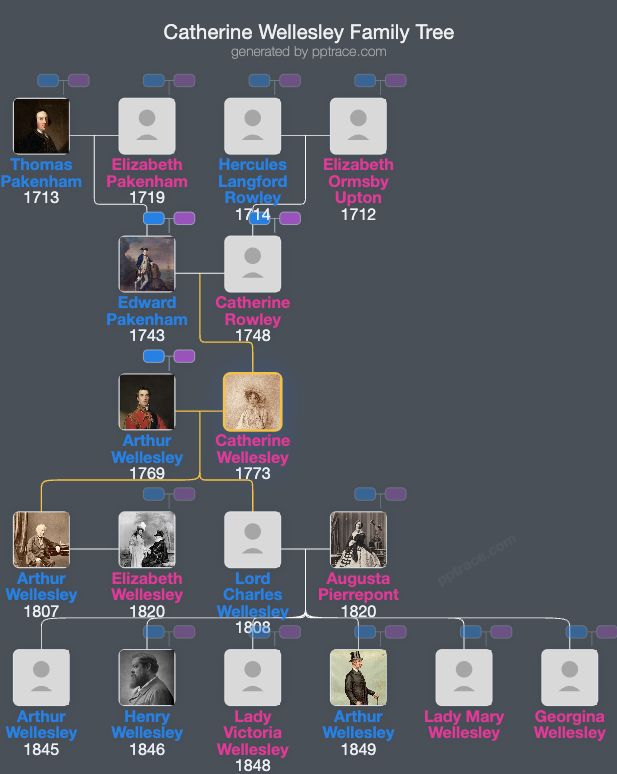
Family Tree
Tap  to expand more relatives
Introduction
Catherine Sarah Dorothea Wellesley, Duchess of Wellington (née Pakenham), was born on 14 January 1773 in Dublin, Ireland. She was the daughter of Edward Pakenham and Catherine Rowley. In 1776, her father succeeded as the 2nd Baron Longford, after which she was styled "The Honourable Catherine Pakenham." Her paternal grandparents were Thomas Pakenham, 1st Baron Longford, and Elizabeth Cuffe, 1st Countess of Longford. Her maternal grandparents were Elizabeth Rowley, 1st Viscountess Langford, and Hercules Langford Rowley, who served as a Member of Parliament.
Pakenham had several siblings, including Thomas Pakenham, 2nd Earl of Longford; General Sir Edward Pakenham; and Lieutenant-General Sir Hercules Robert Pakenham, who was an aide-de-camp to King William IV.
She met Arthur Wellesley, who later became the 1st Duke of Wellington, in Ireland during their youth. Wellesley visited her family’s Dublin home multiple times and expressed his feelings toward her. At that time, her family disapproved of the match because Wellesley was the third son in a large family with limited prospects. Following this rejection, Wellesley focused on his military career, serving in the Netherlands and India, and achieved rapid career advancement. During this period, Pakenham remained hopeful for reconciliation but acknowledged to a friend, Olivia Sparrow, that she thought the situation was resolved. She was engaged to Galbraith Lowry Cole, second son of the Earl of Enniskillen, but later broke off the engagement after Sparrow informed her that Wellesley still considered himself attached to her. Pakenham believed the stress from the affair affected her health.
In 1795–6, Pakenham was ill and weakened, and by the time Wellesley returned to England, she was in poor health. Wellesley, after traveling to Ireland to meet her, proposed marriage. Despite her concerns about her appearance and health, she agreed to marry him. They were married on 10 April 1806 at St. George's Church, Dublin, by Wellesley's brother Gerald Wellesley. After a brief honeymoon, Wellesley returned to England, and Pakenham followed. They established a household in Harley Street, London, but their relationship was characterized by differences; Wellesley was reserved and action-oriented, while Pakenham was protective and possessive. They had two sons, Arthur (born 1807) and Charles (born 1808), and lived largely separately, occupying different rooms in their house.
Her brother, Edward "Ned" Pakenham, served under Wellesley during the Peninsular War, and Wellesley's regard for him improved his relationship with Pakenham until Ned's death at the Battle of New Orleans in 1815. Wellesley remained in Portugal and Spain during the Peninsular War, not returning to England until 1814. Pakenham developed short-sightedness, which caused her to squint when talking. Wellesley regarded her as vain and vacuous, but historical accounts suggest she loved him and focused her attention on her children and adopted children.
In 1814, she was created Duchess of Wellington upon Wellesley's elevation to the dukedom. She later joined Wellesley in France when he served as ambassador following Napoleon's exile to Elba. Contemporary observers described her appearance as not fitting the traditional role of an ambassadress, but others, such as Maria Edgeworth and Germaine de Staël, regarded her as agreeable and admirable.
Catherine Wellesley became seriously ill in 1831. She visited her husband before her illness worsened. She died on 24 April 1831.