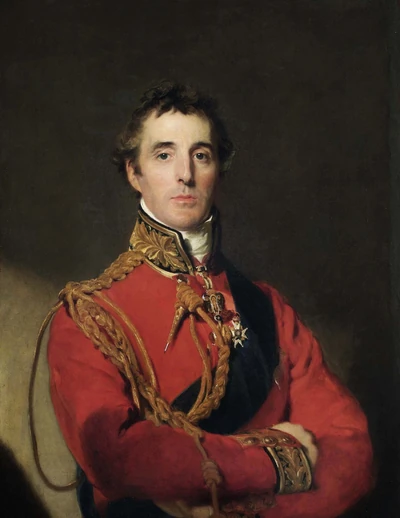
Arthur Wellesley, 1st Duke Of Wellington
| Name | Arthur Wellesley, 1st Duke Of Wellington |
| Title | British Field Marshal, Prime Minister of the United Kingdom, 1828–1830, 1834 |
| Gender | Male |
| Birthday | 1769-05-01 |
| nationality | Republic of Ireland |
| Source | https://www.wikidata.org/wiki/Q131691 |
| pptrace | View Family Tree |
| LastUpdate | 2025-11-26T23:27:19.328Z |
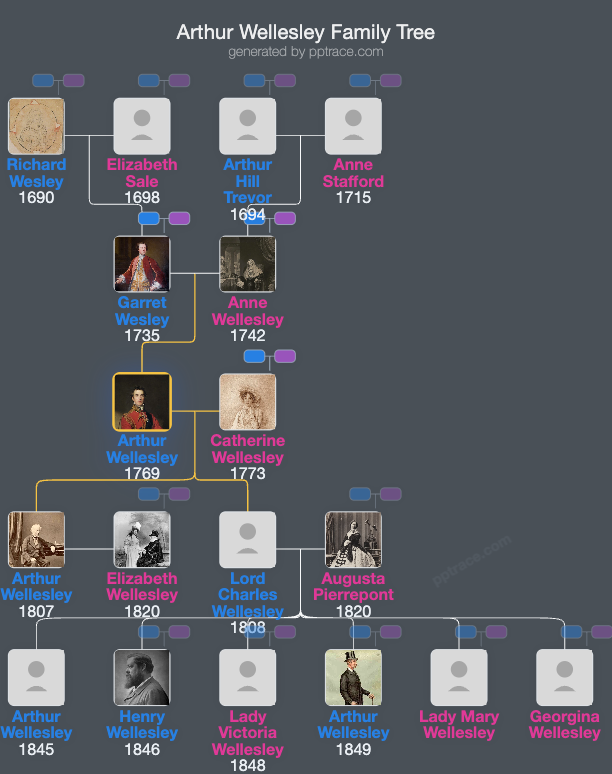
Family Tree
Tap  to expand more relatives
Introduction
Arthur Wellesley, 1st Duke of Wellington (born Wesley; 1 May 1769 – 14 September 1852), was an Anglo-Irish military officer and statesman. He served as Prime Minister of the United Kingdom on two occasions during the early 19th century. His military accomplishments include key roles in the Anglo-Mysore Wars, culminating in the defeat of Tipu Sultan in 1799, and in the Napoleonic Wars, notably at the Battle of Waterloo in 1815, which resulted in the coalition victory over Napoleon Bonaparte.
Wellesley was born in Dublin, Ireland, into a Protestant Ascendancy family. His father was Garret Wesley, 1st Earl of Mornington, and his mother was Anne Hill-Trevor, Countess of Mornington. His family belonged to the aristocracy of Ireland, and Wellesley was the sixth of nine children. He was baptized at St. Peter's Church in Dublin, with his birthplace variously reported as Dublin or County Meath; the precise location remains subject to historical dispute.
He received education at various institutions including the diocesan school in Trim, Mr. Whyte's Academy in Dublin, Brown's School in Chelsea, and Eton College from 1781 to 1784. After a period in Brussels due to financial constraints following his father's death in 1781, he enrolled at the French Royal Academy of Equitation in Angers in 1786, where he developed proficiency in horsemanship and learned French.
Wellesley's early military career began in 1787 when he was commissioned as an ensign in the 73rd Regiment of Foot. Subsequently, he served as aide-de-camp to the Lord Lieutenant of Ireland, Lord Buckingham. He was promoted through various regiments and became a member of the Irish House of Commons representing Trim in 1790. During this period, he also engaged in social activities and politics, aligning with the government in Dublin.
In 1796, Wellesley achieved the rank of colonel and participated in campaigns in Flanders. Later, he was dispatched to India, where he fought in the Fourth Anglo-Mysore War, notably winning the Battle of Seringapatam in 1799. Following this victory, he was appointed governor of Seringapatam and Mysore. He continued his military success at the Battle of Assaye in 1803 as a major-general, defeating the Maratha Confederacy.
Wellesley gained prominence during the Peninsular War (1808–1814), leading British and allied forces against the French in Spain and Portugal. His leadership culminated in his promotion to field marshal after the victory at Vitoria in 1813. After Napoleon’s first exile in 1814, he served as Britain’s ambassador to France and was created Duke of Wellington.
In 1815, during the Hundred Days, Wellington commanded British-led forces at Waterloo, assisted by Prussian troops under Gebhard Leberecht von Blücher. Their combined forces defeated Napoleon, ending his rule.
Following his military career, Wellington entered politics as a member of the Tory party. He served as Prime Minister from 1828 to 1830, and briefly in 1834. His tenure included overseeing the passage of the Roman Catholic Relief Act 1829 and opposing the Reform Act 1832. He remains the only Irish-born individual to have served as British Prime Minister. Wellington continued active involvement in political affairs and military leadership until his retirement in 1846. He held the position of Commander-in-Chief of the Forces until his death in 1852.