Frances Greville
| Name | Frances Greville |
| Title | Irish poet |
| Gender | Female |
| Birthday | 1727-01-01 |
| nationality | — |
| Source | https://www.wikidata.org/wiki/Q5478677 |
| pptrace | View Family Tree |
| LastUpdate | 2025-11-26T12:30:38.653Z |
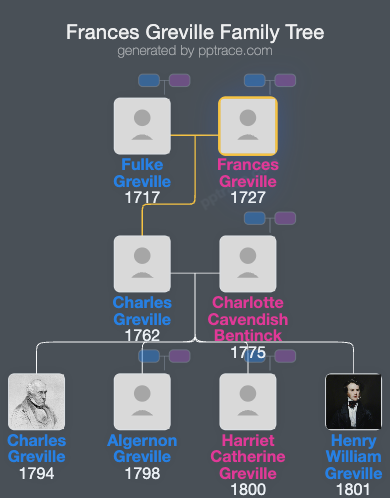
Family Tree
Tap  to expand more relatives
Introduction
Frances Greville, née Macartney, was born circa 1724 in Longford, Ireland, and died in 1789. She was an Anglo-Irish poet and a figure of social prominence in Georgian England. She was one of four daughters of James Macartney and Catherine Coote. Her mother, Catherine, was the daughter of the distinguished judge Thomas Coote and the niece of Richard Coote, 1st Earl of Bellomont.
In the early 1740s, Greville was residing in London, where she accompanied Sarah Lennox, Duchess of Richmond. Her social prominence is evidenced by her mention in Horace Walpole’s 1746 poem, "The Beauties," where she is referred to as "Fanny" among the notable women at court.
In 1748, Frances married Fulke Greville of Wilbury House in Wiltshire after an elopement. Fulke Greville was known to be a gambler and a dandy, but historical accounts suggest that he loved Frances, as her presence is documented in his writings, particularly in "Maxims, Characters, and Reflections" (1756), where she appears under the character of "Flora." It is believed that Frances contributed to the volume herself.
As an amateur poet, Frances Greville gained recognition for her poem "Prayer for Indifference," first published in the Edinburgh Chronicle in 1759. The poem criticizes the burgeoning cult of sensibility and was frequently reprinted over the subsequent decades. It was often paired with another poem that praised sensibility, reflecting its thematic contrast. Aside from this notable work, her literary output was generally limited to vers de société, or light, socially-oriented poetry.
During the 1760s and 1770s, Greville traveled extensively. Her husband was appointed envoy to Bavaria in 1764. She was known as a conversationalist and maintained friendships with notable figures such as Charles and Frances Burney and Richard Brinsley Sheridan. Sheridan dedicated his play "The Critic" to her.
Greville was the mother of four children, including her daughter Frances Anne Crewe (1748–1818), who became a prominent Whig hostess. Her sons William (1751–1837), Henry (1760–1816), and Charles (1762–1832) pursued careers in the military. Henry later became a theatrical manager, though with limited success.
Frances Greville died on 28 July 1789 at Hampton, London. She was buried at St Peter’s Church in Petersham.
**References**
- Fuller, Joyce, ed. *British Women Poets, 1660–1800*. Troy, New York: Whitson Publishing Company, 1990.
- Lonsdale, Roger. *Eighteenth Century Women Poets*. Oxford: Oxford University Press, 1989.
**External Links**
- Frances Greville at the Eighteenth-Century Poetry Archive (ECPA)
- Betty Rizzo, 'Greville, Frances (1727?–1789)', Oxford Dictionary of National Biography, Oxford University Press, Sept 2004; online edition, Jan 2008.
- Works by or about Frances Greville at the Internet Archive
- Works by Frances Greville at LibriVox