Mōri Takanori
| Name | Mōri Takanori |
| Title | Japanese aristocrat, founder of shorthand writing system (1867-1939) |
| Gender | Male |
| Birthday | 1867-01-10 |
| nationality | Tokugawa shogunate |
| Source | https://www.wikidata.org/wiki/Q11547710 |
| pptrace | View Family Tree |
| LastUpdate | 2025-11-17T06:47:38.790Z |
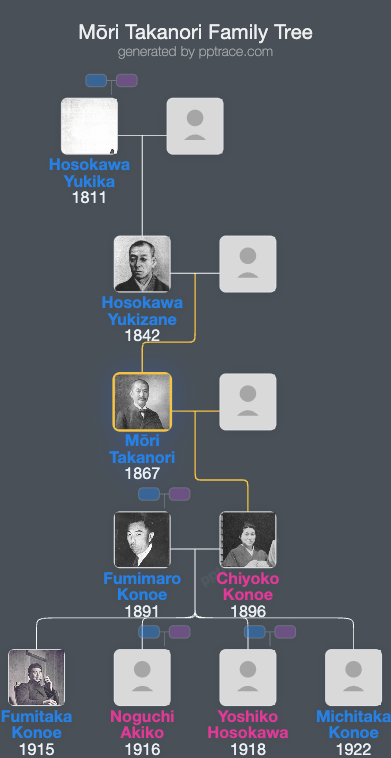
Family Tree
Tap  to expand more relatives
Introduction
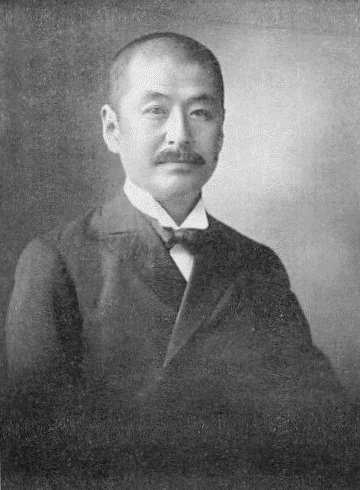
Takayuki Mōri (December 5, 1867 – June 12, 1939) was a Japanese noble (viscount) in the pre-war period, serving as a member of the House of Peers. He is also known as the founder of the Mōri-style shorthand method.
Life
Takayuki Mōri was born in Kumamoto Prefecture as the second son of Yukimasa Hosokawa, lord of the Higo Uto Domain. His childhood name was Kanjiro. Through his sister-in-law, the beautiful girl (daughter of Tatusunori Hosokawa), who became the second wife of Takakene Mōri, lord of the Bungo Saiki Domain, Takakene adopted him. After the abolition of domains and establishment of prefectures, he moved to Tokyo and, following the death of his adoptive father in 1876, inherited the family estate. He was ennobled as a viscount on July 8, 1884.
Study and Research
In 1888, he studied abroad in Germany, engaging in research on shorthand techniques. He returned to Japan in 1891, was appointed an official in the Imperial Household Ministry, but in 1893 returned to Saiki, continuing his research on Japanese shorthand.
Education and Political Activity
In September 1907, he moved back to Tokyo to reside and educate his children. On June 21, 1913, he was elected as a viscount member of the House of Peers, serving two more terms thereafter. In July 1920, he announced his shorthand method as "Mōri-style Shorthand" and in April 1923 established the Mōri Shorthand School to teach the technique.
Charitable Activities and Foundation
In 1924, he invested his personal funds to establish the "Mōri Family Service Foundation," promoting education and industry in Saiki.
Achievements and Honors
His term as a House of Peers member ended on July 9, 1932, after which he donated 1,000 yen to the shorthand division. He died at his home in his later years; his grave is located at Tozen-ji Temple in Shiba Takane. His posthumous Buddhist name is Sōki-in Taisen Kaisen Kōhin Daishi.
Honors and Decorations
He was awarded the Fourth Rank as of December 21, 1896; promoted to the Third Rank on January 10, 1919; received the Order of the Sacred Treasure, Third Class, on May 31, 1924; and elevated to the Second Rank on December 15, 1931.
Works
His notable works include "Mōri-style Japanese Shorthand Technique."
Family and Relatives
His first wife was Takako, daughter of Naoya Ii, the 10th lord of the Echigo Yawata Domain (1871–1888). His second wife was Kenzuko, adopted daughter of Naoya Ii and daughter of Naoya’s brother, Naoharu Ii. His children include eldest daughter Hisako, who married Nagakazu Kuroda; second daughter Chiyoko, who married Monpei Kono; third daughter Yasuko, who married his younger brother Hideharu; and fifth daughter Kiyoko, who married Tōmaro Tsukuba. His eldest son Takamasa died young, and the family headship was succeeded by his second son, Takatō. All his children learned shorthand; Yasuko assisted Hirata Kumao, secretary to Prince Saionji Kinmochi, in dictating the "Hara Diary." His great-grandson Bunko, the grandson of his eldest daughter, currently holds the family headship.
References and Source Materials
Information is drawn from "Japan Shorthand Writers Directory" (published October 28, 1953), the Nihon Jinmei Daijiten (Kodansha), "Roster of the House of Peers (Part B)," revised December 1946, issued by the House of Peers Secretariat (1947), and "A Hundred Years of Parliamentary System - Directory of House of Peers and House of Councillors Members" by the Ministry of Finance Printing Bureau (1990).