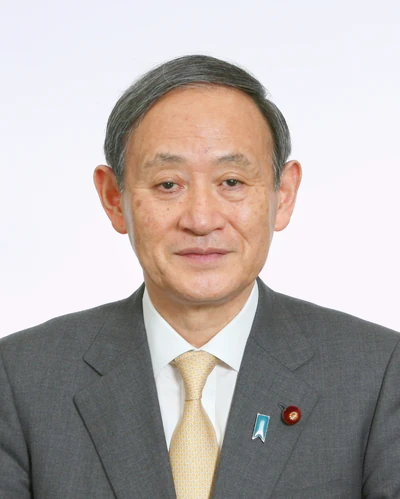
Yoshihide Suga
| Name | Yoshihide Suga |
| Title | Prime Minister of Japan from 2020 to 2021 |
| Gender | Male |
| Birthday | 1948-12-06 |
| nationality | Japan |
| Source | https://www.wikidata.org/wiki/Q122465 |
| pptrace | View Family Tree |
| LastUpdate | 2025-11-17T06:48:51.780Z |
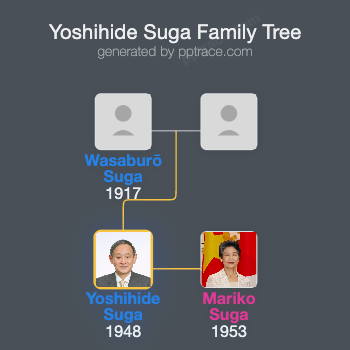
Family Tree
Tap  to expand more relatives
Introduction
Yoshihide Suga (菅 義偉, Suga Yoshihide) was born on December 6, 1948, in Ogachi, Akita Prefecture, Japan. His family engaged in strawberry farming in a rural area, and after completing high school in Yuzawa, he relocated to Tokyo. Suga attended Hosei University, where he earned a Bachelor of Laws degree in 1973. During his time at university, he worked in a cardboard factory to support his studies.
Following his graduation, Suga gained experience working on a House of Councillors election campaign. In 1975, he became an aide to LDP Diet Member Hikosaburo Okonogi, a position he held for eleven years. He resigned in October 1986 to pursue his own political career. In April 1987, Suga was elected to the Yokohama Municipal Assembly, campaigning through extensive door-to-door visits and popular street-corner speeches at train stations. His campaigning style earned him the nickname "the shadow mayor" due to his influence in local government.
Suga was elected to the national legislature, the House of Representatives, in the 1996 general election, representing Kanagawa's 2nd district as a member of the Liberal Democratic Party (LDP). During his tenure, he developed a close alliance with Shinzo Abe, then Chief Cabinet Secretary. He shifted political support from Prime Minister Keizo Obuchi to Seiroku Kajiyama early in his legislative career. Suga was re-elected in subsequent elections in 2000, 2003, and 2005.
In November 2005, Suga was appointed Senior Vice Minister for Internal Affairs and Communications under Prime Minister Junichiro Koizumi. He was promoted in September 2006 to Minister of Internal Affairs and Communications and concurrently served as Minister for the Privatization of Postal Services, with additional responsibilities for Decentralization Reform starting in December 2006. He was involved in the development of Japan’s "hometown donation" system, which facilitated tax deductions for local donations by taxpayers.
Suga served as Minister of Internal Affairs and Communications until August 2007 when he was replaced in a cabinet reshuffle. He successfully retained his seat in the 2009 general election during a period of declining support for the LDP. In October 2011, he became Chairman of the LDP Party of Organization and Movement Headquarters. By September 2012, he was appointed Executive Acting Secretary-General of the party.
In December 2012, following Shinzo Abe’s victory in the general election, Suga was appointed Chief Cabinet Secretary, a role he held through Abe’s second term until 2020. His tenure made him the longest-serving Chief Cabinet Secretary in Japanese history, with a total duration of 2,820 days. He was also given the portfolio of Minister in charge of Okinawa Prefecture's Base Burden in September 2014 and remained a core figure in the government throughout Abe’s administration.
During his role as Chief Cabinet Secretary, Suga participated in policy initiatives targeting tourism, foreign workers, and telecommunications, and supported Japan’s economic measures including aggressive monetary policy by the Bank of Japan. His political stance was associated with ultranationalist and far-right groups, notably Nippon Kaigi. In 2019, Suga announced the name of Japan’s Reiwa era, earning media attention and increasing his national prominence.
Following Shinzo Abe’s resignation in August 2020, Suga was elected as the leader of the Liberal Democratic Party and became Prime Minister of Japan. His premiership prioritized response measures to the COVID-19 pandemic, the coordination of vaccine distribution, and overseeing the delayed 2020 Tokyo Summer Olympics and Paralympics. During this period, Japan also announced plans for achieving carbon neutrality by 2050.
Suga’s approval ratings declined amid dissatisfaction with pandemic management and the Olympic execution. On September 3, 2021, he announced he would not seek reelection as LDP president and subsequently resigned as Prime Minister. His tenure concluded on October 4, 2021, when Fumio Kishida succeeded him as Prime Minister.