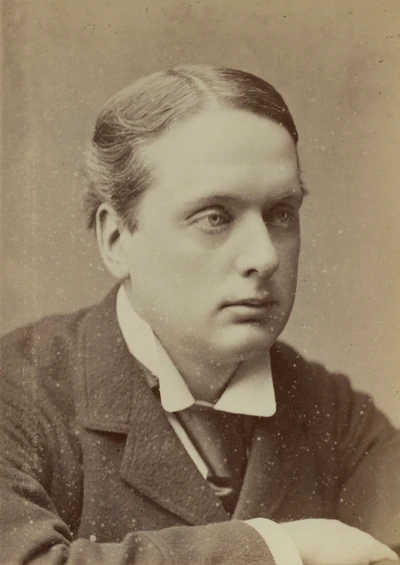
Archibald Primrose, 5th Earl Of Rosebery
| Name | Archibald Primrose, 5th Earl Of Rosebery |
| Title | British Liberal politician and Prime Minister of the United Kingdom (1847–1929) |
| Gender | Male |
| Birthday | 1847-05-07 |
| nationality | United Kingdom |
| Source | https://www.wikidata.org/wiki/Q244620 |
| pptrace | View Family Tree |
| LastUpdate | 2025-11-26T23:30:45.115Z |
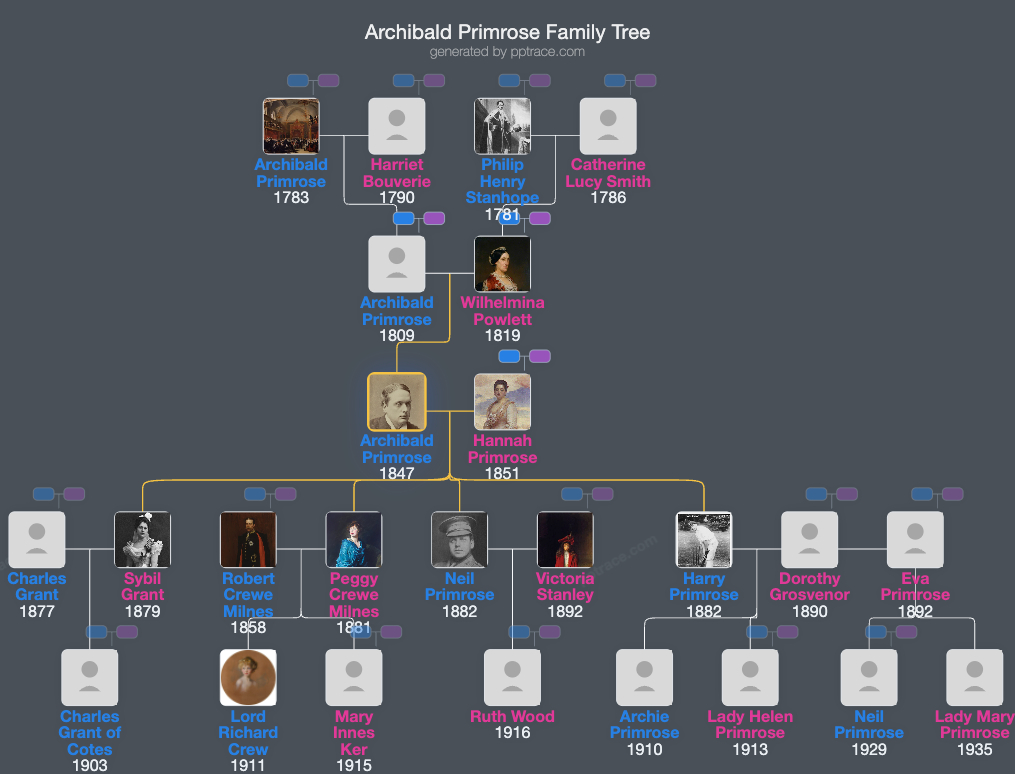
Family Tree
Tap  to expand more relatives
Introduction
Archibald Philip Primrose, 5th Earl of Rosebery, 1st Earl of Midlothian, was born on 7 May 1847 in Charles Street, Mayfair, London. His father was Archibald Primrose, Lord Dalmeny (1809–1851), and his mother was Lady Catherine Lucy Wilhelmina Stanhope (1819–1901). His father was the heir apparent to the 4th Earl of Rosebery, and held the courtesy title Lord Dalmeny. The elder Lord Dalmeny served as Member of Parliament for Stirling from 1832 to 1847 and was First Lord of the Admiralty under Lord Melbourne.
In 1851, his father died, predeceasing his own father, the 4th Earl of Rosebery. Subsequently, Archibald Primrose inherited the earldom upon his grandfather's death in 1868, when he was 21 years old. He inherited an income of approximately £30,000 annually and owned substantial landholdings in Scotland, Norfolk, Hertfordshire, and Kent.
His mother remarried in 1854 to Lord Harry Vane, later known as Harry Powlett, 4th Duke of Cleveland. The relationship between Rosebery and his mother was described as poor. He had an elder sister, Lady Leconfield, who was married to Henry Wyndham, 2nd Baron Leconfield.
For his education, Rosebery attended Bayford House school in Hertfordshire, followed by Eton College from 1860 to 1865. At Eton, he developed a close friendship with his tutor William Johnson Cory. He then matriculated at Christ Church, Oxford, in January 1866, where he was a member of the Bullingdon Club. He left Oxford in 1868 after being fined for owning a horse contrary to university rules.
He toured the United States in 1873, 1874, and 1876. He was briefly engaged to Marie Fox, the adopted daughter of Henry Fox, 4th Baron Holland, but she declined marriage due to her refusal to renounce Roman Catholicism.
Upon the death of his grandfather in 1868, Rosebery became the 5th Earl of Rosebery. The peerage was part of the Scottish Peerage, which did not automatically grant him a seat in the House of Lords. However, in 1828, his grandfather was created 1st Baron Rosebery in the Peerage of the United Kingdom, entitling him to sit in the House of Lords and barring a career in the House of Commons.
As an Earl, Rosebery inherited a substantial estate and income, including approximately 40,000 acres in Scotland and land elsewhere. His property holdings included land in Norfolk, Hertfordshire, and Kent.
Rosebery’s early political activities included criticizing Charles I at Eton for despotism and praising his Whig ancestors. He was approached by Benjamin Disraeli and William Ewart Gladstone for party recruitment, ultimately aligning with the Liberals. He sponsored the 1879 Midlothian Campaign, which benefited Gladstone's successful bid for the Midlothian constituency. He served as Foreign Secretary under Gladstone in 1886 and again during 1892–1894, concentrating on French and German foreign relations, and colonial expansion in Africa.
In 1889, Rosebery became the first chairman of the London County Council, representing a significant role in local government. He was appointed a Knight of the Order of the Garter in 1892. His tenure as Foreign Secretary and later as Prime Minister was marked by foreign policy conflicts, notably over Uganda and the Armenian crisis, and internal party disagreements.
He succeeded William Ewart Gladstone as leader of the Liberal Party and Prime Minister in 1894. His government was characterized by internal strife and foreign policy challenges, and it ended with his resignation in June 1895, following a vote of no confidence. The Liberal Party was subsequently defeated in the 1895 general election, and Rosebery retired from politics in 1896.
Rosebery was known for his oratory, sportsmanship, and interests in writing and collecting art and historical works. He was identified as a political figure favoring imperialism and social reform, with a stance against socialism. Despite his various roles and activities, historians generally assess his tenure as a period of limited success in foreign and domestic policy. He died on 21 May 1929.