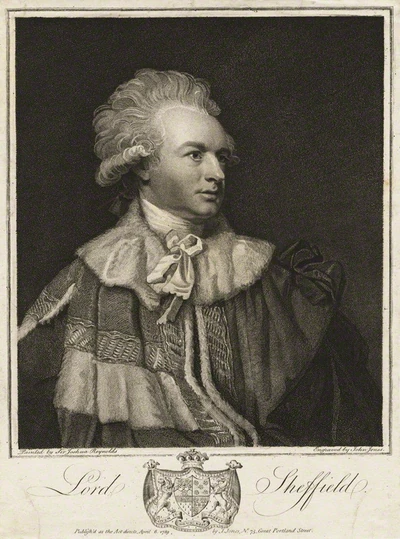
John Baker Holroyd, 1st Earl Of Sheffield
| Name | John Baker Holroyd, 1st Earl Of Sheffield |
| Title | English politician |
| Gender | Male |
| Birthday | 1735-12-21 |
| nationality | England |
| Source | https://www.wikidata.org/wiki/Q6220354 |
| pptrace | View Family Tree |
| LastUpdate | 2025-11-26T23:24:50.831Z |
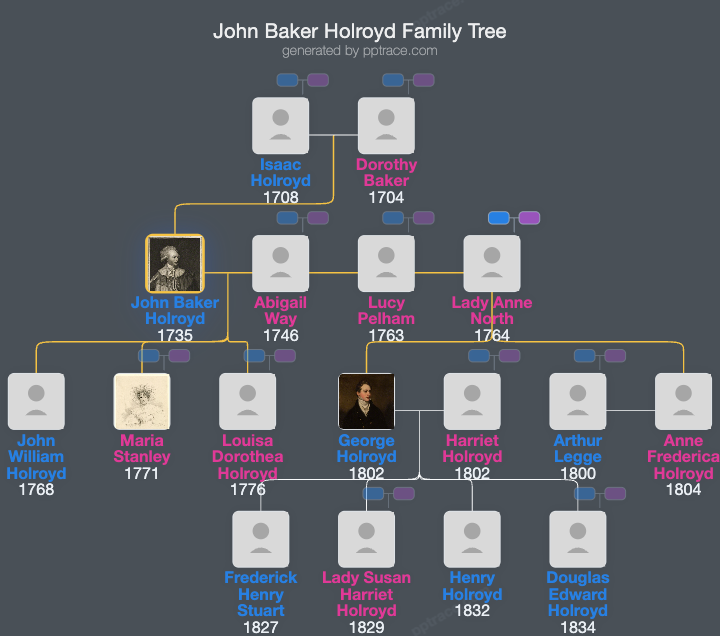
Family Tree
Tap  to expand more relatives
Introduction
John Baker Holroyd, 1st Earl of Sheffield (21 December 1735 – 30 May 1821), was an Anglo-Irish politician and military officer. He held prominent positions relating to agriculture and commerce, including serving as President of the Board of Agriculture in 1803.
Holroyd was born as the eldest son of Isaac Holroyd (1708–1778), Esq. of Dunamore, County Meath, and his wife Dorothy Baker (1708–1777). His paternal grandfather, Isaac Holroyd (1643–1706), was a merchant from an old Yorkshire family that settled in Ireland following the Restoration period. Holroyd adopted the surname Baker upon inheriting his uncle Rev. James Baker's estates in 1768, and later added Holroyd after the death of his father in 1778.
He entered the British Army in 1760, initially commanding the Royal Foresters under John Manners, Marquess of Granby. After the war, he was promoted to captain. Nearly two decades later, during conflicts involving multiple European powers, he began service as a major and eventually commanded the 22nd Regiment of Light Dragoons, a cavalry unit he established during the Anglo-France War.
In 1763, Holroyd traveled on the European continent, visiting Lausanne, Switzerland, where he developed a close friendship with the historian Edward Gibbon. Gibbon later became a notable historian and authored "The History of the Decline and Fall of the Roman Empire." In 1764, Holroyd appeared at Lausanne; this connection would influence his later activities.
In 1769, using his inherited wealth, Holroyd purchased Sheffield Hall in Sussex for £31,000 from Lord De La Warr. His political career began with his election as a Member of Parliament for Coventry in 1780, where he opposed anti-Catholic agitators such as Lord George Gordon and the Gordon riots.
He was created Irish peerages: Baron Sheffield of Dunamore in 1781 and Baron Sheffield of Roscommon in 1783, the latter with a special remainder passing to his daughters, which did not interrupt his parliamentary career. Holroyd was re-elected for Coventry in 1781 and for Bristol in 1790. In 1802, he was elevated to a peerage in the United Kingdom as Baron Sheffield of Sheffield, York, and in 1816, he was granted the titles Viscount Pevensey and Earl of Sheffield in the Irish peerage.
Holroyd was elected a Fellow of the Royal Society in 1783. He married three times: first to Abigail Way, daughter of Lewis Way, with whom he had a son and two daughters; Abigail died in 1793. His second marriage was to The Hon. Lucy Pelham, daughter of Thomas Pelham, 1st Earl of Chichester, in 1795; this marriage ended with her death in 1797. His third marriage was to Lady Anne North, daughter of the former Prime Minister Lord North, on 20 January 1798.
He died in 1821 and was buried in the Sheffield family mausoleum at the Church of St Mary and St Andrew in Fletching, East Sussex. Edward Gibbon was also buried there in 1794 during a visit from Lord Sheffield, in accord with their close friendship. The family mausoleum contains memorial panels for the Holroyd family.
Holroyd's descendants succeeded him as the second and third Earls of Sheffield. The third Earl was known as a patron of cricket, and upon his death, the earldom became extinct. His daughter, Maria Josepha, married John Stanley, 1st Baron Stanley of Alderley, and through this, the Irish barony later passed to Edward Stanley, 4th Baron Stanley of Alderley, who became the fourth Baron Sheffield.
As an author, Holroyd published several works. In 1783, he authored "Observations on the Commerce of the American States," analyzing trade between Great Britain and America, including export and import data from 1773 and the 1780s. This work opposed William Pitt's 1783 bill to relax navigation laws in favor of the U.S., defending the Navigation Acts.
In 1790, he published "Observations on the Project for Abolishing the Slave Trade," taking a conservative stance against immediate abolition, citing concerns over property rights and the practicality of ending slavery swiftly.
His 1785 publication, "Observations on the Manufactures, Trade, and Present State of Ireland," discussed trade policies and advocated for protectionist measures regarding agriculture. He supported higher fixed prices for corn, more cultivation on inferior land, and emphasized the importance of rich farmers for agricultural progress.
Holroyd also addressed the trade in wool and woollens, opposing restrictions on wool exports and advising on importing sheep from Spain. His reports include "Observations on the Objections made to the Exportation of Wool from Great Britain to Ireland" (1800), and "On the Trade in Wool and Woollen Manufactures" (1809–1812).
He was involved in debates on maritime policy, criticizing the suspension of Navigation Laws which he believed harmed the British maritime industry and naval strength, as articulated in his 1804 publication, "Strictures on the Necessity of Maintaining the Navigation and Colonial System of Great Britain."