Lord Eustace Cecil
| Name | Lord Eustace Cecil |
| Title | Member of Parliament |
| Gender | Male |
| Birthday | 1834-04-24 |
| nationality | United Kingdom of Great Britain and Ireland |
| Source | https://www.wikidata.org/wiki/Q6679229 |
| pptrace | View Family Tree |
| LastUpdate | 2025-11-26T12:46:03.902Z |
Family Tree
Tap  to expand more relatives
Introduction
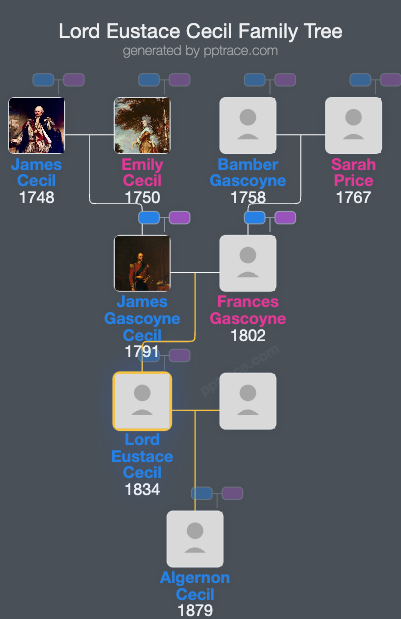
Lord Eustace Brownlow Henry Gascoyne-Cecil (24 April 1834 – 3 July 1921) was a British politician affiliated with the Conservative Party. He was the youngest son of James Gascoyne-Cecil, 2nd Marquess of Salisbury, and his first wife, Frances Gascoyne.
Eustace Cecil received education at Harrow School and later attended the Royal Military College, Sandhurst. He served in the British Army, initially with the 43rd Light Infantry and subsequently with the Coldstream Guards during the Crimean War from 1855 to 1856. He achieved the rank of lieutenant colonel in 1861 and retired from active military service in 1863.
In 1874, Cecil was appointed by Prime Minister Benjamin Disraeli, then leader of the Conservative Party, as the second Surveyor General of the Ordnance. In this role, he served as the principal civilian adviser to the Secretary of State for the Ordnance.
On 18 September 1860, he married Lady Gertrude Scott, the fourth daughter of John Scott, 2nd Earl of Eldon. They had three children: Evelyn (1865–1941), who later became the 1st Baron Rockley; Blanche Louise (1872–1945); and Algernon (1879–1953).
Cecil authored a book titled "Impressions of Life at Home and Abroad," published in 1865 by Hurst and Blackett of 13 Great Marlborough Street, London. The publication comprised a collection of papers originally appearing in the St. James's Medley. The book discusses themes such as the moral and material conditions of the vagabond populations in large cities, including descriptions of midnight life in London and New York. It also contains comparative analyses of prison discipline in French and English prisons, as well as accounts of experiences in Haiti and Barbary.
In 1874, Cecil purchased a sizable tract of land at Lytchett Heath, where he constructed Lytchett Heath House in 1875. Additionally, in 1898, he financed the building of St Aldhelm's Church at Lytchett Heath, designed by George Crickmay. The church was intended as a private place of worship and was dedicated to commemorate Queen Victoria’s Diamond Jubilee. The dedication ceremony was performed by the Bishop of Salisbury, the Right Reverend John Wordsworth, on 31 May 1898.
Eustace Cecil's contributions include his military service, political appointments, literary work, and philanthropic efforts related to land development and religious architecture.