Samuel Richard Bosanquet
| Name | Samuel Richard Bosanquet |
| Title | barrister |
| Gender | Male |
| Birthday | 1800-04-01 |
| nationality | — |
| Source | https://www.wikidata.org/wiki/Q7412469 |
| pptrace | View Family Tree |
| LastUpdate | 2025-11-16T10:19:15.682Z |
Family Tree
Tap  to expand more relatives
Introduction
Samuel Richard Bosanquet (1 April 1800 – 27 December 1882) was an English barrister and writer who contributed to discussions on legal, social, and theological topics.
He was born on April 1, 1800, into the Bosanquet family of Forest House, Essex, and Dingestow Court, Monmouthshire. His younger brother was James Whatman Bosanquet, a banker and biblical writer. Bosanquet received his education at Eton College and Christ Church, Oxford. He graduated with honours in 1822, earning a first-class degree in mathematics and a second-class degree in classics. He proceeded to the Master of Arts degree in 1829.
Bosanquet was called to the bar at the Inner Temple. In 1832, he was appointed as one of the revising barristers responsible for the passage of the Reform Act. He inherited the family estates in 1843.
He served as chairman of the Monmouthshire quarter sessions for 35 years. Bosanquet was involved in philanthropy, promoting local institutions and enterprises. He died at Dingestow Court on December 27, 1882.
Throughout his career, Bosanquet began writing by contributing leading articles to The Times and frequently published in the British Critic.
In the legal field, he published annotated editions of the Tithe Commutation Act in 1837 and the Poor Law Amendment Act in 1839. His 1839 edition aimed to clarify misconceptions about the Poor Law Amendment Act by explaining its provisions and the roles of the agents involved.
He also authored "New System of Logic and Development of the Principles of Truth and Reasoning" in 1839, advocating for a logical system based on Christian ethics, which was further expanded in the 1870 second edition with applications to religion.
Bosanquet engaged in debates on the Poor Laws, expanding articles from the British Critic into works titled "The Rights of the Poor" and "Christian Almsgiving Vindicated" (1841). He argued that destitution was often due to inadequate incomes among wage earners and advocated for individual charity over state or public legal provisions.
His writings included a series of essays "Principia" (1843), criticizing modern liberalism and warning of national decline before the second advent. His "Letter to Lord John Russell" (1848) expressed hostility toward liberal policies and suggested replacing parliamentary governance with paternal despotism.
In theology, Bosanquet published several works: he examined and exposed "Vestiges of the Natural History of Creation" (second edition, 1845); provided short homilies on the Gospels according to St. Matthew (1854) and St. John (1856); authored "Eirenicon" (1867), discussing church union and toleration; and interpreted biblical visions typologically in "The Successive Visions of the Cherubim" (1871). He also attempted to align Indian mythology with biblical chronology in "Hindoo Chronology and Antediluvian History," reprinting and annotating Alexander Hamilton's earlier work.
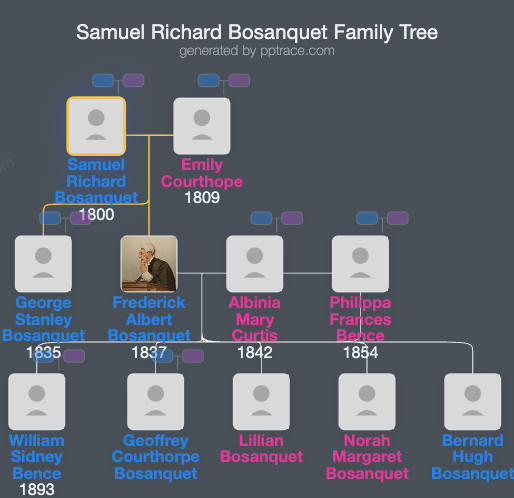
Bosanquet was married to Emily Courthope, and they had ten children, including Frederick Albert Bosanquet.
References:
- Dictionary of National Biography, London: Smith, Elder & Co., 1885–1900.
This biography is derived from public domain sources, specifically the Dictionary of National Biography.