Takeo Miki
| Name | Takeo Miki |
| Title | Japanese politician (1907-1988) |
| Gender | Male |
| Birthday | 1907-03-17 |
| nationality | Japan |
| Source | https://www.wikidata.org/wiki/Q317675 |
| pptrace | View Family Tree |
| LastUpdate | 2025-11-17T06:46:43.160Z |
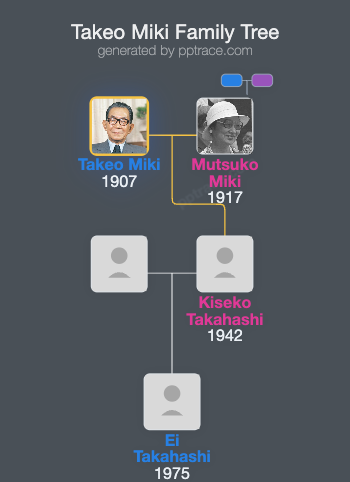
Family Tree
Tap  to expand more relatives
Introduction
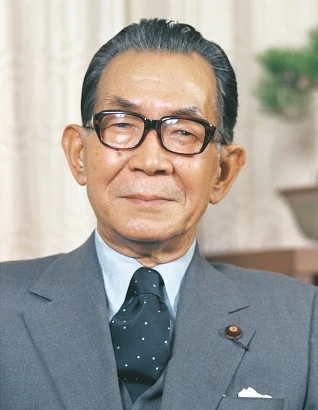
Takeo Miki (三木 武夫, Miki Takeo) was born on 17 March 1907 in Gosho, Tokushima Prefecture, Japan. He was the only child of Hisayoshi Miki, a farmer-merchant involved in trading fertilizers, sake, rice, and general goods, and his wife Takano. The family was not of particularly high social standing or wealth. Hisayoshi was born in Kakihara, near Gosho, and after working briefly in Osaka, he returned to Gosho to work for the Shibata family, the largest landowner in the area. Hisayoshi met Takano Miki through work with the Shibata family, and after marriage, they were provided a house by the family.
Miki was raised with notable attention to his health and well-being, being the only child. He enrolled at Meiji University’s Faculty of Law and spent four years from 1932 to 1936 traveling in the United States. During this period, Miki studied at the University of Southern California in Los Angeles and observed American society, including its attitudes towards totalitarian regimes such as Nazi Germany, Fascist Italy, and the Soviet Union. He was awarded an honorary Doctor of Laws degree from USC in 1966.
He was first elected to Japan’s Imperial Diet in 1937, beginning a political career that spanned over five decades during which he was re-elected 19 times. During World War II, in the 1942 general election, Miki voiced opposition to the military government under Hideki Tojo, which was uncommon among elected officials at the time. His opposition efforts were supported by Kan Abe, the grandfather of future Prime Minister Shinzo Abe.
Following the war, Miki led the centrist National Cooperative Party and participated in the 1947 and 1949 general elections. In the early 1950s, he joined Ichirō Hatoyama's Democratic Party, which critiqued then-Prime Minister Shigeru Yoshida’s Liberal Party. The Democratic Party merged with other factions in 1955 to form the Liberal Democratic Party (LDP), which Miki joined.
Within the LDP, Miki held several cabinet positions under different prime ministers, such as Ichirō Hatoyama, Nobusuke Kishi, Hayato Ikeda, and Eisaku Satō. He was especially critical of Kishi’s handling of the 1960 protests against the U.S.-Japan Security Treaty, and he participated in the faction-led opposition to Kishi’s administration. Miki was part of the anti-Kishi faction that called for Kishi’s resignation after the treaty was ratified under contentious circumstances.
In subsequent years, Miki served as Minister of Science and Technology, Minister of International Trade and Industry from 1965 to 1966, and Minister of Foreign Affairs from 1966 to 1968 under Prime Minister Eisaku Satō. Notably, he engaged in secret discussions with U.S. officials about Okinawa’s reversion and advocated for regional economic cooperation, including positions on Pacific trade policies.
Miki was appointed Prime Minister of Japan on 9 December 1974, succeeding Kakuei Tanaka, who resigned amid corruption allegations. Miki’s tenure was characterized by efforts to pursue political reform, including investigations into the Lockheed bribery scandal and attempts to implement political funding legislation. During his premiership, he reaffirmed the policy of limiting defense spending to 1% of Japan’s GDP, a stance that influenced military and fiscal policies for decades.
His government faced challenges including the 1976 Lockheed scandal’s impact on the LDP’s popularity. The party lost its majority in the 1976 elections, and Miki resigned on 24 December 1976, succeeded by Takeo Fukuda.
Miki married Mutsuko Mori in 1940. He died on 14 November 1988.