Mutsuko Miki
| Name | Mutsuko Miki |
| Title | Japanese activist |
| Gender | Female |
| Birthday | 1917-07-31 |
| nationality | Japan |
| Source | https://www.wikidata.org/wiki/Q29365 |
| pptrace | View Family Tree |
| LastUpdate | 2025-11-17T06:46:44.056Z |
Family Tree
Tap  to expand more relatives
Introduction
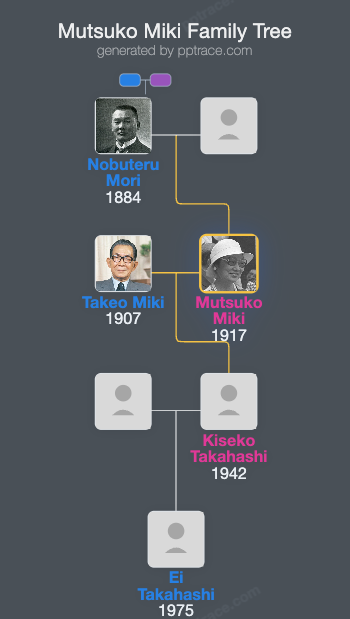
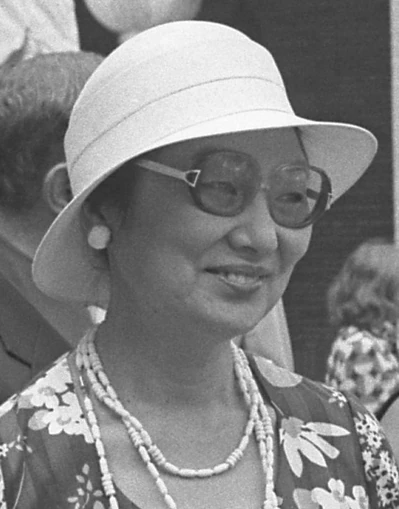
Mutsuko Miki (三木 睦子, Miki Mutsuko) was born on 31 July 1917 and died on the same date in 2012. She was a Japanese activist known for her advocacy in areas including pacifism, reparations for comfort women, and fostering Japan’s diplomatic relations with North Korea. She was married to Takeo Miki, who served as the Prime Minister of Japan from 1974 to 1976, during which time she held the formal title of First Lady.
Her family background includes her father, Nobuteru Mori, who was a member of the Japanese House of Representatives and the founder of Showa Denko, a significant chemical engineering company. Mutsuko Miki had siblings involved in government agencies: her brother Kiyoshi Mori served as the head of the Management and Coordination Agency, later absorbed into the Ministry of the Interior, and another brother, Yoshihide Mori, was the head of the Environment Agency, a predecessor to the Ministry of the Environment.
In 1940, Mutsuko Mori married Takeo Miki. Her husband’s tenure as Prime Minister lasted two years, concluding in 1976. Takeo Miki passed away in 1988.
Following her husband's political career and his death, Miki remained active in public advocacy. She was a prominent supporter of Japanese pacifism. She strongly opposed efforts to repeal Article 9 of the Japanese Constitution, which prohibits Japan from maintaining military forces for war, and she campaigned extensively throughout Japan. In 2004, Miki collaborated with other notable figures—including Takeshi Umehara, Nobel laureate Kenzaburō Ōe, and writer Hisae Sawachi—to establish the Article 9 Association, an organization dedicated to defending the pacifist clause. Her last recorded involvement with the association was in May 2011. She was quoted as stating, "It is an extremely normal thing to express opinions for peace."
Miki also advocated for the recognition and compensation of comfort women. In 1995, she joined the Asian Women’s Fund, a charity established by the government of Prime Minister Tomiichi Murayama, to provide reparations to former comfort women. However, she publicly severed her ties with the organization in 1996 when the Japanese government expressed reluctance to issue official reparations directly to the victims.
In addition, Miki promoted the normalization of diplomatic relations between Japan and North Korea. In 2000, she traveled to North Korea alongside former Prime Minister Tomiichi Murayama. Prior to the visit, she handcrafted teacups from soil collected in Japan, North Korea, and South Korea. She intended these "souvenirs" to symbolize harmony among the three nations. Murayama noted that Miki hoped her gestures would convey the importance of peaceful relations. In recognition of her efforts to foster friendship, she was awarded a North Korean Order of Friendship in 2002.
Throughout her life, Mutsuko Miki served as chair or leader of various organizations, including the Asian Ladies Friendship Society. She passed away at a hospital in Tokyo due to colon cancer on her 95th birthday, 31 July 2012. Her survivors included her eldest daughter, Kiseko Takahashi, a former member of the House of Councillors, and her nephew, Eisuke Mori, a current member of the House of Representatives.