William Compton
| Name | William Compton |
| Title | English army officer |
| Gender | Male |
| Birthday | 1625-01-01 |
| nationality | — |
| Source | https://www.wikidata.org/wiki/Q4230107 |
| pptrace | View Family Tree |
| LastUpdate | 2025-11-26T23:20:55.428Z |
Family Tree
Tap  to expand more relatives
Introduction
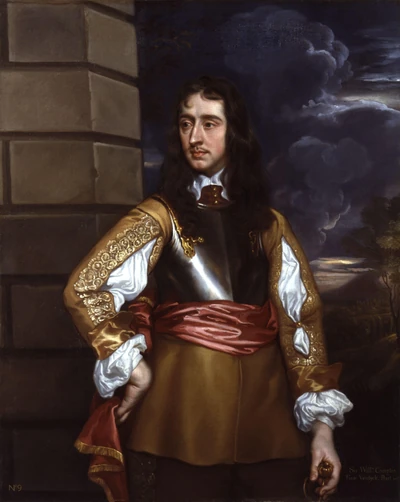
Sir William Compton (1625 – 18 October 1663) was an English military officer associated with the Royalist faction during the English Civil War. His actions during this period led to the moniker "the godly cavalier," a title attributed to him by Oliver Cromwell in 1648.
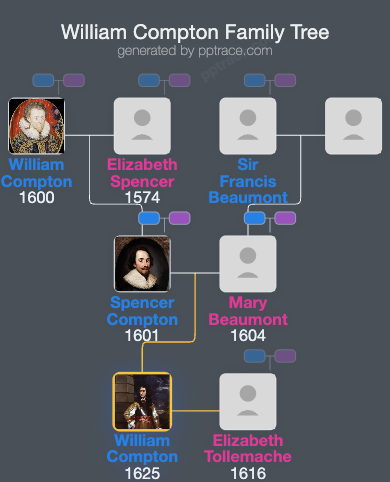
Born as the third son of Spencer Compton, 2nd Earl of Northampton, and his wife Mary Beaumont, William Compton was involved early in the conflict. At the onset of the First English Civil War, he was instructed by his father to support the Royalist cause. He was granted command of a regiment by King Charles I and participated in the capture of Banbury. During this engagement, Compton led three attacks, during which he had two horses shot from under him. Following the surrender of Banbury's town and castle, he was appointed lieutenant-governor of the town under his father and received knighthood at Oxford on 12 December 1643.
On 19 July 1644, parliamentary forces comprising troops from Northamptonshire, Warwick, and Coventry laid siege to Banbury. Compton defied their attack, and the siege lasted for thirteen weeks until relief was provided by his brother, James Compton, 3rd Earl of Northampton, on 26 October 1644. William Compton remained governor of Banbury until the political landscape shifted with the king's departure from Oxford, culminating in his surrender of the town on 8 May 1646 under honorable terms.
In 1648, Compton participated in the Kentish expedition supporting King Charles I. During the siege of Colchester, he served as major-general of the king's forces. Despite being confined for some time during the siege by General Thomas Fairfax, Compton maintained discipline within the garrison and was noted for his leadership. After his release, Oliver Cromwell remarked of him, "the sober young man, and the godly cavalier."
Compton was active in the Sealed Knot, a royalist organization that managed multiple attempts to restore Charles II between 1652 and 1659. He was imprisoned in 1655 and again in 1658 due to his royalist activities. Following the Restoration of the monarchy in 1660, Compton was elected Member of Parliament for Cambridge in the Cavalier Parliament on 11 March 1661. Subsequently, King Charles II appointed him master of the ordnance.
Sir William Compton died suddenly on 18 October 1663 at Drury Lane, London, and was buried in Compton-Wynyates, Warwickshire, where a monument was erected in his memory. His colleague Samuel Pepys, who served with him on the Committee for Tangier, expressed deep regret at his death, describing him as "a man in a thousand" and noting that no one ever spoke ill of him. Pepys also observed the continuing merriment at court despite the mourning for Compton, implying a view of mortality and societal indifference towards individual death.
Compton was married to Elizabeth Tollemache, daughter of Sir Lionel Tollemache, 2nd Baronet, and Elizabeth Stanhope. Elizabeth was previously the widow of William Alington, 1st Baron Alington. The couple had no children, and Elizabeth died in 1671.