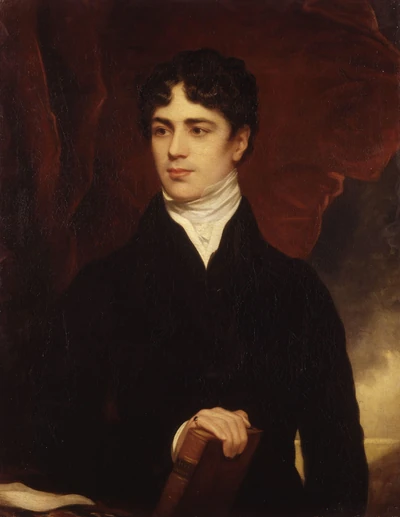
John Lambton, 1st Earl Of Durham
| Name | John Lambton, 1st Earl Of Durham |
| Title | British politician (1792-1840) |
| Gender | Male |
| Birthday | 1792-04-12 |
| nationality | United Kingdom of Great Britain and Ireland |
| Source | https://www.wikidata.org/wiki/Q336437 |
| pptrace | View Family Tree |
| LastUpdate | 2025-11-26T23:27:55.348Z |
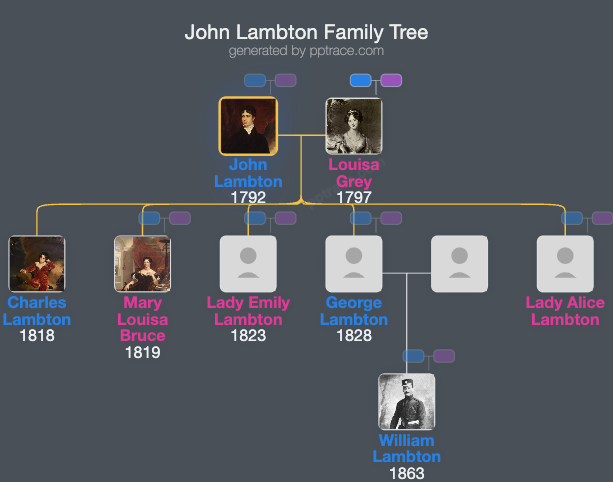
Family Tree
Tap  to expand more relatives
Introduction
John George Lambton, 1st Earl of Durham, was born on 12 April 1792 in Westminster, England. His father was William Henry Lambton, and his mother was Lady Anne Barbara Frances, daughter of George Bussy Villiers, 4th Earl of Jersey. Lambton was christened with the names of his grandfathers, John Lambton and George Villiers. He attended Eton College before joining the British Army in 1809 as a cornet in the 10th Hussars; he resigned his commission in 1811.
Following the death of his father in 1797, Lambton inherited substantial wealth derived largely from mining rights on lands around Lambton Castle in County Durham, as well as other properties including Dinsdale Park and Low Dinsdale Manor. He was involved in coal mining operations through Lambton Collieries.
In 1821, Lambton earned the nickname "Jog Along Jack" after claiming that a comfortable income for an English gentleman might be around £40,000 per year. He supported educational initiatives such as the Mechanics' Institutes and the newly established University of London.
Lambton was first elected to the British Parliament representing County Durham in 1812, a position he held until 1828. In 1828, he was elevated to the peerage as Baron Durham of the City of Durham and of Lambton Castle. As a Member of Parliament and later as a peer, he supported liberal causes, including the defense of Queen Caroline and reforms removing restrictions on Dissenters and Roman Catholics. His father-in-law, Lord Grey, became Prime Minister in 1830, and Lambton was appointed to the Privy Council and served as Lord Privy Seal. He was a key supporter of the Reform Bill of 1832, which aimed to reform the electoral system in Britain.
In 1833, Lambton was created Viscount Lambton and Earl of Durham. Between 1835 and 1837, he served as ambassador to Russia, during which he was invested as a Knight of the Order of St. Alexander Nevsky, as well as the Orders of St. Andrew and St. Anna. In 1837, he was appointed a Knight Grand Cross of the Order of the Bath.
In 1838, Lord Durham was appointed Governor General and High Commissioner for British North America. His responsibilities included investigating the political unrest following the Rebellions of 1837 in Upper Canada (Ontario) and Lower Canada (Quebec). He arrived in Lower Canada on 29 May 1838 alongside Edward Gibbon Wakefield. His mission involved examining the causes of rebellion and recommending reforms. His report, published in January 1839, proposed responsible government and a legislative union of Upper and Lower Canada, as well as the Maritime Provinces, to address issues of governance and the status of French Canadians. Notably, he recommended the assimilation of French Canadians, describing them in his report as "a people with no literature and no history." His suggestion to unite Upper and Lower Canada resulted in the creation of the Province of Canada in 1841, which later became part of the Confederation of Canada in 1867.
His recommendations regarding responsible government were initially rejected but later implemented, leading to the establishment of responsible parliamentary systems in the Canadian provinces. The colonial union and political developments he proposed contributed to the formation of the Dominion of Canada, a federal state incorporating Ontario and Quebec.
Lambton was also involved in industrial enterprise as a major coal owner in northeast England and participated in the Limitation of the Vend cartel, a price-fixing alliance among mine owners.
He was married twice. His first marriage was to Harriet Cholmondeley in 1812, with whom he had three daughters: Lady Frances Charlotte, Lady Georgiana Sarah Elizabeth, and Lady Harriet Caroline. Harriet Cholmondeley died in 1815. His second marriage was to Lady Louisa Grey, daughter of Charles Grey, 2nd Earl Grey, in 1816. They had two sons and three daughters, including Charles William (who died young), Lady Mary Louisa, Lady Emily Augusta, Lord George Frederick D'Arcy, and Lady Alice Anne Caroline.
John George Lambton, 1st Earl of Durham, died at Cowes on the Isle of Wight on 28 July 1840 at the age of 48. He was buried at St Mary and St Cuthbert in Chester-le-Street. His only surviving son succeeded him as the 2nd Earl of Durham. Lady Louisa Grey died in 1841 at Genoa.