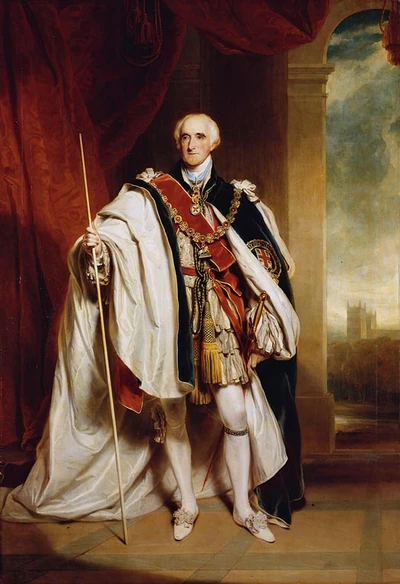
Richard Wellesley, 1st Marquess Wellesley
| Name | Richard Wellesley, 1st Marquess Wellesley |
| Title | British politician (1760-1842) |
| Gender | Male |
| Birthday | 1760-06-20 |
| nationality | Great Britain |
| Source | https://www.wikidata.org/wiki/Q335205 |
| pptrace | View Family Tree |
| LastUpdate | 2025-11-26T23:27:27.328Z |
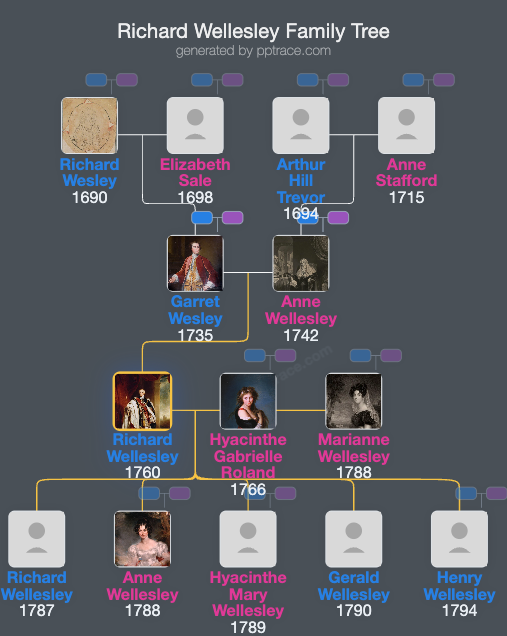
Family Tree
Tap  to expand more relatives
Introduction
Richard Colley Wellesley, 1st Marquess Wellesley (20 June 1760 – 26 September 1842), was an Anglo-Irish politician and colonial administrator. He was styled as Viscount Wellesley until 1781, when he succeeded his father as the 2nd Earl of Mornington. In 1799, he was granted the Irish peerage title of Marquess Wellesley of Norragh. Additionally, he held the title of Baron Wellesley in the Peerage of Great Britain. External sources often refer to him as "Mornington" from 1799 onward.
He was born in Dangan Castle, County Meath, Ireland, into the Ascendancy, the established Anglo-Irish aristocracy. His parents were Garret Wesley, 1st Earl of Mornington, and Anne, the eldest daughter of Arthur Hill-Trevor, 1st Viscount Dungannon. Wellesley's younger brother was Arthur Wellesley, who became the 1st Duke of Wellington.
Wellesley's education included the Royal School in Armagh, Harrow School, and Eton College, where he distinguished himself as a classical scholar. He additionally studied at Christ Church, Oxford. He is one of the few individuals known to have attended both Harrow and Eton. In 1780, he entered the Irish House of Commons as the representative for Trim. Following his father's death in 1781, he became the 2nd Earl of Mornington and took his seat in the Irish House of Lords. In 1782, he served as Grand Master of the Grand Lodge of Ireland for one year.
Due to familial financial difficulties, he sold all of his Irish estates, which were affected by the extravagance of his father and grandfather. In 1781, he was appointed Custos Rotulorum of Meath. He also held the seat in the British House of Commons for Bere Alston in Devon starting in 1784 and was appointed a Lord of the Treasury by William Pitt the Younger.
His political career included involvement in the passage of the 1792 Slave Trade Bill, where he participated in debates and modifications within the House of Lords. In 1793, he became a member of the Board of Control over Indian affairs. In 1797, he was appointed Governor-General of India, succeeding Lord Cornwallis.
His tenure in India was marked by significant military campaigns and administrative reforms. His primary objective was to limit French influence in India, which involved military actions against Tipu Sultan of Mysore. In 1798, Wellesley planned and led the campaign that resulted in the capture of Seringapatam on 4 May 1799, and the death of Tipu Sultan. His military efforts also led to the Second Anglo-Maratha War, and treaties under his leadership increased British influence in central India while reducing French presence primarily to Pondicherry.
As an administrator, Wellesley founded Fort William College as a training center for colonial officials and improved trade policies. He also contributed to cultural and scientific initiatives, including the establishment of a natural history collection and the Barrackpore Menagerie. During his time in India, he was involved in political controversies, including the expulsion of British traders from Oudh, which led to a motion for impeachment that was defeated in Parliament in 1808.
In 1808, Wellesley returned to Britain and engaged in politics, declining several ministerial appointments due to criticism and political controversies related to his tenure in India. In 1809, he was appointed British ambassador to Spain and later served as Foreign Secretary from 1809 to 1812 in Spencer Perceval’s cabinet. His role included navigating alliances during the Napoleonic Wars and advocating for Catholic emancipation.
Wellesley was made a Knight of the Garter in 1812 and refused to join the government following Perceval’s death. He was involved in critical debates concerning European diplomacy and internal British politics, including criticism of the Congress of Vienna and the European settlement of 1814.
His family included his younger brother Arthur Wellesley, the Duke of Wellington, and his own descendants carried various titles. Wellesley's career spanned significant military, diplomatic, and political spheres during a pivotal period of British history.