Morimasa Nagaoka
| Name | Morimasa Nagaoka |
| Title | (1881-1904) |
| Gender | Male |
| Birthday | 1881-01-01 |
| nationality | Q188712 |
| Source | https://www.wikidata.org/wiki/Q11652150 |
| pptrace | View Family Tree |
| LastUpdate | 2025-11-16T10:34:46.944Z |
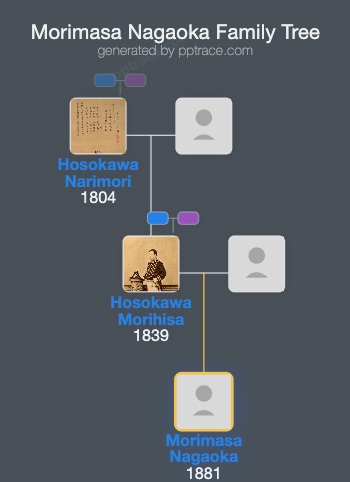
Family Tree
Tap  to expand more relatives
Introduction
Moriharu Nagaoka (March 31, 1881 – August 31, 1904) was a Japanese aristocrat and an Army second lieutenant. His official rank was Senior Fifth Rank with the Sixth Class of the Order of the Rising Sun, and in his military career, he served in the Russo-Japanese War, where he was killed in action.
According to information about his birth and family background, Moriharu Nagaoka was the second son of the 12th Lord of Kumamoto Domain, Morihisa Hosokawa. His mother was Hiroko Naboeshima, daughter of Naomasa Nabeshima. His family relations include an illegitimate older half-brother, Morishige Hosokawa, as well as younger brothers Moriteru Hosokawa and Moriteru Hosokawa.
In his childhood, it is recorded that he attended Gakushuin Peeress School and was a friend of the Crown Prince, later Emperor Taisho. In 1896, at the age of 15, he became the adopted son of his uncle, Viscount Morikimi Nagaoka, thereby inheriting the Nagaoka family.
He graduated from Gakushuin Secondary School in 1899, and in 1901, he volunteered for the Imperial Guard Division Cavalry Regiment and became a cadet officer. On November 30, 1903 (Meiji 36), he graduated from the Imperial Japanese Army Academy.
Moriharu Nagaoka was conscripted in 1904 when the Russo-Japanese War broke out. After deployment, he served as a second lieutenant in the Army Cavalry within the Imperial Guard Headquarters and engaged in combat in Korea and Manchuria. During battle in Dingzhou, he was wounded, but he achieved military distinction during the Battle of the Water Divide northwest of Jixian, and was awarded a letter of commendation. Unfortunately, he was killed in action during the Battle of Liao Yang on August 31 of the same year.
In recognition of his achievements, a bronze statue was erected in 1906 within Suizenji Jojuen Garden in Kumamoto City. The creation of the statue was led by Baron Toshiyuki Matsui.
A reference for his biography is the "Kumamoto City History" (1932), compiled by Kumamoto City.