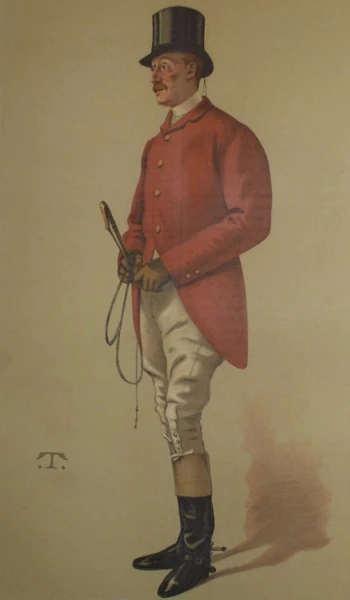
George Middleton
| Name | George Middleton |
| Title | English horseman, equerry to John Spencer, 5th Earl Spencer (1846-1892) |
| Gender | Male |
| Birthday | 1846-04-16 |
| nationality | United Kingdom of Great Britain and Ireland |
| Source | https://www.wikidata.org/wiki/Q2004836 |
| pptrace | View Family Tree |
| LastUpdate | 2025-11-26T23:32:44.758Z |
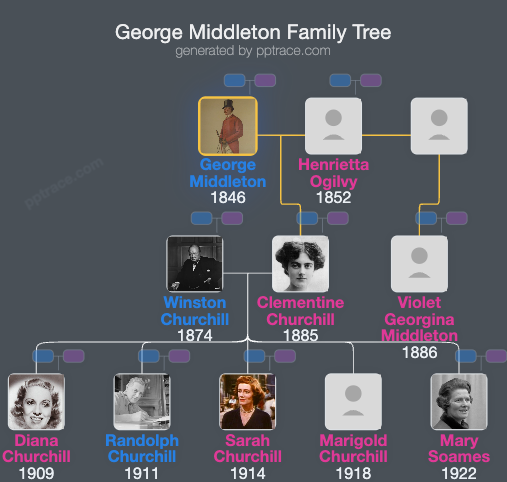
Family Tree
Tap  to expand more relatives
Introduction
William George Middleton was born on 16 April 1846 in Barony, Glasgow, Lanarkshire, Scotland. His parents were George Middleton and Mary Margaret Hamilton. Middleton was part of a Scottish family with a tradition of involvement in sporting activities. For his early education, he attended the Glasgow Academy. When his family relocated to London, he received private tutoring at Wimbledon.
In 1865, Middleton was gazetted to the 12th Lancers, a cavalry regiment of the British Army. His first recorded race victory occurred in 1867 at Cork Park. By 1870, he had joined the staff of the Lord Lieutenant of Ireland as an aide-de-camp, operating from the Viceregal Lodge in Dublin. During his military service, he was promoted to the rank of captain before leaving the service.
Middleton was widely recognized as one of the most skilled and popular riders in the United Kingdom. His prowess in riding over challenging steeplechase courses, including the Punchestown Grand National in Ireland, was notable. Besides his equestrian pursuits, Middleton was also an accomplished cricketer and was a member of the Jockey Cricket Club.
In 1874, the Empress Elisabeth of Austria, known as "Sisi," visited England, arriving on 2 August of that year. During this visit, she met Lord Spencer and Middleton, who was then serving as his equerry. When the Empress returned to England in 1876, she visited Lord Spencer at Althorp, and Middleton was tasked with guiding her during her visits. She left England in February 1882 and did not hunt in England or Ireland afterwards. Middleton met Elisabeth again on 20 March 1888 at her palace in Gödöllő, Hungary, which appears to be their last recorded meeting.
In 1875, Middleton became engaged to Charlotte Baird, daughter of William Baird of Elie. The marriage took place on 25 October 1882 at St. George’s, Hanover Square. The couple had one daughter, Violet Georgiana, born in 1886. Middleton’s wife was reportedly jealous of his long-standing relationship with the Empress Elisabeth, although there is no documented evidence of misconduct. After Middleton's death, Charlotte Baird destroyed all her letters to him.
William George Middleton died on 9 April 1892 at the age of 45. His death occurred during the Midland Sportsman's Cup at Lord Willoughby de Broke's estate in Kineton. He was fatally injured in a fall from his horse during a Parliamentary steeplechase. Middleton was interred in full riding attire at Haselbech, Northamptonshire. His coffin was covered with the Union Jack and surrounded by lances of the 12th Lancers, his regiment. The funeral service was conducted by Reverend W. Lloyd, the local rector. Among those present were his widow, his daughter, and numerous notable figures in the hunting and sporting community, including Earl Spencer, Lord and Lady Willoughby de Broke, Sir Saville Crossley, and others.
Middleton is depicted in the arts, appearing as the Empress Elisabeth's lover in Kenneth MacMillan’s ballet Mayerling. His courtship of Charlotte Baird and his relationship with the Empress are also detailed in Daisy Goodwin’s novel The Fortune Hunter. Additionally, he is portrayed by Colin Morgan in the 2022 film Corsage, directed by Marie Kreutzer.
References include obituaries from The Times (15 April 1892), and works by Sigrid-Maria Größing, John Welcome, and others that discuss Middleton's life and connections to notable historical and cultural narratives.