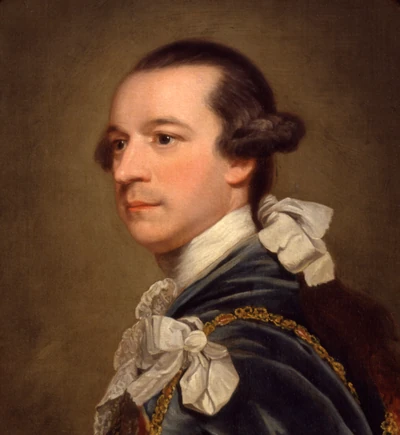
Charles Watson-Wentworth, 2nd Marquess Of Rockingham
| Name | Charles Watson-Wentworth, 2nd Marquess Of Rockingham |
| Title | British Prime Minister (1730-1782) |
| Gender | Male |
| Birthday | 1730-05-13 |
| nationality | Great Britain |
| Source | https://www.wikidata.org/wiki/Q378043 |
| pptrace | View Family Tree |
| LastUpdate | 2025-11-26T23:23:39.022Z |
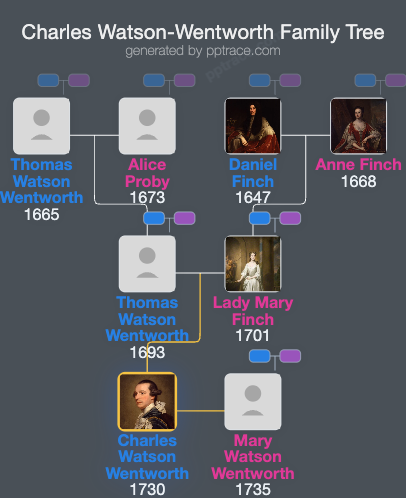
Family Tree
Tap  to expand more relatives
Introduction
Charles Watson-Wentworth, 2nd Marquess of Rockingham (13 May 1730 – 1 July 1782), was a British statesman affiliated with the Whig party. He was known for serving as Prime Minister of Great Britain in two terms during the mid-18th century. Prior to his political career, he held various courtesy titles, including The Honourable Charles Watson-Wentworth before 1739, Viscount Higham between 1739 and 1746, Earl of Malton from 1746 to 1750, and subsequently Marquess of Rockingham from 1750.
**Family and Early Life**
Born in 1730, Rockingham was a descendant of the 1st Earl of Strafford. He was the second son of Thomas Watson-Wentworth, 1st Baron Malton (later 1st Earl of Malton), and Lady Mary Finch, daughter of the 7th Earl of Winchilsea. His upbringing took place at Wentworth Woodhouse near Rotherham, Yorkshire. Upon the death of his elder brother in 1739, he assumed the courtesy title Viscount Higham.
**Military Service During the Jacobite Rising**
During the Jacobite rising of 1745, Rockingham’s father organized volunteers to defend against Charles Edward Stuart, known as "The Young Pretender." At that time, Charles Watson-Wentworth was made a colonel and participated in military activities without parental consent. He rode from Wentworth to Carlisle to join forces led by the Duke of Cumberland in pursuit of the Jacobite forces. His actions received praise; correspondences from family members highlighted the admiration he garnered for his bravery.
**Titles and European Travel**
In April 1746, his father was elevated to Marquess of Rockingham, and Charles himself assumed the title Earl of Malton. He traveled extensively across Europe during his youth, studying in Rome under George Quarme and making observations about the political climate among English expatriates. Before his father's death in 1750, he was created Baron Malton and Earl Malton in the Irish peerage.
**Political Career and Parliamentary Service**
On his 21st birthday in 1751, Rockingham inherited his father’s estates, which generated an annual income of approximately £20,000 at the time. He controlled parliamentary seats in Malton and Higham Ferrers, as well as numerous church livings. That same year, he was appointed Lord Lieutenant of the West Riding and held other regional offices.
His maiden speech in the House of Commons was delivered on 17 March 1752, supporting legislation related to Scottish lands post-Jacobite rising. Despite initial criticisms, he continued to develop his oratorical skills through education in classic and modern history, employing tutors such as George Quarme.
**Court Positions and Honors**
In 1752, Rockingham was appointed Lord of the Bedchamber to King George II. He married Mary Bright in 1753. He joined clubs including White's, the Jockey Club, and the Royal Society, and was appointed Vice Admiral of the North in 1755. During the French invasion scare of 1756, he raised volunteer militias and maintained order during civil unrest.
He requested and received an appointment to the Order of the Garter in 1760. After the death of George II, his grandson George III ascended to the throne. Rockingham was allied with figures like the Duke of Newcastle, opposing the influence of Lord Bute, a favorite of the new king. He resigned as Lord of the Bedchamber in 1762 in protest against royal policies.
**Prime Ministership**
Following the resignation of William Pitt the Elder and subsequent political shifts, Rockingham was appointed Prime Minister in 1765, leading a government that included Henry Seymour Conway and the Duke of Grafton as secretaries of state. Irish statesman and philosopher Edmund Burke served as his private secretary.
His government addressed issues concerning the American colonies, notably advocating for the repeal of the Stamp Act in 1766, which he managed to do through parliamentary votes. Despite this, he also supported the Declaratory Act, asserting Parliament’s authority over the colonies in all cases.
**Death**
Charles Watson-Wentworth, 2nd Marquess of Rockingham, died of influenza on 1 July 1782.