Mary Watson Wentworth, Marchioness Of Rockingham
| Name | Mary Watson Wentworth, Marchioness Of Rockingham |
| Title | political wife |
| Gender | Female |
| Birthday | 1735-01-01 |
| nationality | Great Britain |
| Source | https://www.wikidata.org/wiki/Q18529281 |
| pptrace | View Family Tree |
| LastUpdate | 2025-11-26T12:24:49.149Z |
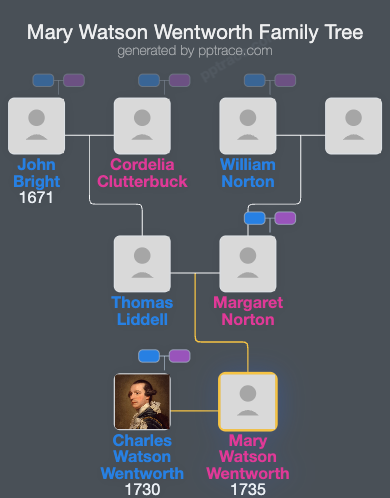
Family Tree
Tap  to expand more relatives
Introduction
Mary Watson-Wentworth, Marchioness of Rockingham, née Liddell and later Bright, was born circa 1735 in Pontefract, West Yorkshire, England. She was the only child of Thomas Liddell, who was the Lord of the Manor of Ecclesall in South Yorkshire, and Margaret Norton. Her baptism took place on 27 August 1735 in Ackworth, West Yorkshire. Originally sharing the surname Liddell with her father, she adopted the surname Bright after her father inherited Badsworth Hall from his grandfather, John Bright.
On 26 February 1752, Mary Bright married Charles Watson-Wentworth, a Whig politician who served as Prime Minister of Great Britain in 1782 and again from 1765 to 1766. The marriage lasted until Charles Watson-Wentworth’s death on 1 July 1782.
Throughout her husband's political career, Lady Rockingham was recognized for her involvement and influence. Contemporary accounts describe her as a skilled political figure, with opposition party members occasionally addressing their correspondence directly to her. She was often referred to as her husband's "secretary," a characterization she and others acknowledged. Charles Watson-Wentworth himself referred to her as "My Minerva at my elbow," highlighting her active role in political affairs.
Following her husband’s death, Lady Rockingham received correspondence from Edmund Burke, who wrote that her name should be remembered alongside her husband's, noting her significant contributions to his service to the country. She owned a notable garment known as the Rockingham Mantua—a silk satin mantua brocaded with silver thread and trimmed with silver lace. This garment was considered part of a matching set with her husband, and she mentioned the sets in her letters. One letter includes a remark from Lord Stormont, indicating that wearing her dress was viewed as bourgeois, and she expressed hope that he would approve of her wearing it, considering it a compliment to her.
In 1785, Lady Rockingham settled at Hillingdon House in Middlesex. She remained there until her death. She died on 19 December 1804 and was buried alongside her husband at York Minster.