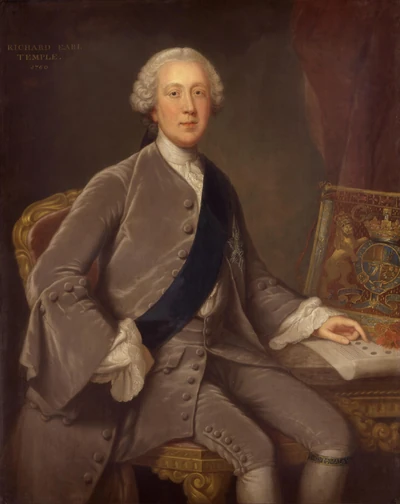
Richard Grenville-Temple, 2nd Earl Temple
| Name | Richard Grenville-Temple, 2nd Earl Temple |
| Title | First Lord of the Admiralty (1711-1779) |
| Gender | Male |
| Birthday | 1711-09-26 |
| nationality | Great Britain |
| Source | https://www.wikidata.org/wiki/Q2041357 |
| pptrace | View Family Tree |
| LastUpdate | 2025-11-26T23:23:18.282Z |
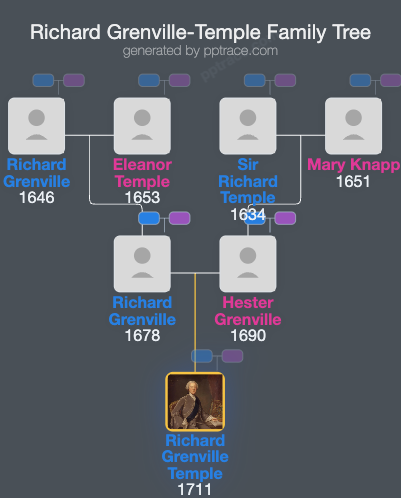
Family Tree
Tap  to expand more relatives
Introduction
Richard Grenville-Temple, 2nd Earl Temple, born on 26 September 1711, and deceased on 12 September 1779, was a British politician and peer. He held the position of Lord Privy Seal from 1757 to 1761 and is recognized for his association with William Pitt, serving alongside him in the Pitt–Newcastle ministry during Britain’s involvement in the Seven Years' War from 1756 to 1761. In 1761, he resigned from office together with Pitt in protest over the ministry’s refusal to declare war on Spain.
Early Life and Education:
Richard Grenville-Temple was the eldest son of Richard Grenville (1678–1727) of Wotton Underwood, Buckinghamshire, and his wife Hester, who later became Countess Temple. He was educated at Eton College. In 1734, he was elected a Member of Parliament for the borough of Buckingham. Upon the death of his mother in 1752, he inherited her titles and extensive estates, including Wotton and Stowe House, adopting the surname Temple in addition to his original surname Grenville. On 7 May 1737, he married Anna Chamber, an heiress.
Political Career and the Seven Years' War:
The marriage of his sister Hester to William Pitt in 1754 marked a turning point in his political career, linking him closely with Pitt. In November 1756, Temple became First Lord of the Admiralty in the government of the Duke of Devonshire and William Pitt. His tenure was marked by opposition from King George II, who dismissed him and Pitt in April 1757. When the coalition government of Newcastle and Pitt was formed in June 1757, Temple was appointed to the office of Privy Seal. He was the only cabinet member to support Pitt’s proposal to declare war on Spain in 1761. Both he and Pitt resigned on 5 October 1761 over disagreements on war policy.
Later Political Life:
Following his resignation, Temple became known for his factional political stance. He had a contentious relationship with his brother, George Grenville, who became First Lord of the Treasury in 1763. Despite their differences, they reconciled before 1765. During this period, Temple played a significant role in opposing Pitt’s attempts to establish a government in 1765 and 1766, refusing to join Pitt’s administration when offered the Treasury but not an equal share in nominations. This led to a deterioration of his relationship with Pitt, and he engaged in libel against Pitt, often aligning with his brother George Grenville in opposition to the government.
Involvement in Charitable and Financial Activities:
Temple was a benefactor to various causes, notably serving as vice president of the Foundling Hospital from 1760 to 1768, a charity dedicated to aiding abandoned children in London. He used his wealth generously in private life, lending money to figures such as William Pitt and supporting John Wilkes financially, including providing Wilkes with a freehold qualification for the 1768 Middlesex election. He was also involved in publishing and patronage, backing the weekly newspaper The North Briton.
Cricket and Personal Interests:
He was an avid cricket enthusiast and served as patron and captain of the Buckinghamshire cricket team, organizing matches such as the Northamptonshire versus Buckinghamshire game at Cow Meadow, Northampton, in August 1741.
Death and Succession:
Richard Grenville-Temple died in early September 1779 at the age of 67 following a fall from his phaeton. Since he had no surviving children, his titles and estates were inherited by his nephew, George Nugent-Temple-Grenville, who became the 1st Marquess of Buckingham.
Family:
He married Anna Chamber, with whom he had a daughter; however, she died in infancy. His marriage significantly increased his wealth due to Anna’s inheritance from the Chamber family.
Sources:
His correspondence and personal papers are documented in the Grenville Papers (London, 1852), and his life is discussed in works such as the Oxford Dictionary of National Biography and historical memoirs by contemporaries.