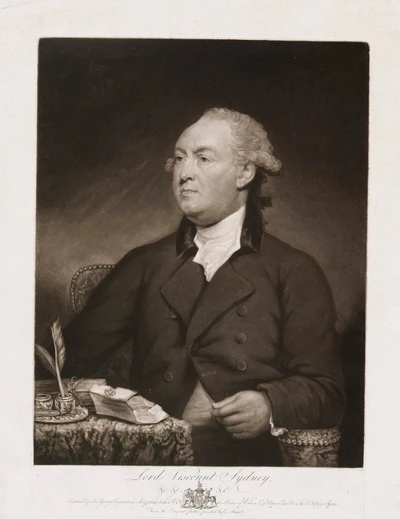
Thomas Townshend, 1st Viscount Sydney
| Name | Thomas Townshend, 1st Viscount Sydney |
| Title | British Viscount (1733-1800) |
| Gender | Male |
| Birthday | 1733-02-24 |
| nationality | Great Britain |
| Source | https://www.wikidata.org/wiki/Q332533 |
| pptrace | View Family Tree |
| LastUpdate | 2025-11-26T23:24:12.133Z |
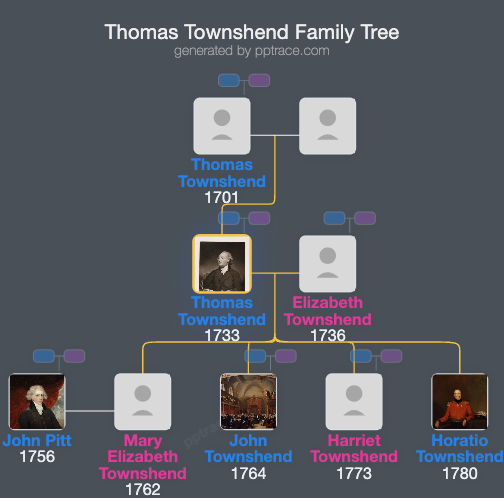
Family Tree
Tap  to expand more relatives
Introduction
Thomas Townshend, 1st Viscount Sydney (24 February 1733 – 30 June 1800), was a British politician. He served in the House of Commons from 1754 until 1783, when he was elevated to the peerage as Baron Sydney. Subsequently, he became the 1st Viscount Sydney. He held several significant Cabinet positions during the latter half of the 18th century.
Born at Frognal House in Sidcup, Kent, Townshend was the son of the Honorable Thomas Townshend, the second son of Charles Townshend, 2nd Viscount Townshend. His mother was Albinia, daughter of John Selwyn. He received his education at Clare College, Cambridge.
In his political career, Townshend was elected to the House of Commons in 1754 as a Whig representative for Whitchurch in Hampshire. He remained in this position until 1783. Initially aligned with his great-uncle, the Duke of Newcastle, he later associated with William Pitt the Elder in opposition to George Grenville. He held the offices of Clerk of the Household to the Prince of Wales (1756–1760) and Clerk of the Green Cloth from 1761 to 1762. In 1765, he was appointed a Lord of the Treasury in the ministry of Lord Rockingham and continued in that role under William Pitt (then Lord Chatham). In December 1767, he became a member of the Privy Council and joint-Paymaster of the Forces.
During his tenure, Townshend supported policies related to the American revenue program, aligning with his cousin Charles Townshend's positions. He was compelled to leave office in June 1768 due to political shifts. He then remained in opposition, frequently criticizing the American Revolutionary War in the House of Commons. During this period, he was inclined toward the Chathamite faction.
Townshend returned to government administration as Secretary at War during the second Rockingham ministry. When Lord Shelburne became Prime Minister in 1782, Townshend succeeded him as Home Secretary and became Leader of the House of Commons. In this role, he inherited plans for an expedition against Spanish possessions in South America, notably Argentine territories and parts of the Pacific.
In 1783, Townshend was appointed to plan a British expedition that involved a naval raid on Buenos Aires and subsequent operations along the coasts of Chile, Peru, and Mexico, with the goal of undermining Spanish influence. The expedition, commanded by Commodore Sir Robert Kingsmill and involving Captain Arthur Phillip, set sail in January 1783. Although an armistice with Spain was concluded shortly afterward, the plan influenced subsequent British colonial strategies.
Townshend's involvement extended into intelligence activities, including espionage operations against French and Spanish naval arsenals, particularly at Toulon, from 1784 to 1786. He was created Baron Sydney of Chislehurst on 6 March 1783 and then elevated to Viscount Sydney in 1789. He opposed the Fox-North coalition and served as Home Secretary from 1783 to 1789.
The city of Sydney in Nova Scotia, Canada, was named in his honor in 1785, and in 1788, the city of Sydney in New South Wales, Australia, was named after him due to his role in the colonization efforts there. As Home Secretary, he was instrumental in developing the colony of New South Wales, establishing a constitution and judicial system suitable for a colony of free citizens, and ensuring that the legal regime incorporated rights akin to English law.
In his personal life, Townshend married Elizabeth Powys, daughter of Richard Powys, MP, in 1760. He died in June 1800 at the age of 67. His son, John, succeeded him. He was buried in the parish church of St Nicholas's in Chislehurst. His wife, the Viscountess Sydney, died in May 1826.
His reputation has been scrutinized by later historians, with some criticizing his political capabilities and others noting his role in colonial development and policy. His contributions include the foundation of legal and administrative frameworks for New South Wales and the naming of Sydney, Nova Scotia, in recognition of his efforts supporting Loyalist settlers in Canada.