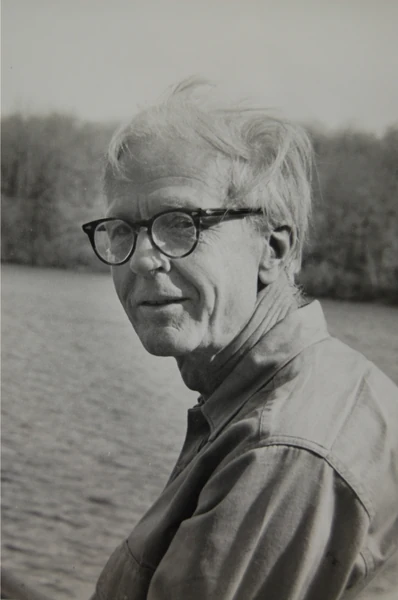
Hassler Whitney
| Name | Hassler Whitney |
| Title | American mathematician (1907–1989) |
| Gender | Male |
| Birthday | 1907-03-23 |
| nationality | United States of America |
| Source | https://www.wikidata.org/wiki/Q742072 |
| pptrace | View Family Tree |
| LastUpdate | 2025-11-29T01:00:41.849Z |
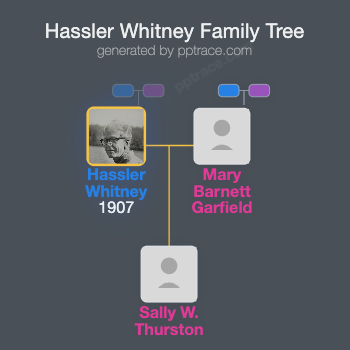
Family Tree
Tap  to expand more relatives
Introduction
Hassler Whitney (March 23, 1907 – May 10, 1989) was an American mathematician known for his contributions to singularity theory, manifold theory, embeddings, immersions, characteristic classes, and geometric integration theory.
**Early Life and Family Background**
Whitney was born in New York City. His father, Edward Baldwin Whitney, served as a judge in the First District of the New York Supreme Court. His mother, A. Josepha Newcomb Whitney, was involved in art and political activism. Whitney’s paternal lineage includes prominent figures such as Connecticut Governor and Chief Justice Simeon E. Baldwin, Yale University professor William Dwight Whitney, and American founding father Roger Sherman. His maternal grandfather was astronomer and mathematician Simon Newcomb, and his maternal grandmother was Mary Hassler Newcomb, granddaughter of Ferdinand Rudolph Hassler, the first superintendent of the Coast Survey. Whitney's great-uncle Josiah Whitney was an early surveyor of Mount Whitney.
**Marriages and Family**
Whitney was married three times. His first marriage was to Margaret R. Howell on May 30, 1930. The couple had three children: James Newcomb, Carol, and Marian. After divorcing Howell, Whitney married Mary Barnett Garfield on January 16, 1955, with whom he had two daughters, Sarah Newcomb (later Sally Thurston), a statistician, and Emily Baldwin. His third marriage was to Barbara Floyd Osterman on February 8, 1986.
**Residences and Personal Interests**
In 1939, Whitney and his first wife commissioned architect Edwin B. Goodell Jr. to design their home in Weston, Massachusetts, exemplifying the International Style of architecture. Whitney was also engaged in music, playing viola and violin, and participated in the Princeton Musical Amateurs. An avid mountain climber, Whitney completed the first ascent of the Whitney–Gilman ridge on Cannon Mountain, New Hampshire, in 1929, a route regarded as one of the most challenging in the eastern United States. He climbed most peaks in Switzerland and was a member of the Swiss Alpine Society and the Yale Mountaineering Society.
**Death and Commemoration**
Whitney died in Princeton, New Jersey, on May 10, 1989, following a stroke. His wish was to have his ashes placed atop the Dent Blanche mountain in Switzerland, which was carried out by Oscar Burlet of the Swiss Alpine Club on August 20, 1989.
**Academic Career**
Whitney earned bachelor’s degrees in physics (1928) and music (1929) from Yale University. He received his PhD in mathematics from Harvard University in 1932 under the supervision of George David Birkhoff; his dissertation was titled *The Coloring of Graphs*. At Harvard, he held positions including instructor and assistant professor.
He subsequently held numerous roles: NRC Fellow (1931–33), assistant professor (1935–40), associate professor (1940–46), and full professor (1946–52). Whitney was a professor at the Institute for Advanced Study from 1952 to 1977 and became professor emeritus until his death. Other notable positions include chairmanship of the Mathematics Panel for the National Science Foundation (1953–56), an exchange professorship at the Collège de France (1957), and presidency of the International Commission of Mathematical Instruction (1979–82).
He was a member of several esteemed societies, including the National Academy of Sciences, the American Philosophical Society (elected 1947), the London Mathematical Society (honorary member, 1980), and the Swiss Mathematics Society (honorary). Whitney served as editor of the *American Journal of Mathematics* (1944–49) and *Mathematical Reviews* (1949–54).
**Honors and Awards**
Whitney received numerous awards, including the Lester R. Ford Award (1969), the National Medal of Science (1976), the Wolf Prize (1982), and the Steele Prize from the American Mathematical Society (1985).
**Research Contributions**
Whitney’s early research focused on graph theory, particularly graph coloring, contributing to the foundation of modern combinatorics. His 1933 paper established fundamental concepts in matroid theory. He developed conditions for embedding smooth manifolds into Euclidean space, showing that manifolds could be embedded in spaces of sufficiently high dimension, with significant refinement provided by the Whitney trick in 1944. His work advanced the understanding of the intrinsic and extrinsic geometry of manifolds and introduced key concepts in algebraic topology, including cohomology and characteristic classes.
Whitney also made influential contributions to the topology of singular spaces, introducing the Whitney conditions for stratifications. His work laid important groundwork for later developments in singularity theory, as well as in the study of smooth maps and their singularities. His book *Geometric Integration Theory* provided foundational insights into Stokes’ theorem with singular boundaries.
**Teaching and Educational Activities**
Starting in 1967, Whitney dedicated part of his career to elementary education, actively engaging in teaching and observing mathematics instruction at various levels. He spent time teaching pre-algebra to seventh-grade students and led courses for teachers, advocating for methods to reduce mathematical anxiety and improve pedagogical approaches.