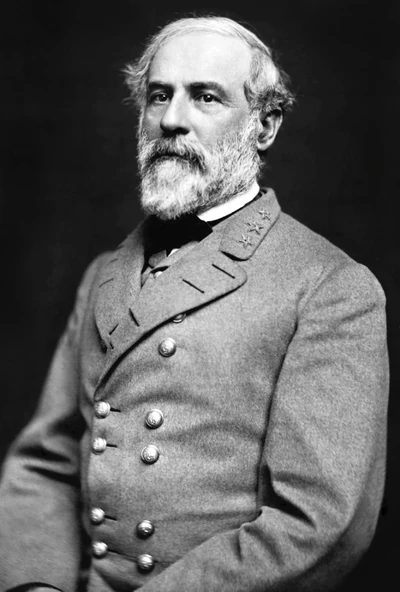
Robert E. Lee
| Name | Robert E. Lee |
| Title | Confederate States general (1807–1870) |
| Gender | Male |
| Birthday | 1807-01-19 |
| nationality | United States of America |
| Source | https://www.wikidata.org/wiki/Q165557 |
| pptrace | View Family Tree |
| LastUpdate | 2025-11-17T06:36:50.379Z |
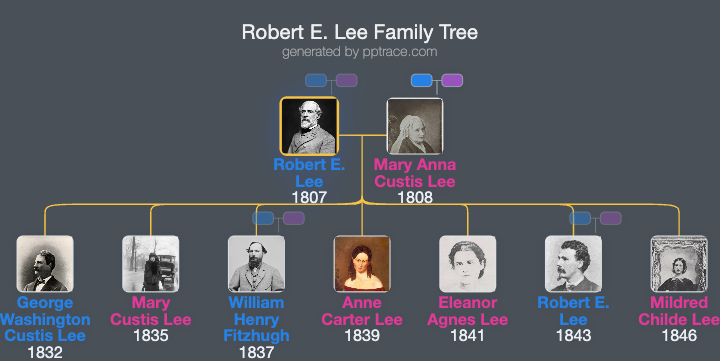
Family Tree
Tap  to expand more relatives
Introduction
Robert Edward Lee was born on January 19, 1807, at Stratford Hall Plantation in Westmoreland County, Virginia. He was the son of Henry "Light Horse Harry" Lee III, a Revolutionary War officer, and Anne Hill Carter Lee. His ancestry included Richard Lee I, who emigrated from Shropshire, England, to Virginia in 1639. The Lee family experienced financial difficulties due to failed investments, leading to Mr. Lee's imprisonment for debt. Following his release, the family relocated to Alexandria, which was part of the District of Columbia at the time and later reverted to Virginia in 1847.
Lee attended Eastern View, a school for young gentlemen in Fauquier County, Virginia, and subsequently the Alexandria Academy, where he displayed aptitude in mathematics. Although raised in a Christian household, he was not confirmed in the Episcopal Church until age 46. The family relied on support from relatives, notably William Henry Fitzhugh, who influenced Lee's appointment to the United States Military Academy at West Point. Lee delivered a letter of recommendation written by Fitzhugh, which facilitated his admission in 1825.
At West Point, Lee focused on engineering and graduated second in his class in 1829, with no demerits during his four-year training. He was commissioned as a brevet second lieutenant in the Corps of Engineers. Following graduation, Lee returned to Virginia after the death of his mother on July 26, 1829.
Lee's early military assignments included work on fortifications such as Cockspur Island in Georgia, where he contributed to the construction efforts for Fort Pulaski. In 1831, he was transferred to Fort Monroe in Virginia, where he continued engineering duties. During this period, Lee developed a relationship with Mary Anna Custis, a great-granddaughter of Martha Washington. The pair married on June 30, 1831, after Mary Custis accepted his proposal with her father's approval.
Throughout his military career, Lee held various positions, including assisting Brigadier General Charles Gratiot in Georgia and serving in Washington, D.C., where he worked on border surveying in Michigan in 1835. His duties encompassed a range of engineering, budgeting, and designing projects.
In 1834, Lee was transferred to Washington, D.C., and continued his engineering work. His family life included two children: Custis Lee, born at Fort Monroe, and Robert Lee Jr. The couple's household life was characterized by Lee's punctuality and meticulousness.
Lee served in the United States Army for 32 years, distinguished himself during the Mexican–American War, and served as Superintendent of West Point at one point in his career. His military service was marked by notable competencies in engineering and battlefield command prior to the Civil War.
In 1861, Virginia seceded from the Union, and Lee chose to align with his home state despite his personal opposition to secession and his offer of a senior command in the Union Army. During the Civil War, he initially served as a Confederate military adviser and later took command of the Army of Northern Virginia in June 1862, after Joseph E. Johnston's wounding.
Lee led the Confederate forces through key battles such as the Seven Days Battles, Second Battle of Bull Run, and the Battle of Antietam. His leadership included victories at Fredericksburg and Chancellorsville, but he also suffered significant defeats, most notably at Gettysburg in July 1863. Throughout the latter part of the war, he engaged Ulysses S. Grant's Union armies in protracted campaigns, culminating in the surrender at Appomattox Court House in April 1865.
Following the Civil War, Lee became president of Washington College in Lexington, Virginia, where he promoted reconciliation between the North and South. He supported the eventual abolition of slavery through the Thirteenth Amendment but did not endorse racial equality. Lee died on October 12, 1870, in Lexington, Virginia. His legacy has been subject to ongoing historical analysis, with various interpretations of his military strategies, personal beliefs, and role in American history.