William Henry Fitzhugh Lee
| Name | William Henry Fitzhugh Lee |
| Title | Confederate Army general (1837-1891) |
| Gender | Male |
| Birthday | 1837-05-31 |
| nationality | United States of America |
| Source | https://www.wikidata.org/wiki/Q1387911 |
| pptrace | View Family Tree |
| LastUpdate | 2025-11-29T00:59:52.180Z |
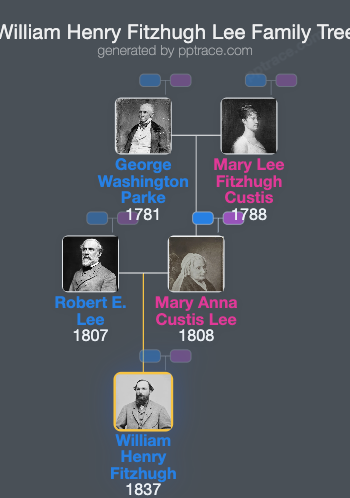
Family Tree
Tap  to expand more relatives
Introduction
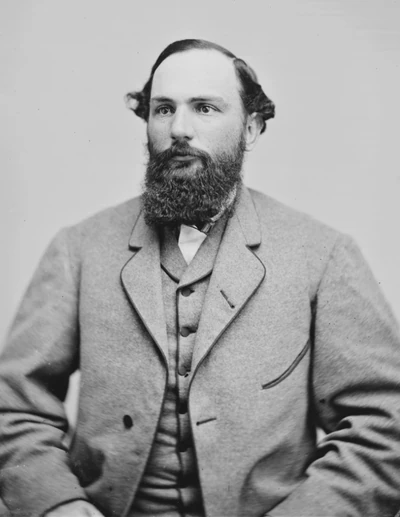
William Henry Fitzhugh Lee was born on May 31, 1837, at Arlington House in Arlington, Virginia. He was the second son of General Robert E. Lee and Mary Anna Custis. He was commonly known by the nickname "Rooney Lee" or "W. H. F. Lee," with the nickname often spelled "Roony" among friends and family. Rooney Lee was named after William Henry Fitzhugh, his maternal great-uncle, who died in 1830. His father began calling him Rooney at an early age, though the exact reason for this nickname is not documented. The nickname was used to distinguish him from his cousin Fitzhugh Lee.
Lee received higher education at Harvard University, where he formed a friendship with Henry Adams. Adams documented this relationship in chapter four of his autobiography, "The Education of Henry Adams."
In 1857, Lee entered the United States Army as a second lieutenant, following in his father's military footsteps. He served under Albert Sidney Johnston with the 6th U.S. Infantry and took part in the Utah War against Mormon settlers. In 1859, Lee resigned his army commission to operate his White House Plantation located on the south shore of the Pamunkey River in New Kent County, Virginia.
With the onset of the American Civil War, Lee was commissioned as a captain in the Confederate Army cavalry and was soon promoted to major. His initial service included leadership in western Virginia during Brigadier General William Loring's campaign and subsequent operations in the Shenandoah Valley under Stonewall Jackson. In late 1861, Lee was assigned to Major General J.E.B. Stuart's cavalry, which was part of the Confederate forces fighting in the Peninsula Campaign. He participated in Stuart's first ride around the Union Army and was involved in the Seven Days Battles near Richmond.
During the Northern Virginia Campaign, Rooney Lee played a significant role in Stuart's attack on Union General John Pope's supply base at Catlett's Station on August 22, 1862, where he captured a paymaster's safe filled with Union currency. His regiment was later attached to Brigadier General Fitzhugh Lee's brigade during the Maryland Campaign. He was knocked unconscious during the Battle of South Mountain when a horse fell beneath him, preventing his participation in the Battle of Antietam. After recovering, Lee commanded Fitzhugh Lee's cavalry brigade during the Chambersburg Raid, and he was promoted to brigadier general for his conduct.
Lee commanded the 3rd Brigade of Stuart's Cavalry Division at the Battle of Fredericksburg and was detached to defend against Union Stoneman's Raid at Chancellorsville. During the Gettysburg Campaign, he was wounded in the thigh at Brandy Station and was captured by Union forces while recovering at Hickory Hill. He was held as a prisoner at Fort Monroe and later in New York until he was exchanged on February 25, 1864, for Union Brigadier General Neal S. Dow.
Following his exchange, Lee was promoted to major general in April 1864, commanding a division in the Confederate Cavalry Corps during key battles such as The Wilderness, Spotsylvania, and North Anna. After the death of J.E.B. Stuart, Rooney Lee's role increased, and he took command of his division. His forces participated in defending Richmond and Petersburg, including the Second Battle of Deep Bottom, the Battle of Boydton Plank Road, and the siege of Petersburg. During the final campaign, his division was involved in screening the retreat from Petersburg, including at the Battle of Namozine Church. He surrendered alongside his father at Appomattox Court House on April 9, 1865, with approximately 300 officers and men.
After the Civil War, Lee resumed estate management at White House Plantation. Following his mother's death in 1873, he inherited Ravensworth Plantation in Fairfax County, Virginia. He served in the Virginia Senate from 1875 to 1878 and was elected to the U.S. House of Representatives as a Democrat in 1887, serving until his death.
Lee died on October 15, 1891, at Ravensworth and was buried in the University Chapel at Washington and Lee University in Lexington, Virginia. He was married twice; first in 1859 to Charlotte Georgiana Wickham, with whom he had two children—Robert Edward Lee and Charlotte Carter Lee—both of whom died young. His second marriage was in 1867 to Mary Tabb Bolling, with whom he had two sons: Robert Edward Lee III and George Bolling Lee.
His maternal lineage was linked to George Washington Parke Custis and indirectly related to Martha Dandridge and President George Washington. He was also a descendant of Charles II of England through Lady Charlotte Lee and possibly of George I through Benedict Swingate Calvert.