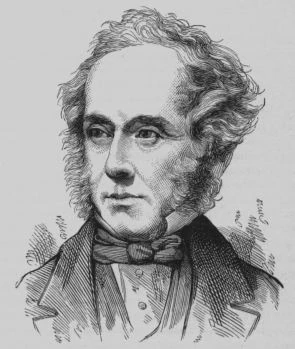
Henry Temple, 3rd Viscount Palmerston
| Name | Henry Temple, 3rd Viscount Palmerston |
| Title | British statesman and prime minister (1784–1865) |
| Gender | Male |
| Birthday | 1784-10-20 |
| nationality | United Kingdom of Great Britain and Ireland |
| Source | https://www.wikidata.org/wiki/Q193656 |
| pptrace | View Family Tree |
| LastUpdate | 2025-11-26T23:28:17.383Z |
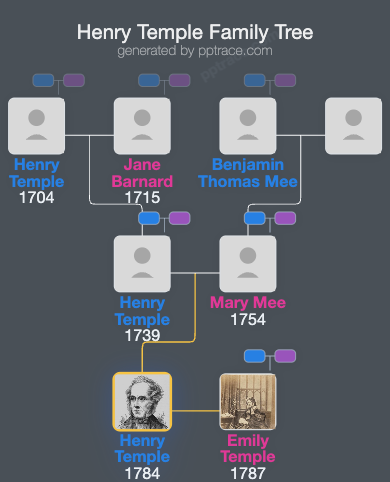
Family Tree
Tap  to expand more relatives
Introduction
Henry John Temple, 3rd Viscount Palmerston (20 October 1784 – 18 October 1865), was a British politician and statesman. He is commonly referred to as Lord Palmerston. Palmerston served as Prime Minister of the United Kingdom in two non-consecutive terms, from 1855 to 1858 and from 1859 until his death in 1865.
Born in Westminster, London, Palmerston was a member of the Irish branch of the Temple family. His father was Henry Temple, 2nd Viscount Palmerston (1739–1802), and his mother was Mary Mee (1752–1805), a daughter of Benjamin Mee, a London merchant. In 1802, he inherited his father's Irish peerage, becoming the 3rd Viscount Palmerston, but this Irish peerage did not grant him a seat in the House of Lords. Instead, he became a Member of Parliament (MP) in the House of Commons in 1807.
Palmerston's early years included a period of travel on the Continent from 1792 to 1794, during which he learned to speak Italian fluently. He was educated at Harrow School (1795–1800), where he was known for his confrontations with bullies, and later attended the University of Edinburgh (1800–1803). At Edinburgh, he studied political economy under Dugald Stewart. He then attended St John's College, Cambridge (1803–1806), where he earned first-class honours despite the lack of formal examinations due to his peerage status.
In his military-related roles, Palmerston joined the Volunteers during the Napoleonic Wars, eventually commanding the South-West Hampshire Local Militia from 1809 to 1816. His political career began in earnest with his election as Tory MP for Newport, Isle of Wight, in 1807. He also served in various governmental positions, including as Junior Lord of the Admiralty and later as Secretary at War from 1809 to 1828, overseeing military finances.
Palmerston was appointed Secretary at War during the tenure of multiple governments and was involved in organizing the army's financial affairs. Notably, in 1818, he was shot at by Lieutenant David Davies, who was mentally ill; the wound inflicted was only a grazing injury.
In 1830, Palmerston became Foreign Secretary, a position he held repeatedly until 1851, responding to various European conflicts. He served as Home Secretary in 1852 under Earl of Aberdeen's government and enacted social reforms, although he opposed electoral reform.
In 1855, after the collapse of Aberdeen’s coalition over the handling of the Crimean War, Palmerston became Prime Minister. His leadership is characterized as being politically independent and personally popular. He was known for shaping British foreign policy during a period of imperial expansion and stands as the earliest British Prime Minister regarded as truly popular by the public.
Palmerston remained in office until his death on 18 October 1865, at the age of 80. He was the most recent British Prime Minister to die in office. His foreign policy aimed at maintaining the balance of power and safeguarding British interests globally, with notable policies concerning India, China, Italy, Belgium, and Spain. His role in the Opium Wars has been subject to historical scrutiny, as have the broader consequences of the British conquest of India.
Palmerston's tenure considerably influenced British diplomacy and foreign affairs, and his political career spanned several decades during which Britain reached the zenith of its imperial power.