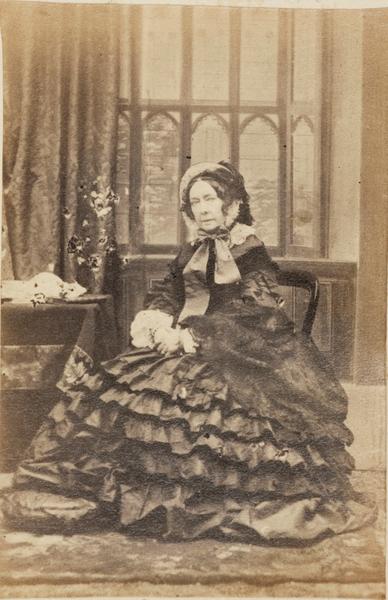
Emily Temple, Viscountess Palmerston
| Name | Emily Temple, Viscountess Palmerston |
| Title | British countess (1787-1869) |
| Gender | Female |
| Birthday | 1787-04-21 |
| nationality | United Kingdom of Great Britain and Ireland |
| Source | https://www.wikidata.org/wiki/Q5372252 |
| pptrace | View Family Tree |
| LastUpdate | 2025-11-12T01:17:08.346Z |
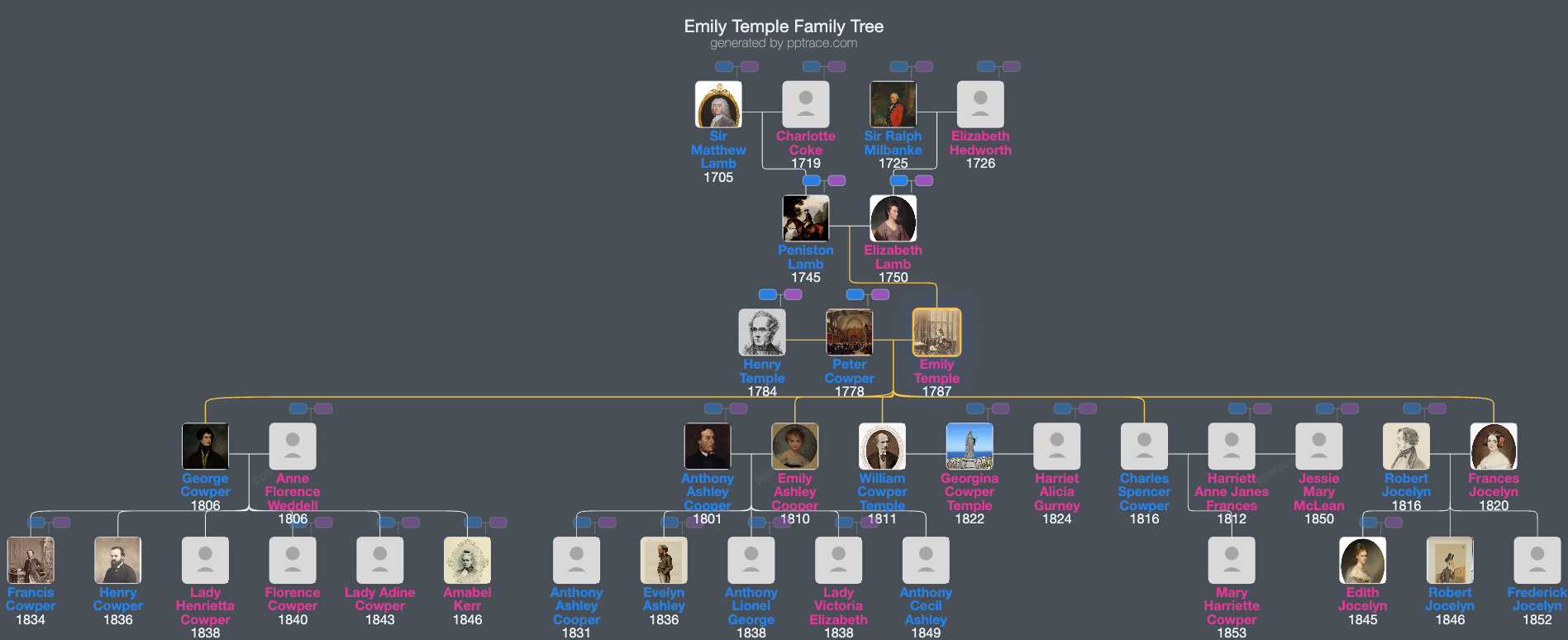
Family Tree
Tap  to expand more relatives
Introduction
Emily Temple, Viscountess Palmerston (née Lamb; later Clavering-Cowper), was born in 1787 and died in 1869. She was known prior to her marriage as The Honourable Emily Lamb from 1787 until 1805 and as Countess Cowper from 1805 to 1839. Her family was prominent in British political and social circles, and she was associated with the Whig party and close to Queen Victoria. Emily was the sister of William Lamb, who served as Prime Minister of the United Kingdom twice.
Her parents were Peniston Lamb and Elizabeth Milbanke. Her paternity remains uncertain due to her mother's numerous extramarital affairs, leading to speculation about her biological father. The Lamb family had attained significant influence by the mid-18th century, with her father being created Viscount Melbourne in 1781. Emily had several siblings, including William Lamb, Frederick Lamb, a diplomat, and George Lamb, a playwright and journalist. She maintained a close relationship with her brother William, who affectionately called her "that little devil Emily," and she harbored a dislike for his wife, Lady Caroline Lamb.
At age eighteen, Emily married Peter Clavering-Cowper, 5th Earl Cowper (1778–1837). The marriage connected her to the Cowper family, and she became Countess Cowper upon her husband’s accession. Lord Cowper was characterized as a reserved and pleasant man, contrasting with Emily’s lively social skills. She was active in the Regency era social scene, particularly as a patroness of Almack's, an exclusive social club. She was recognized for her kindness, generosity, and her ability to retain good relations even with those she disliked, such as her sister-in-law Caroline.
Emily engaged in love affairs during her marriage, including one with Carlo Andrea Pozzo di Borgo, a Corsican diplomat who later became Russian Ambassador to Britain. She was noted for her beauty and charm, and her popularity at Almack’s made her one of the most influential patronesses, distinguished from others by her warmth and approachability.
Her relationship with Henry John Temple, 3rd Viscount Palmerston, developed at Almack's. Palmerston, known as "Cupid" due to his romantic pursuits, became a frequent guest at her social gatherings. As Lord Cowper's health declined, Emily and Palmerston entered into a romantic relationship. By the late 1820s, Palmerston was aligned with the Whig party, partly due to his association with Emily's family. Her mother, on her deathbed in 1818, advised her to remain loyal to Palmerston, hinting at future potential for marriage.
Following Lord Cowper’s death in 1837, shortly after Queen Victoria’s accession, Emily was permitted to marry Palmerston. The marriage took place on December 16, 1839, when both were in their early fifties. Palmerston was 55, and Emily was 52. The couple resided at Broadlands and maintained a notably harmonious relationship. Lady Palmerston continued her role as a social hostess and diplomat’s confidante, often testing diplomatic ideas during gatherings. Their shared punctuality fault and mutual charm contributed to their reputation as a well-matched pair.
Emily and Palmerston had five children, three sons and two daughters. Records suggest that one of her daughters, Emily, was likely fathered by Palmerston, and her son William may have been fathered by Carlo Andrea Pozzo di Borgo.
Her children included George Cowper, 6th Earl Cowper; Lady Emily Cowper, who married the 7th Earl of Shaftesbury; William Cowper-Temple, 1st Baron Mount Temple; Honorable Charles Spencer Cowper; and Frances Jocelyn, Viscountess Jocelyn. Emily Temple, Viscountess Palmerston, died in 1869, four years after her husband’s death in 1865.