Frederick North, 2nd Earl Of Guilford
| Name | Frederick North, 2nd Earl Of Guilford |
| Title | Prime Minister of Great Britain from 1770 to 1782 |
| Gender | Male |
| Birthday | 1732-04-13 |
| nationality | Great Britain |
| Source | https://www.wikidata.org/wiki/Q312593 |
| pptrace | View Family Tree |
| LastUpdate | 2025-11-26T23:24:37.987Z |
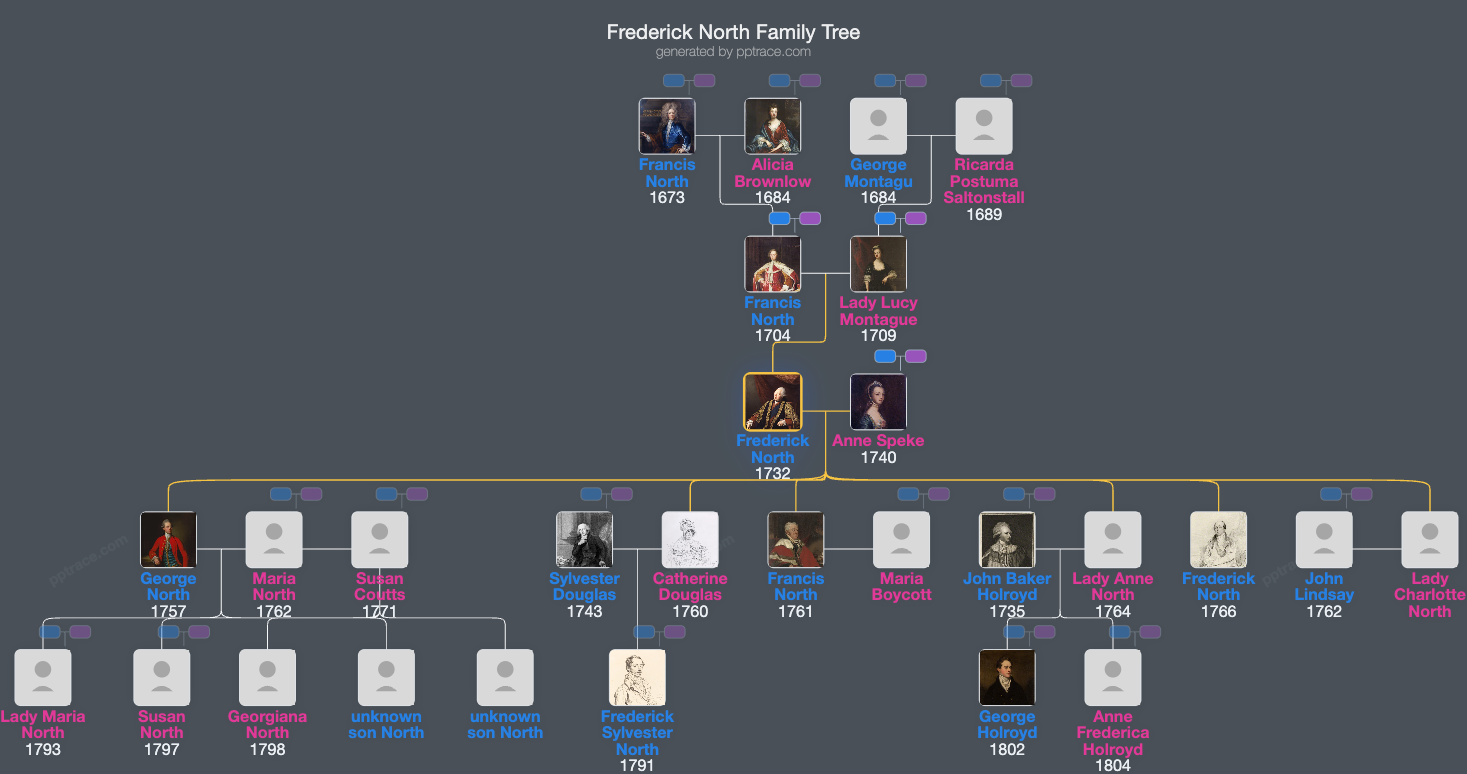
Family Tree
Tap  to expand more relatives
Introduction
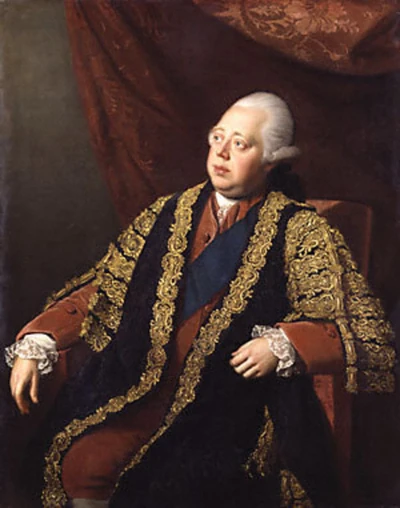
Frederick North, 2nd Earl of Guilford, was born on 13 April 1732 in London at the family residence on Albemarle Street. He was commonly known by his courtesy title Lord North from 1752 until 1790. North spent much of his early years at Wroxton Abbey in Oxfordshire. He was the son of Francis North, 1st Earl of Guilford, and Lady Lucy Montagu. His father served as Lord of the Bedchamber to Frederick, Prince of Wales, from 1730 to 1751. North’s birth coincided with a period when there was speculation about his paternity due to his strong resemblance to King George III; some contemporaries suggested he might be the illegitimate son of Frederick, Prince of Wales, though there is little supporting evidence for this theory.
His paternal lineage traced back to Henry Montagu, 1st Earl of Manchester, and he was related to Samuel Pepys and the 3rd Earl of Bute. His family background was not initially wealthy, but it improved in 1735 when his father inherited property from a cousin. North's mother, Lady Lucy Montagu, was the daughter of George Montagu, 1st Earl of Halifax, and Ricarda Posthuma Saltonstall. Lady Lucy died in 1734, and his father remarried. North’s stepmother, Elizabeth Kaye, died in 1745, when North was thirteen years old. He had a close relationship with his family despite occasional turbulence with his father. A notable family connection was with William Legge, 2nd Earl of Dartmouth, a stepbrother and lifelong friend.
North received education at Eton College from 1742 to 1748. He then attended Trinity College, Oxford, where he was awarded a Master of Arts degree in 1750. After university, he embarked on the Grand Tour of Europe with Lord Dartmouth, staying in Leipzig for nearly nine months, studying under Johann Jacob Mascov. Their travels took them through Austria, Italy (including Rome from December 1752 to Easter 1753), Switzerland, and France. They returned to England in early 1754.
North was elected Member of Parliament for Banbury on 15 April 1754 at age 22, serving until 1790. His early political career included a position as a junior Lord of the Treasury starting on 2 June 1759, during the Pitt–Newcastle ministry. He gained a reputation as a capable administrator and parliamentarian. While he considered himself a Whig initially, he did not align strictly with any faction, and it became evident that his political leanings were predominantly Tory.
On 23 June 1759, North was appointed Lieutenant-Colonel of the 1st Somerset Militia, commanding the unit in the West Country. He resigned from this role in November 1761 to focus on his parliamentary duties. In November 1763, North spoke in the House of Commons against radical MP John Wilkes, supporting Wilkes' expulsion for his attacks on the Prime Minister and King, which was approved by a significant majority.
North’s political trajectory included serving in various government posts, such as Joint Paymaster of the Forces and becoming a Privy Counsellor in 1766. He succeeded Charles Townshend as Chancellor of the Exchequer in December 1767 and became Leader of the House of Commons in 1768.
He formed a government on 28 January 1770, succeeding the Duke of Grafton as Prime Minister. His tenure coincided with Britain’s post-Seven Years’ War dominance, and he maintained many members of the previous cabinet despite political differences. His relationship with King George III was notably cordial.
During the Falklands Crisis of 1770, North’s government successfully responded to Spain’s attempt to seize the Falkland Islands, an event which bolstered Britain’s naval prestige. Subsequently, North’s administration faced escalating tensions with the American colonies, culminating in the outbreak of the American Revolutionary War following the battles and unrest that began with the Boston Tea Party in 1773 and the battles of Lexington and Concord in 1775. North’s government enacted punitive legislation known as the Coercive Acts or the Intolerable Acts, attempting to quell rebellion, but these measures increased colonial hostility.
North’s leadership during the American War of Independence involved delegating military strategy to figures such as Lord George Germain and the Earl of Sandwich. Despite initial victories including the capture of New York and Philadelphia, the British ultimately struggled to suppress the rebellion.
Frederick North, 2nd Earl of Guilford, died on 5 August 1792 in London.