John Hedworth
| Name | John Hedworth |
| Title | British Member of Parliament (1683-1747) |
| Gender | Male |
| Birthday | 1683-00-00 |
| nationality | Great Britain |
| Source | https://www.wikidata.org/wiki/Q24260349 |
| pptrace | View Family Tree |
| LastUpdate | 2025-11-26T12:38:28.225Z |
Family Tree
Tap  to expand more relatives
Introduction
John Hedworth (10 July 1683 – 31 May 1747) was a British colliery owner and politician associated with Chester Deanery, Durham. He served as a Member of Parliament (MP) for County Durham for a period of 34 years, from 1713 until his death in 1747.
Early Life and Family Background
Hedworth was baptized on 10 July 1683. He was the eldest surviving son of Ralph Hedworth of Chester Deanery and Eleanor Lambton, daughter of Henry Lambton of Lambton Hall, located in county Durham. The Hedworth family were prominent coal owners in Sunderland.
Education and Early Career
He matriculated at Lincoln College, Oxford, on 18 March 1700 at the age of 16. In the same year, he was admitted to the Middle Temple. In 1705, Hedworth inherited the family estates and coalfields following the death of his father.
Marriage
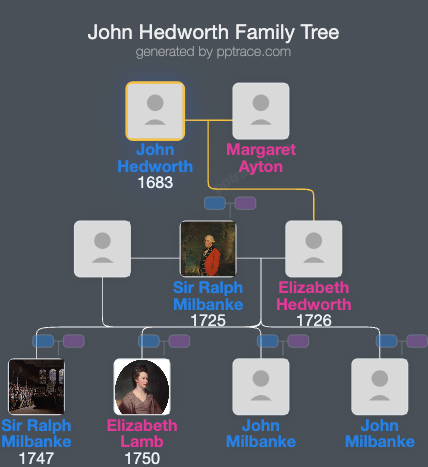
On 28 August 1714, Hedworth entered into a marriage settlement with Susanna Sophia Pleasant, daughter of William Pleasant, a merchant from London. He later married Margaret Ayton, daughter of Samuel Ayton of West Herrington in county Durham, on 14 August 1729. Margaret Ayton died in 1731.
Political Career
Hedworth's involvement in coal trade affairs became evident in 1711 when coal owners from Northumberland sought his support in opposing a parliamentary bill aimed at preventing trade combinations. He was considered a leading figure in this matter.
He was first elected unopposed as MP for County Durham in the 1713 general election. His activity in Parliament was limited; however, he participated in votes such as opposing the expulsion of Richard Steele on 18 March 1714 and assisting in the drafting of a bill related to the endowment of poor vicarages. His political alignment appeared inconsistent, as he was listed both as a Whig and a Tory at different times, and considered a Whig who sometimes voted with Tories.
In the 1715 general election, Hedworth was again elected as a Whig but maintained an independent voting record, generally siding with the Opposition in Parliament. He served as Mayor of Hartlepool for the years 1716-1717, 1728-1729, and again for 1740-1741.
In subsequent elections, Hedworth was returned to Parliament in 1722, 1727, and 1734. His votes included opposition to the Excise Bill in 1733, support for the Government on the Spanish convention in 1739, and opposition on the place bill in 1740. He also supported the Government regarding the chairman of the elections committee in December 1741 and was identified as a Pelham supporter in October 1742. His voting record in 1744 was limited to a single division supporting the Hanoverians, and by 1746 he was classified as an Old Whig.
Later Life and Legacy
Hedworth's second marriage was to Margaret Ayton in 1729; he had one daughter, Elizabeth, with her. From his first marriage to Eleanor, he fathered a daughter named Eleanor. His estate was inherited by his daughters. Eleanor Hedworth married Sir Richard Hylton, 5th Baronet, and was the mother of Hylton Jolliffe. Elizabeth Hedworth married Sir Ralph Milbanke, 5th Baronet and Member of Parliament.
John Hedworth died of a violent colic on 31 May 1747. His estate passed to his daughters, Eleanor and Elizabeth.