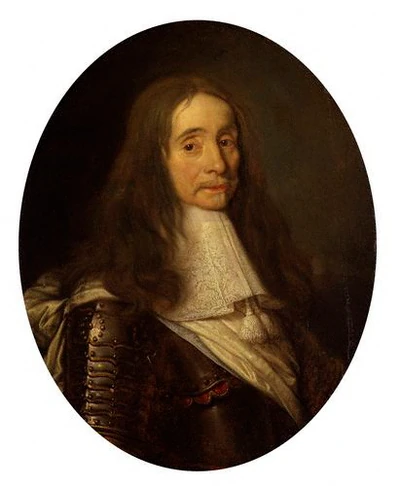
Montagu Bertie, 2nd Earl Of Lindsey
| Name | Montagu Bertie, 2nd Earl Of Lindsey |
| Title | English politician |
| Gender | Male |
| Birthday | 1608-00-00 |
| nationality | Kingdom of England |
| Source | https://www.wikidata.org/wiki/Q3861098 |
| pptrace | View Family Tree |
| LastUpdate | 2025-11-26T23:21:12.610Z |
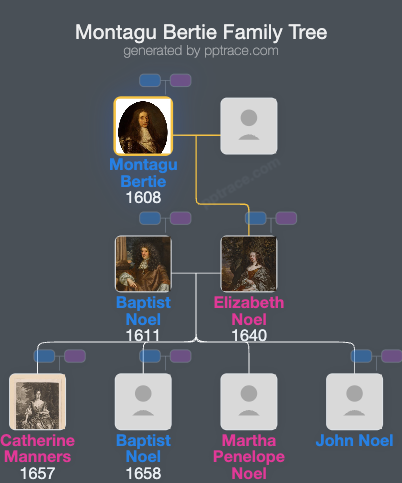
Family Tree
Tap  to expand more relatives
Introduction
Montagu Bertie, 2nd Earl of Lindsey, KG, PC (born in 1608 and died on 25 July 1666), was an English nobleman involved in military, political, and court life during the 17th century.
He was born at Grimsthorpe Castle in Grimsthorpe, the eldest son of Robert Bertie, 1st Earl of Lindsey, and Elizabeth Montagu, daughter of Edward Montagu, 1st Baron Montagu of Boughton. Bertie attended Sidney Sussex College, Cambridge, for a brief period in 1623.
His early political career included serving as Member of Parliament for Lincolnshire in 1624 and for Stamford from 1625 to 1626. Upon his father's elevation to an earldom, he assumed the courtesy title of Lord Willoughby de Eresby. During his youth, he served as Captain of a cavalry troop in the Low Countries.
Bertie gained favor with King Charles I and was appointed a Gentleman of the Privy Chamber, High Steward of Boston, and Steward, Warden, and Chief Ranger of Waltham Forest in 1634. In 1639, he raised The King's Life Guard of Foot, a regiment of four companies, for service in the First Bishops' War, obtaining a captaincy. The following year, he was appointed High Steward of the Honour of Bolingbroke and the Manor of Sutton.
In 1640, with the convening of the Long Parliament, Bertie was summoned to the House of Lords through a writ of acceleration as Baron Willoughby de Eresby. In 1641, he traveled to Scotland with four companions, an event recorded in the poem "A Scottish Journie."
During the English Civil War, both Bertie and his father supported the Royalist cause. He raised a cavalry regiment in Lincolnshire and commanded the Life Guards at the Battle of Edgehill, where his father was wounded fatally. After his father's death, Bertie surrendered to the Parliamentarians to attend to his father, who was mortally wounded, and was imprisoned in Warwick Castle. While in imprisonment, he authored a declaration asserting his loyalty to the Crown. He was released in July 1643 after a prisoner exchange and rejoined the Royalist forces at Oxford.
Bertie held several military commands, including colonel of the King's Life Guards of Foot and later lieutenant-general of the Life Guards "and all the foot." He participated in notable battles, such as the First and Second Battles of Newbury, Cropredy Bridge, and Lostwithiel; he was wounded at Naseby. Throughout the war, he also engaged in diplomatic efforts, serving as a commissioner for negotiations with Parliament and advocating for reconciliation. He served as a Gentleman of the Bedchamber from 1643 to 1649, Steward, Keeper, and Ranger of Woodstock in 1644, and was present at Oxford's surrender in 1646. He attended King Charles I during his trial and burial and was involved in the Treaty of Newport in 1648.
Following the execution of Charles I in 1649, Bertie retired from public life. His movements were monitored during the later Royalist uprisings, but he did not take active part in them.
After the Restoration of the monarchy in 1660, Bertie was restored to royal favors. He was re-appointed to the Privy Council, became Lord Great Chamberlain, and was appointed Lord Lieutenant of Lincolnshire. On 1 April 1661, he was made a Knight of the Garter. He officiated as Lord Great Chamberlain at King Charles II's coronation on 23 April 1661 and, in 1662, was appointed as one of the commissioners for the Earl Marshal's office. Bertie died in 1666 at Campden House in Kensington, the residence of his son-in-law, and was buried at Grimsthorpe.
He was married twice: first to Martha Ramsay (née Cockayne), Dowager Countess of Holderness, on 18 April 1627. They had eight children, including Robert Bertie, 3rd Earl of Lindsey, and James Bertie, 1st Earl of Abingdon. Martha died in July 1641. He later married Bridget Wray, Baroness Norris, sometime between 1646 and 1653, producing four additional children, including the future Earl of Abingdon.
References to his activities and family are documented in historical records of the period.