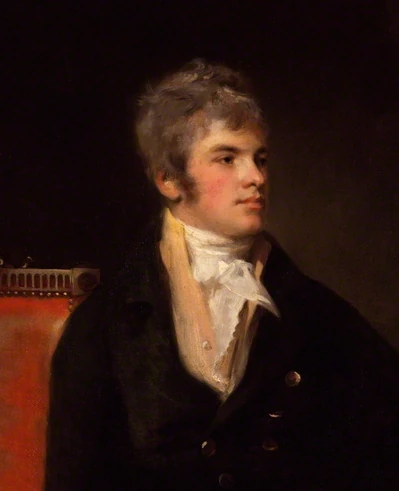
Henry Petty-Fitzmaurice, 3rd Marquess Of Lansdowne
| Name | Henry Petty-Fitzmaurice, 3rd Marquess Of Lansdowne |
| Title | British politician (1780–1863) |
| Gender | Male |
| Birthday | 1780-07-02 |
| nationality | United Kingdom of Great Britain and Ireland |
| Source | https://www.wikidata.org/wiki/Q332639 |
| pptrace | View Family Tree |
| LastUpdate | 2025-11-26T23:25:08.631Z |
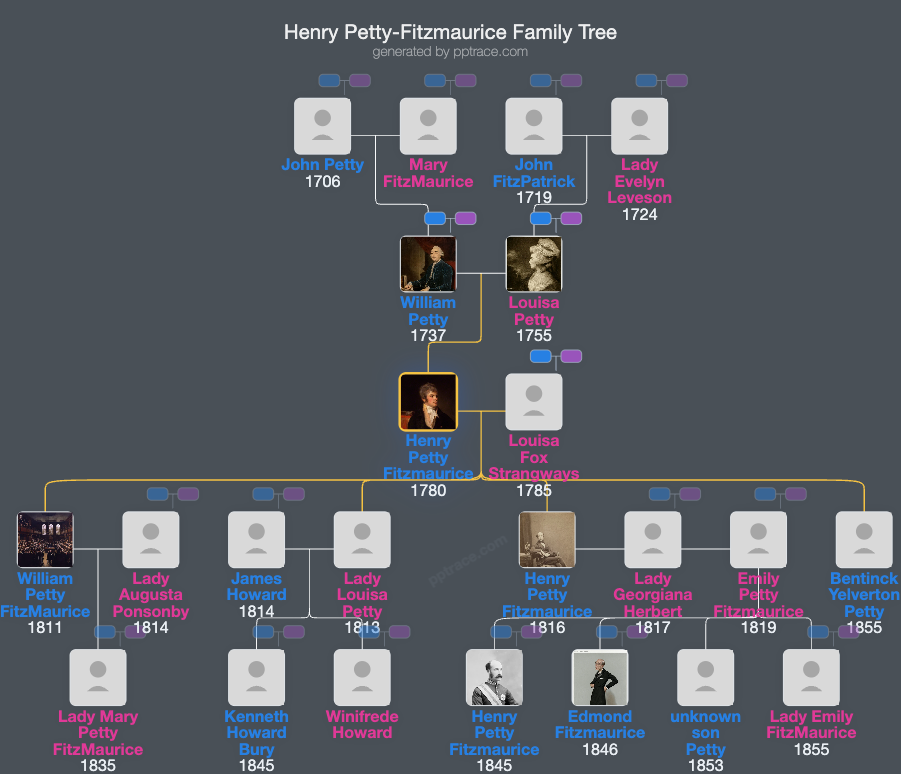
Family Tree
Tap  to expand more relatives
Introduction
Henry Petty-Fitzmaurice, 3rd Marquess of Lansdowne (2 July 1780 – 31 January 1863), was a British statesman active during the 19th century. He was born in 1780 as Lord Henry Petty and was the son of William Petty, 1st Marquess of Lansdowne, who served as Prime Minister, and Lady Louisa FitzPatrick, daughter of John FitzPatrick, 1st Earl of Upper Ossory. His education included attendance at Westminster School, the University of Edinburgh, and Trinity College, Cambridge.
In 1802, Lansdowne entered the House of Commons as a Member of Parliament for Calne, which was a family borough. During his parliamentary career, he demonstrated early involvement in national politics, notably serving as Chancellor of the Exchequer in Lord Grenville’s Ministry of All the Talents in February 1806. At that time, he represented the University of Cambridge. However, he lost his parliamentary seat and his ministerial position in 1807.
In 1809, Lansdowne succeeded his elder half-brother, John Petty, as the 3rd Marquess of Lansdowne. The previous marquess, his half-brother, was compelled to leave Ireland due to his alleged involvement in the United Irish conspiracy led by Robert Emmet. The 3rd Marquess inherited estates in Ireland and became active in political and social spheres as a leader within the Whig party. His interests included advocating for Roman Catholic emancipation, abolition of the slave trade, and the promotion of popular education.
He assumed the title of the 4th Earl of Kerry in 1818, succeeding his cousin, Francis Thomas Fitzmaurice. Lansdowne held various government positions, including Secretary of State for the Home Department from July 1827 to January 1828 during the brief tenure of George Canning’s government. From November 1830 to August 1841, he served as Lord President of the Council under Earl Grey, and continued in this role under Lord Melbourne from 1846 to 1852, with the exception of a few months in 1835 when Sir Robert Peel was Prime Minister. He declined the offer of a dukedom in 1857.
Throughout his career, Lansdowne served in every Whig or Liberal Ministry from 1806 until his death in 1863 and was appointed Lord President of the Council three times. Despite declining the premiership, he remained a prominent and influential figure within the party. In his later years, he was widely regarded as "the Nestor of the Whigs." He maintained close relations with Queen Victoria, often consulted on political matters, and was influential within political circles.
In addition to his political work, Lansdowne chaired the inaugural meeting of the London Statistical Society, serving as its first president from 1834 to 1836 and again from 1842 to 1844. As a landowner and philanthropist, he donated the site for the Holy Cross Church in Kenmare, Ireland, which was built in 1864.
He was married in 1808 to Lady Louisa Fox-Strangways, daughter of the 2nd Earl of Ilchester. The couple had three children: William Thomas Petty-FitzMaurice, who was styled Earl of Kerry and died in 1836; Lady Louisa, who married Hon. James Kenneth Howard and had children; and Henry Petty-FitzMaurice, who succeeded as the 4th Marquess of Lansdowne. His eldest son predeceased him, and he was succeeded by his surviving son Henry, the father of Henry Petty-FitzMaurice, 5th Marquess of Lansdowne.
Henry Petty-Fitzmaurice died on 31 January 1863 at the age of 82.