William Watts
| Name | William Watts |
| Title | British East India Company official |
| Gender | Male |
| Birthday | 1722-00-00 |
| nationality | — |
| Source | https://www.wikidata.org/wiki/Q8020096 |
| pptrace | View Family Tree |
| LastUpdate | 2025-11-26T12:32:55.524Z |
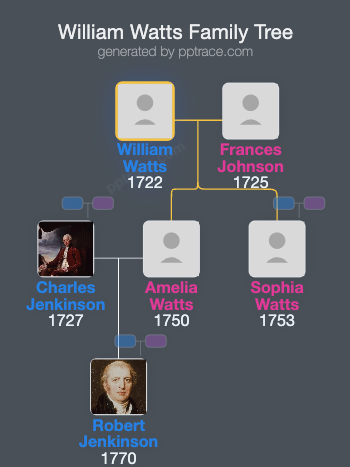
Family Tree
Tap  to expand more relatives
Introduction
William Watts (circa 1722 – 4 August 1764) was a British official associated with the East India Company during the mid-18th century. His activities significantly contributed to the political and territorial consolidation of British influence in Bengal.
Born around 1722, Watts was the son of William Watts, an academy master in London, and his first wife, Mary Hills. On 24 March 1749, he married Frances Altham, née Croke, at Calcutta. Frances, commonly known as Begum Johnson, was a widow with notable familial connections. She resided most of her life in Calcutta, which, by 1772, served as the de facto capital of British India. Through his marriage to Frances, Watts was connected to the Governors of Fort St. David and Calcutta.
Professionally, Watts held the position of chief of the Cossimbazar factory, an East India Company trading post. His role expanded when Robert Clive appointed him as the company's representative to the Nawab's court at Murshidabad. In this capacity, Watts was involved in devising a secret plan to overthrow Siraj ud-Daulah, the last independent Nawab of Bengal. He established contact with dissident emirs, including Mir Jafar, Rai Durlabh, and Yar Lutuf Khan. Watts participated in the conspiracy that culminated in the Battle of Plassey on 23 June 1757, a pivotal event leading to British domination in Bengal. On 5 June 1757, Watts visited Mir Jafar and secured his oath of allegiance. For his efforts, he received £114,000 from the Nawab's treasury and was appointed governor of Fort William on 22 June 1758, following the earlier desertion of Roger Drake and the British capture of the fort during the events surrounding the Black Hole of Calcutta. Four days subsequently, Watts resigned from the position, passing it to Robert Clive and returning to England.
After his return to Britain, Watts constructed South Hill Park in Berkshire, which later became an arts center. In 1759, he declined an offer of government support to contest an election in Ipswich, citing personal unfitness for a busy political campaign but indicating willingness to pay for a secure seat. Near the end of his life, in June 1764, Watts was purchasing Hanslope Park in Buckinghamshire; however, he died on 4 August 1764 before completing the transaction. His son, Edward Watts, finalized the purchase, becoming Lord of the Manor. William Watts was interred in the Watts family vault at Hanslope parish church. His memoir, "Memoirs of the Revolution in Bengal," was published in 1764, the year of his death.
William Watts fathered three surviving children with Frances Altham, following the loss of a child named William in infancy. His children and descendants include significant figures in British politics and empire, notably through his daughter Amelia. She married Charles Jenkinson, later the first Earl of Liverpool, a close adviser to King George III. Amelia died at age 19 shortly after giving birth to Robert Jenkinson, who later became Prime Minister of the United Kingdom. Another daughter, Sophia, married George Poyntz Ricketts of Midgham, Jamaica, and Grove Place in Nursling, Hampshire. Ricketts served as governor of Tobago in 1793 and of Barbados from 1794 until his death in 1800. Their son, Charles Milner Ricketts (1776–1867), was an administrator in India, married a sister of MP Michael Prendergast, and later became a Member of Parliament. William Watts's son Edward married Florentia Wynch, daughter of Alexander Wynch, former Governor of Madras, on 26 March 1778.