Takayuki Ōtsuki
| Name | Takayuki Ōtsuki |
| Title | Japanese military personnel (1835-1900) |
| Gender | Male |
| Birthday | 1835-12-14 |
| nationality | Japan |
| Source | https://www.wikidata.org/wiki/Q11438459 |
| pptrace | View Family Tree |
| LastUpdate | 2025-11-17T09:48:54.414Z |
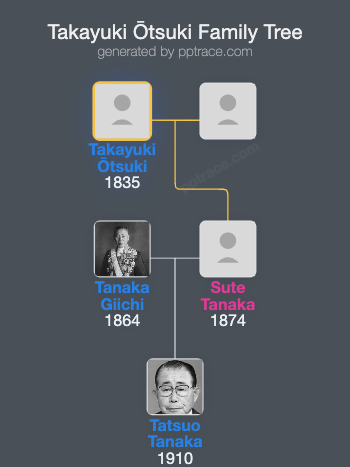
Family Tree
Tap  to expand more relatives
Introduction
Takayuki Otsuki (December 24, 1835 (Temper 6, 11th month 5) – June 12, 1900 (Meiji 33)), was a Japanese army officer and lieutenant general in the Imperial Japanese Army. His childhood name was Yasutarō. He was born within Sakura Castle as the son of a Satsuma domain vassal of the Sakura Domain. His father was Yajirota Ōtsuki Nao Tadashi, and his mother was Tsuna.
He received his education at the domain's school, Seidoku Shōin (the predecessor of present-day Chiba Prefectural Sakura High School), and in 1847 passed an exam to recite the Four Books aloud, a fundamental exercise in Confucian studies. In 1851 (Kaei 4), he was ordered by the domain to train in Takashima-ryū artillery, and in 1853 (Kaei 6) and the following year, he was dispatched to Kanagawaura in Chiba District for coastal defense.
From 1854 (Kaei 7), he studied Rangaku (Dutch Learning) and English under the domain's Western studies scholars like Tetsuya Tetsuzo, and in 1860 (Man'en 1), he was appointed as the domain’s Western studies instructor in Sakura. In 1862 (Bunkyū 2), he assisted in the supervision of official documents related to Western books. By 1865 (Keiō 1), he was made a bannerman and involved in organizing Western-style troops as an infantry officer.
After the Meiji Restoration, following the transfer of his domain to Suruga Province, he promoted the founding of Numazu Military School and invited Seishū Nishi to serve as the school head. After Nishi's resignation, he was promoted to be the head in 1870 (Meiji 3). With the abolition of the han system and the establishment of prefectures in 1871 (Meiji 4), the Numazu Military School was transferred to the Ministry of War, and he became a lieutenant colonel in the army and an aide-de-camp for military studies.
Subsequently, he served as deputy chief of the 3rd Bureau of the Army Ministry, an officer in charge of arms manufacturing, director of artillery factory affairs, vice chairman of the artillery council, director of the artillery bureau, and acting chairman of the artillery council. In 1886 (Meiji 19), he was appointed as a major general and chairman of the artillery council. He also served as inspector of artillery and as commander of the provisional Tokyo Bay Defense Force during the First Sino-Japanese War. In the same year, he was promoted to lieutenant general. He was then transferred to the reserve.
He died on June 12, 1900 (Meiji 33) at the age of 66. At the time of his death, he was awarded the fourth rank as a Counselor of the Court and the Order of the Sacred Treasure, Gold and Silver Star. He was buried in Aoyama Cemetery, Minato-ku, Tokyo. His Buddhist posthumous name was Daikō-in Den Shinsō Takayuki Dai-goji.
Regarding family, his son Chihiro Ōtsuki was a professor at Kyoto Imperial University and an alumnus of Tokyo Imperial University. His fourth son, Furo Ōtsuki, who founded Kōjimachi Girls' School in 1905, was also a notable figure. His sixth daughter, Jūten, married Tanaka Giichi. His grandson is the composer Kunio Ōtsuki.
His awards include the Junior Fifth Court Rank (1874), the Senior Fifth Court Rank (1886), the Third Class of the Order of the Rising Sun with Paulownia Flowers (1885), Gold Yellow Ribbon Decoration (1887), the Imperial Constitution of Japan Commemorative Medal (1889), and the Second Class of the Order of the Sacred Treasure (1895).
Relevant references include "A Brief Biography of Takayuki Otsuki" by Yuhiko Higuchi and "The Collection of Discussions on the Late Tokugawa and Meiji Restoration Figures," edited by Masato Miyaji.
Related topics involve activities of the Edo shogunate's army and officers of the shogunate's military forces.