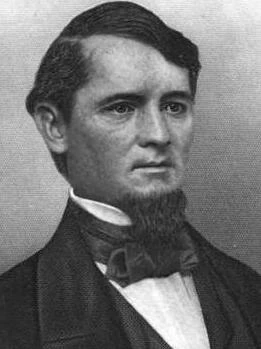
William Hawkins Polk
| Name | William Hawkins Polk |
| Title | American politician (1815-1862) |
| Gender | Male |
| Birthday | 1815-05-24 |
| nationality | United States of America |
| Source | https://www.wikidata.org/wiki/Q2579151 |
| pptrace | View Family Tree |
| LastUpdate | 2025-11-17T06:39:13.923Z |
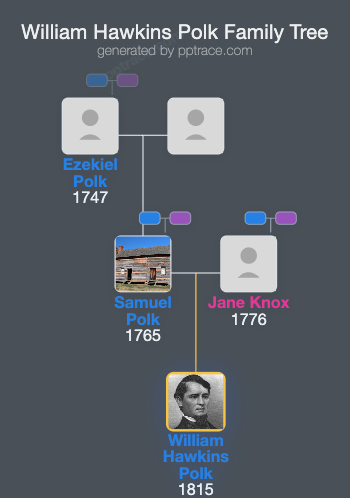
Family Tree
Tap  to expand more relatives
Introduction
William Hawkins Polk was born on May 24, 1815, in Maury County, Tennessee. He was the ninth of ten children of Samuel Polk and Jane (Knox) Polk. Polk attended public schools in Columbia, Tennessee, and studied at the University of North Carolina in 1832 and 1833 before graduating from the University of Tennessee at Knoxville. He studied law, was admitted to the bar in 1839, and began practicing law in Columbia.
Polk’s early life was marked by behavior described as reckless and spendthrift, which drew concern from his family. In 1838, he was involved in a violent incident resulting in the death of Robert Hayes, a Nashville lawyer, following an altercation at the Nelson House in Columbia. Polk was tried for murder but was convicted of lesser charges of assault, receiving a sentence of six weeks in jail and a $750 fine. His defense was led by Gideon Pillow, a lawyer who had previously partnered with his brother, James K. Polk.
In 1841, William H. Polk was elected to Maury County’s seat in the Tennessee House of Representatives. He was reelected in 1843. During this period, he was considered for the position of Speaker of the House but was narrowly defeated. His brother James K. Polk, who had been elected president of the United States in 1844, appointed William H. Polk as chargé d'affaires to the Kingdom of the Two Sicilies on March 13, 1845. Polk arrived in Naples in July 1845 and negotiated a commercial treaty aimed at establishing equal trade terms for the United States with European nations. The treaty was ratified in April 1846 and remained in force until 1855.
During his diplomatic service, Polk reported on conditions in the Kingdom of the Two Sicilies, noting economic hardships, social unrest, and anti-Bourbon sentiment. He advised that the United States could improve its image by providing food shipments to Western Europe. Polk resigned his diplomatic post in May 1847, after requesting a leave of absence to join the Mexican-American War.
In August 1847, Polk joined the U.S. Army as a major in the Third Regiment of U.S. Dragoons, serving under Colonel Edward G.W. Butler. He participated in campaigns against Mexican forces and guerrillas, including engagements at Zacualtipan and the escort of a delegation to Querétaro to exchange ratifications of the Treaty of Guadalupe Hidalgo in 1848, which brought the war to a close.
Polk was active in political communities, serving as a delegate to the 1850 Nashville Convention, where Southern representatives discussed expansion of slavery into new territories. As a moderate Democrat, he supported the Compromise of 1850. In 1851, Polk was elected to the United States House of Representatives for Tennessee's 6th district, winning as an Independent Democrat after failing to secure the Democratic nomination. During his term, he opposed modifications to the Fugitive Slave Act and was critical of General Winfield Scott. He declined to seek reelection in 1853 due to redistricting.
Following his congressional service, Polk remained politically active, participating in strategic discussions on slavery and sectional tensions. He was a delegate in the 1856 presidential election, supporting James Buchanan. In 1857, he was elected again to the Tennessee House of Representatives.
During the late 1850s and early 1860s, Polk opposed secession, delivering numerous speeches advocating for the Union. He supported Stephen Douglas in the 1860 presidential election and remained committed to Unionism after the attack on Fort Sumter in April 1861. Despite initial Unionist sentiments, he expressed support for Tennessee's self-defense if federal troops invaded during the Civil War. In May 1861, Polk chaired the state convention of the Union Party in Tennessee. He remained politically active until his death on December 16, 1862.