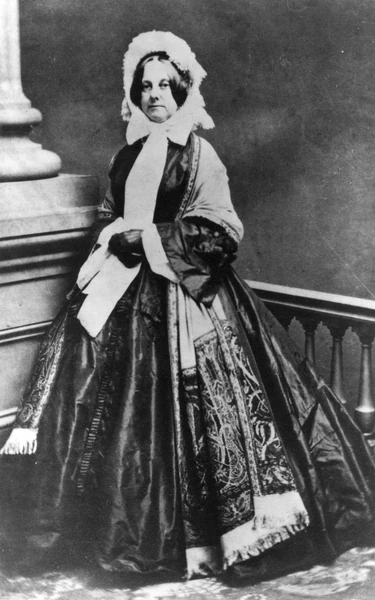
Abigail Fillmore
| Name | Abigail Fillmore |
| Title | First Lady of the United States from 1850 to 1853 |
| Gender | Female |
| Birthday | 1798-03-13 |
| nationality | United States of America |
| Source | https://www.wikidata.org/wiki/Q234266 |
| pptrace | View Family Tree |
| LastUpdate | 2025-11-17T06:39:39.001Z |
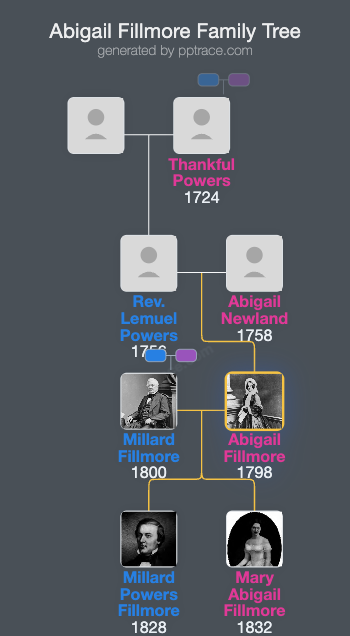
Family Tree
Tap  to expand more relatives
Introduction
Abigail Fillmore (née Powers) was born on March 13, 1798, in Stillwater, Saratoga County, New York. She was the youngest of seven children born to Reverend Lemuel Powers and Abigail Newland. Her father was the leader of the First Baptist Church until his death when Abigail was two years old. Following her father's death, the family relocated to Sempronius, New York, where they lived with her older brother Cyrus Powers due to financial difficulties. Her family possessed a large personal library, which she read extensively, and her mother, a schoolteacher, taught her literacy and other subjects.
At age 16, Abigail Powers began her career as a schoolteacher. She initially worked part-time at the Sempronius Village school in 1814, becoming a full-time teacher in 1817. In 1819, she taught at the private New Hope Academy and independently pursued further studies, including learning French and playing the piano. Her education was supplemented by her work, and she became proficient in multiple academic fields. During this period, she also became familiar with abolitionist ideas through her family's associations.
While teaching at New Hope Academy, Powers took Millard Fillmore as a student. They were engaged in 1819 but did not marry immediately, partly due to financial constraints and familial discouragement. In 1824, she served as a private tutor in Lisle for her cousins and later founded a private school in Broome County. She returned to Sempronius in 1825 to teach and to establish a library. Powers and Fillmore married on February 5, 1826, at her brother's house in Moravia, New York. After marriage, they moved to East Aurora, New York.
The couple had two children: Millard Powers Fillmore, born in 1828, and Mary Abigail "Abbie" Fillmore, born in 1832. In 1830, the Fillmores relocated to Buffalo, New York, where Millard helped establish the city and served in the New York State Assembly. Abigail managed household and familial responsibilities, often traveling with her husband when he was in Albany and Washington, D.C., for political duties. While in Buffalo, she contributed to community development, including helping to establish Buffalo’s first public library and compiling her own personal collection of approximately 4,000 books. She also named the town of Newstead, New York, in 1831.
In 1832, Millard Fillmore was elected to the U.S. House of Representatives, prompting Abigail to initially remain in Buffalo. She later accompanied him to Washington, D.C., in 1836, where she engaged in social activities and observed political proceedings, such as attending Henry Clay’s Senate debate in 1837. She also met notable figures like Charles Dickens during her time in Washington. Following her husband's election as New York State Comptroller, the family moved to Albany, where she participated in social life but expressed disdain for excessive displays of wealth.
In 1842, she sustained a serious ankle injury on Independence Day, which resulted in chronic pain and limited her mobility. The injury required the use of crutches for two years and caused lasting health issues.
In 1848, Abigail gained public recognition when her husband was nominated as the Whig candidate for vice president. The Whig ticket was successful, and she became the Second Lady of the United States on March 4, 1849. Her health concerns kept her in Buffalo rather than Washington. When President Zachary Taylor died on July 9, 1850, Millard Fillmore assumed the presidency, and Abigail became First Lady. She arrived at the White House in October 1850 and managed her new responsibilities, although her health limited her participation. Her tenure as First Lady ended in March 1853 following her death from pneumonia less than a week after her husband's presidency concluded.
Abigail Fillmore died on March 30, 1853, and was buried in East Aurora, New York. Her contributions include establishing the White House Library, which became a notable feature of the presidential residence, and participating in the social and political life of her time. Despite her role in American history, she remains one of the less examined First Ladies, with limited surviving correspondence.