Millard Fillmore
| Name | Millard Fillmore |
| Title | president of the United States from 1850 to 1853 |
| Gender | Male |
| Birthday | 1800-01-07 |
| nationality | United States of America |
| Source | https://www.wikidata.org/wiki/Q12306 |
| pptrace | View Family Tree |
| LastUpdate | 2025-11-17T06:39:34.817Z |
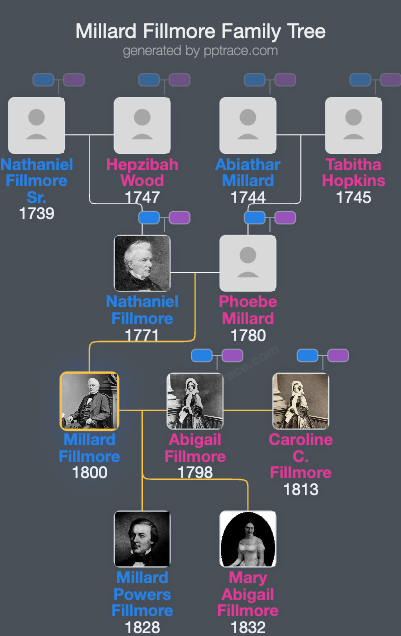
Family Tree
Tap  to expand more relatives
Introduction
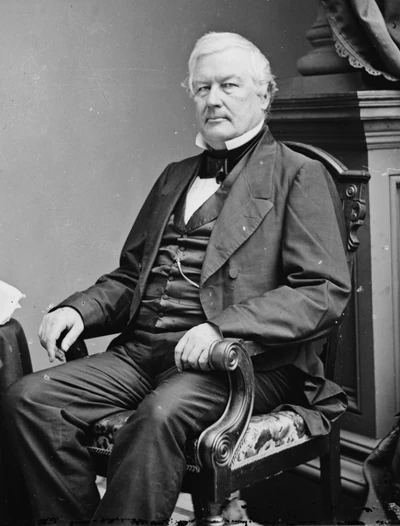
Millard Fillmore (January 7, 1800 – March 8, 1874) was an American politician who served as the 13th president of the United States from 1850 to 1853. He was the last President affiliated with the Whig Party during his tenure and the final U.S. president who was neither a Democrat nor a Republican.
Born in a log cabin in the area now known as Moravia, within the Finger Lakes region of New York, Fillmore was the second of eight children born to Phoebe Millard and Nathaniel Fillmore. His family traced European ancestry to early settlers in Massachusetts and Connecticut. During his childhood, the family experienced economic hardship and limited formal education. Nathaniel Fillmore, his father, was engaged in various trades and local offices, including justice of the peace.
In his youth, Fillmore apprenticed in clothmaking and attended a local academy. He developed an early interest in law and reading, later studying law under Judge Walter Wood after moving to Montville, New York. After a brief period working as a clerk, he moved with his family to East Aurora near Buffalo, where his father purchased a farm.
He was admitted to the New York State Bar in 1823 and established a legal practice in East Aurora, becoming the area’s only resident lawyer. Fillmore married Abigail Powers on February 5, 1826, and they had two children: Millard Powers Fillmore and Mary Abigail Fillmore.
Fillmore's political career began with his involvement in the Anti-Masonic Party, which opposed the influence of Freemasonry in politics. He served in the New York State Assembly from 1829 to 1831, representing Erie County. During this period, he promoted legislation such as non-religious court oaths and the abolition of imprisonment for debt. He later moved to Buffalo, where he continued practicing law and became active in local civic affairs.
He was affiliated with the Whig Party as it formed in the mid-1830s, and held the position of Comptroller of New York starting in 1847, after winning an election for the post. In 1848, Fillmore was elected vice president of the United States under Zachary Taylor. He assumed the presidency in July 1850 upon Taylor’s death. As vice president, he largely remained on the sidelines, but as president, he supported Henry Clay's omnibus bill, leading to the passage of the Compromise of 1850.
The Compromise aimed to address the sectional strife over slavery, notably including the Fugitive Slave Act, which Fillmore enforced despite its controversy. His decision to support and enforce this legislation affected his popularity and contributed to divisions within the Whig Party. Fillmore dismissed Taylor’s cabinet upon assuming office and advocated for the compromise measures in Congress.
In foreign policy, Fillmore supported U.S. Navy expeditions to Japan, opposed French ambitions in Hawaii, and was involved in controversies related to filibuster expeditions to Cuba. He sought the Whig nomination for president in 1852 but was unsuccessful. Following the decline of the Whig Party, Fillmore joined the Know Nothings and was a candidate for vice president in 1856, though he did not win.
During the Civil War, Fillmore opposed secession and supported the Union's preservation, criticizing some of President Abraham Lincoln’s policies. After the war, he expressed support for President Andrew Johnson’s Reconstruction efforts.
After his presidency, Fillmore remained engaged in civic activities, serving as chancellor of the University of Buffalo, a position he helped establish in 1846. He died in 1874 in Buffalo, New York.
His historical reputation has generally been unfavorable among scholars, often ranked among the less effective presidents, particularly due to his policies related to slavery and sectional tensions.