Robert Jenkinson
| Name | Robert Jenkinson |
| Title | English Member of Parliament (died 1710) |
| Gender | Male |
| Birthday | 1655-00-00 |
| nationality | Kingdom of England |
| Source | https://www.wikidata.org/wiki/Q26213321 |
| pptrace | View Family Tree |
| LastUpdate | 2025-11-26T12:33:07.450Z |
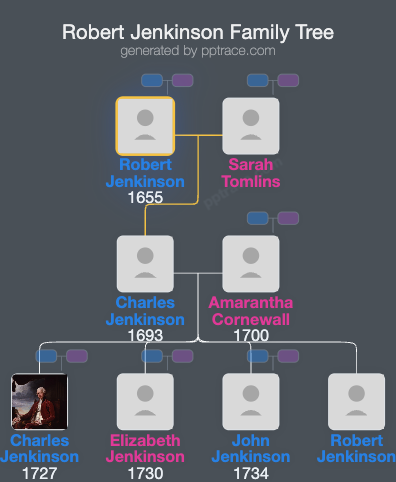
Family Tree
Tap  to expand more relatives
Introduction
Sir Robert Jenkinson, 2nd Baronet (circa 1655 – 1710), was associated with Walcot, Charlbury, Oxfordshire, and Hawkesbury, Gloucestershire. He was a landowner and a politician affiliated with the Tory party who served in the English and later the British House of Commons from 1689 until his death in 1710.
**Early Life and Education**
Born circa 1655, Robert Jenkinson was the eldest son of Sir Robert Jenkinson, 1st Baronet of Walcot, and his wife Mary Bankes. Mary was the daughter of Sir John Bankes of Corfe Castle, Dorset. He matriculated at Brasenose College, Oxford, on 11 November 1671 at the age of 17. The following year, in 1672, he was admitted to the Inner Temple, a professional association for barristers in England. In 1677, upon the death of his father, Jenkinson succeeded to the baronetcy.
**Early Public Service**
Between 1679 and 1680, Jenkinson served as Commissioner for assessment for Oxfordshire. In 1680, he became a freeman of Woodstock and held the office of Justice of the Peace (JP) for Oxfordshire until March 1688. Additionally, he was deputy lieutenant for Oxfordshire from 1681 until February 1688. On 14 February 1684, he married Sarah Tomlins, the daughter of Thomas Tomlins, a London-based grocer. That same year, he gained the status of freeman of Oxford, and in October 1688, he was restored to his role as Justice of the Peace for Oxfordshire.
**Political Career**
Jenkinson was first elected as Member of Parliament (MP) for Oxfordshire in the 1689 English general election. His election marked the start of a parliamentary career that would span over two decades. He was re-elected in 1690 in a contested election and again in 1695 unopposed. However, in 1696, after refusing to sign the Association—a pledge of loyalty following the Glorious Revolution—he lost his positions as deputy lieutenant and Justice of the Peace. During this period, he opposed certain policies, such as the fixing of the guinea’s price at 22 shillings in March 1696 and the attainder of Sir John Fenwick in November 1696.
In subsequent elections, Jenkinson publicly demonstrated his political stance. He was elected again for Oxfordshire in 1698 after a fierce contest and was restored as JP in 1700, a position he held for the remainder of his life. He was re-elected unopposed in the 1701 elections and supported the impeachment proceedings against certain Whig ministers in February 1702. In 1702, he was appointed deputy lieutenant for Oxfordshire, a position he retained the rest of his life.
Throughout the early 1700s, Jenkinson continued to serve as MP, consistently returning unopposed. Notably, he supported the Tack in 1704, an unsuccessful attempt by Tories to attach amendments to an electoral bill. He opposed the Court candidate for Speaker in October 1705 and was re-elected as a Tory in the 1708 British general election.
**Death and Family**
Jenkinson's wife, Sarah, died on 8 August 1709. Sir Robert Jenkinson died on 30 January 1710 and was buried at Charlbury. He was survived by nine sons and five daughters. His eldest son, Robert, succeeded him as the 3rd Baronet.