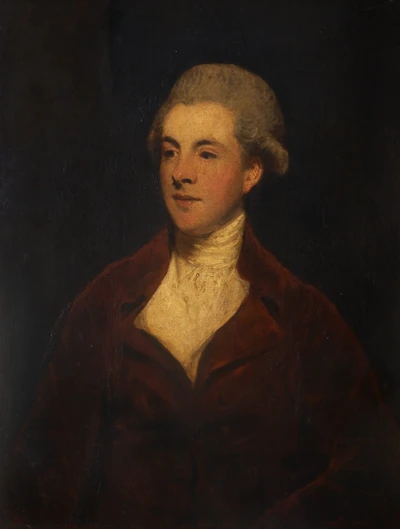
Edward James Eliot
| Name | Edward James Eliot |
| Title | British politician; (1758-1797) |
| Gender | Male |
| Birthday | 1758-08-24 |
| nationality | — |
| Source | https://www.wikidata.org/wiki/Q5343726 |
| pptrace | View Family Tree |
| LastUpdate | 2025-11-26T23:24:09.548Z |
Family Tree
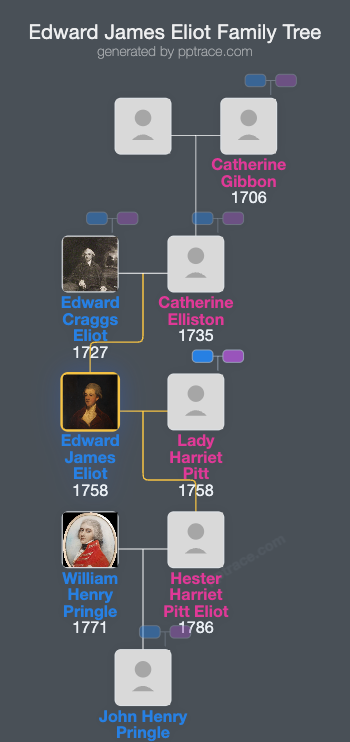
Tap  to expand more relatives
Introduction
Edward James Eliot was born on 24 August 1758 in Cornwall. His mother was Catherine Elliston (circa 1735–1804), the daughter and heir of Edward Elliston of Gestingthorpe, Essex, who served as a captain in the East India Company. His father was Edward Craggs-Eliot (1727–1804), a politician who was created Baron Eliot in 1784.
Eliot attended Pembroke College, Cambridge, beginning his studies in 1775. During his time at Cambridge, he developed a friendship with William Pitt the Younger, who would later serve as Prime Minister. Eliot graduated with a Master of Arts degree in 1780.
He was elected as a Member of Parliament for St Germans in Cornwall in 1780 and later for Liskeard in 1784. In 1782, Eliot became a Treasury minister and continued his political career as part of William Pitt the Younger's government from 1783. In 1785, he was appointed King's Remembrancer in the Exchequer of Pleas.
On 24 September 1785, Eliot married Harriot Pitt, the younger daughter of William Pitt the Elder, and sister to William Pitt the Younger. Their only child, a daughter named Harriot Hester, was born shortly after their marriage. Harriot Pitt died five days after giving birth due to complications from childbirth. Eliot was deeply affected by his wife's death and reportedly did not recover from his grief.
Following her death, Eliot moved to Broomfield, near Clapham, where he associated with the Clapham Sect, a group of evangelical reformers. He had been friends with William Wilberforce, with whom he had traveled to France with Pitt. Living close to Wilberforce and other leaders of the group, Eliot became actively involved in their reform efforts, which included the abolition of the slave trade, prison reform, and poor relief initiatives. He supported campaigns such as the Proclamation Society and Bishop Porteus' Sunday Observance bill. Eliot also acted as a mediator between Wilberforce and Pitt during their legislative efforts.
In 1792, Eliot played a notable role in the passage of the Slave Trade Bill, which, despite initial progress, faced amendments and modifications that delayed its passage in the House of Lords for several years. In 1793, Eliot resigned from his Treasury position due to health issues and was appointed joint commissioner for Indian affairs. He invested in stock of the British East India Company and was considered a candidate for the governorship-general of Bengal; however, his chronic stomach disorder prevented him from accepting the appointment.
Eliot died at Port Eliot, Cornwall, on 17 September 1797. His burial took place at St Germans on 26 September 1797; however, a church record indicates a later burial date of 3 October 1797 due to administrative delays. His death was noted in contemporary newspapers, and both William Pitt the Younger and William Wilberforce mourned his passing. His brother, John Eliot, succeeded to the barony and was later created Earl of St Germans in 1815.