John Tyler
| Name | John Tyler |
| Title | United States federal judge (1747-1813) |
| Gender | Male |
| Birthday | 1747-02-28 |
| nationality | United States of America |
| Source | https://www.wikidata.org/wiki/Q721855 |
| pptrace | View Family Tree |
| LastUpdate | 2025-11-17T06:38:59.797Z |
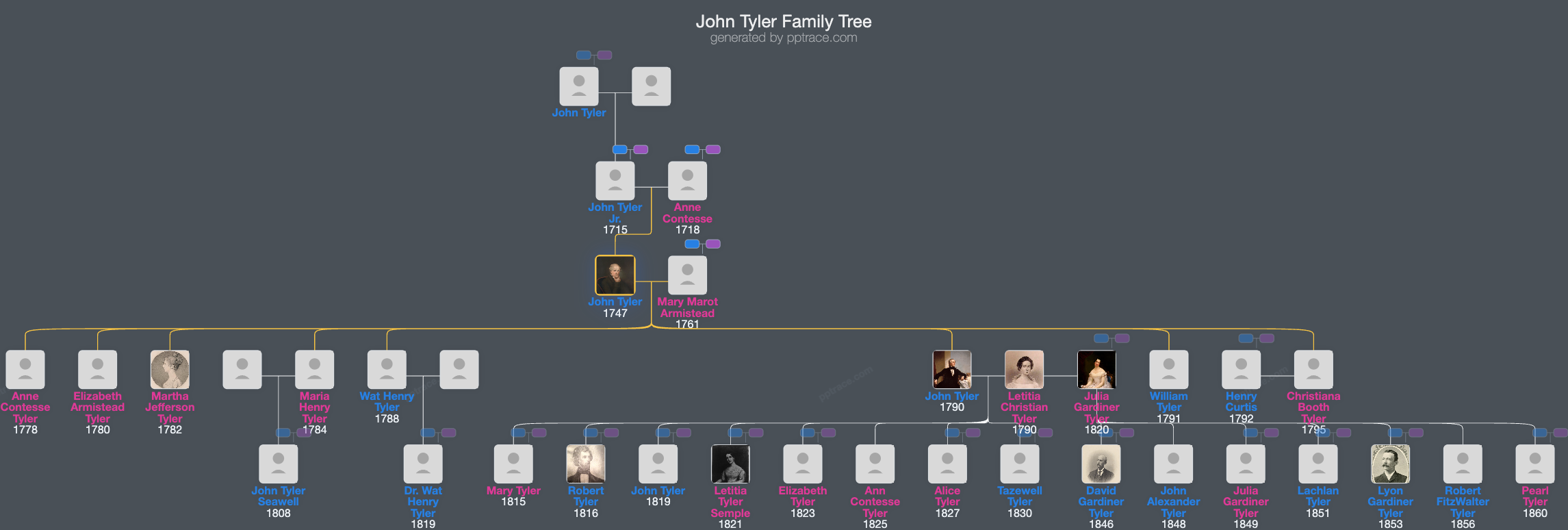
Family Tree
Tap  to expand more relatives
Introduction
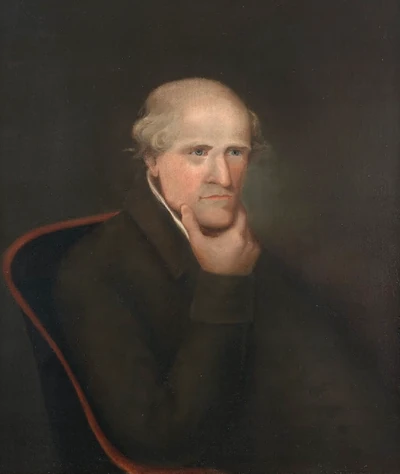
John Tyler Sr. was born on February 28, 1747, in James City County, Virginia, within the British American colonies. He was the son of Anne Contesse and John Tyler, the marshal of the colony's vice-admiralty court. His maternal grandfather was Dr. Louis Contesse, a Huguenot physician.
He received early education at the grammar school associated with the College of William & Mary in Williamsburg, Virginia, beginning in 1754. He continued his studies at the college itself. At the age of nineteen, Tyler was present in the lobby of the Virginia House of Burgesses when Patrick Henry delivered his speech on the Stamp Act of 1765, an event that influenced Tyler's views on British governance. Subsequently, Tyler studied law under Robert Carter Nicholas, a prominent attorney.
Tyler was admitted to the Virginia bar and practiced law privately. Around 1770, he moved to Charles City County, Virginia, where he operated plantations that utilized enslaved labor. Details from the 1787 Virginia tax census indicate that Tyler owned 20 enslaved adults, 14 enslaved children, as well as 12 horses and 75 cattle. Additionally, he was taxed on carriages with six wheels.
During the period leading to the American Revolution, Tyler became involved in local political activities. He was a member of the Charles City County Committee of Safety and participated in raising a company of troops in 1775. Tyler collaborated with Patrick Henry to demand the return or compensation for gunpowder removed by Governor Lord Dunmore from Williamsburg's government magazine. In 1776, Tyler served a one-year appointment as a commissioner in admiralty.
His political career in Virginia commenced in 1778 when he was elected as a delegate representing Charles City County to the Virginia House of Delegates. He was re-elected annually until 1788. In 1781, Tyler was elected as Speaker of the House of Delegates, succeeding Benjamin Harrison, and served in that capacity until 1785. Besides legislative duties, Tyler served as a judge of the Virginia High Court of Admiralty from 1776 to 1788 and was a member of the Virginia Council of State from 1780 to 1781. In 1788, he was elected as a judge of the General Court of Virginia.
Tyler participated in the Virginia Ratifying Convention of 1788, representing Charles City County. He was elected as the convention's vice-president. During the debates over the ratification of the United States Constitution, Tyler aligned with Anti-Federalist positions, voting against ratification. He expressed concerns about the potential loss of liberty, citing the disagreements among Federalists regarding constitutional clauses.
In 1808, Tyler was elected as the 15th Governor of Virginia, serving until 1811. His tenure lasted from 1808 to 1811, during which he held executive authority in the state.
On January 2, 1811, President James Madison appointed Tyler to serve as a judge on the United States District Court for the District of Virginia, filling the vacancy left by Judge Cyrus Griffin. The United States Senate confirmed the appointment on January 3, 1811, and Tyler received his commission on January 7, 1811. He served as a federal judge in Richmond, sometimes hearing cases alongside Chief Justice John Marshall.
John Tyler Sr. died on January 6, 1813, at Greenway Plantation in Charles City County, Virginia. His official papers from his tenure as governor are preserved by the Library of Virginia. In recognition of his prominence, Tyler County in West Virginia was named in his honor.
He married Mary Marot Armistead in 1776. Mary was the only child of Robert Booth Armistead and Ann (Shields) Armistead of Kings Creek Plantation in York County, Virginia. Her ancestors included Robert Booth, who served as a burgess representing York County in 1653 and between 1654 and 1655. Together, John Tyler Sr. and Mary Armistead had eight children, among whom was John Tyler, who later became the 10th President of the United States.