Victoria, Lady Welby
| Name | Victoria, Lady Welby |
| Title | British philosophical writer |
| Gender | Female |
| Birthday | 1837-04-27 |
| nationality | United Kingdom of Great Britain and Ireland |
| Source | https://www.wikidata.org/wiki/Q468736 |
| pptrace | View Family Tree |
| LastUpdate | 2025-11-26T23:33:45.684Z |
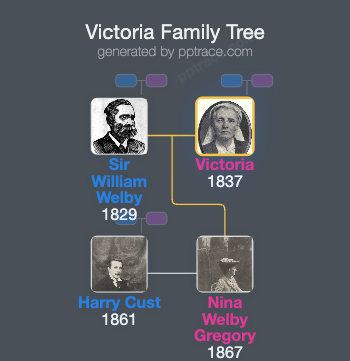
Family Tree
Tap  to expand more relatives
Introduction
Victoria, Lady Welby (27 April 1837 – 29 March 1912), also known as Lady Welby-Gregory, was a British philosopher of language, musician, and watercolourist. She was born in 1837 to the Honorable Charles Stuart-Wortley-Mackenzie and Lady Emmeline Stuart-Wortley. Her full name at birth was Victoria Alexandrina Maria Louisa Stuart-Wortley.
Following the death of her father in 1844, Welby traveled extensively with her mother, documenting these experiences in her diary. In 1855, after her mother's death in Syria, she returned to England to reside with her grandfather, John Manners, the 5th Duke of Rutland, at Belvoir Castle. In 1858, she moved to Frogmore to live with the Duchess of Kent, Princess Victoria of Saxe-Coburg-Saalfeld, who was Queen Victoria's mother. Upon the death of the duchess, Welby was appointed a maid of honour to her godmother, Queen Victoria.
In 1863, she married Sir William Earle Welby-Gregory, 4th baronet (1829–1898), who was involved in British politics. The couple lived at Denton Manor in Lincolnshire and had three children, including a daughter, Nina, who married Harry Cust, a publisher and known figure of the Edwardian era.
Welby began a self-educational journey after her children had left home. Although she had limited formal schooling, she engaged in extensive reading, correspondence, and dialogue with prominent intellectuals of her time. Her early publications focused on Christian theology and interpretation of Christian scriptures. Her first work, *Links and Clues*, was published in 1881 under the pen name "Vita" and later as "Hon. Lady Welby-Gregory." Despite initial limited readership, this prompted her interest in language, rhetoric, persuasion, and philosophy.
By the late 19th century, Welby contributed articles to leading academic journals such as *Mind* and *The Monist*. Her seminal philosophical work, *What Is Meaning? Studies in the Development of Significance*, was published in 1903. She followed with *Significs and Language: The Articulate Form of Our Expressive and Interpretive Resources* in 1911. The term "significs" denoted her theory of meaning, emphasizing language's expressive and interpretative aspects, distinct from semiotics or semantics.
Welby characterized three primary kinds of sense: sense, meaning, and significance, each corresponding to levels of consciousness which she termed "planetary," "solar," and "cosmic," a framework she associated with a form of Darwinian evolution. Her ideas contributed to the development of theories related to semantics, semiotics, and semiology and influenced the Significs movement, especially among Dutch thinkers like Gerrit Mannoury and Frederik van Eeden, and indirectly impacted L. E. J. Brouwer.
Her correspondence with Charles Sanders Peirce, initiated after he reviewed her work positively in *The Nation* in 1903, spanned eight years and was published as *Semiotic and Significs: Correspondence between Charles S. Peirce and Victoria Lady Welby* in 1977. While Welby found Peirce's semiotic theories challenging to follow, her engagement facilitated the introduction of Peirce’s ideas to British thinkers. She also corresponded with William James, F. C. S. Schiller, Mary Everest Boole, Giovanni Vailati, Mario Calderoni, F. H. Bradley, Bertrand Russell, J. Cook Wilson, and Henri Bergson.
Her extracurricular pursuits included founding the Sociological Society of Great Britain and the Decorative Needlework Society, as well as writing poetry and plays. Her interest in language and signification extended beyond academia, emphasizing the everyday use of language and its relation to social and ethical factors.
Following her death in 1912, her collection of books was donated to the University of London Library. In March 2023, she was commemorated by the South Kesteven District Council as one of notable women associated with Grantham.