Joseph Jones
| Name | Joseph Jones |
| Title | American politician (1727-1805) |
| Gender | Male |
| Birthday | 1727-01-01 |
| nationality | United States of America |
| Source | https://www.wikidata.org/wiki/Q1707352 |
| pptrace | View Family Tree |
| LastUpdate | 2025-11-16T10:04:28.564Z |
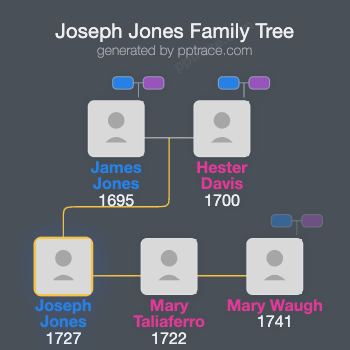
Family Tree
Tap  to expand more relatives
Introduction
Joseph Jones (1727 – October 28, 1805) was an American lawyer and political figure from King George County, Virginia. He was associated with the Anti-Federalist movement during the period of the United States Constitution's ratification.
Born in 1727 in King George County, Virginia, Jones was a member of the Northern Neck region. His parents were James Jones and Hester Lampton Jones (Davis). His father operated a country store and tavern and later became a merchant with connections to England. Jones received his early education in Virginia before traveling to England to continue his studies. In 1749, he attended the Inner Temple in London, and in 1751, he was associated with the Middle Temple, qualifying as a barrister.
Upon returning to Virginia, Jones established a legal practice in Fredericksburg. In 1754, he was appointed King's attorney for Fredericksburg. In 1758, he married Mary Taliaferro, the daughter of Colonel John Taliaferro of Spotsylvania County.
Jones became involved in colonial politics when he joined the Virginia House of Burgesses in 1772, representing his locality. He was recognized as a cautious patriot, participating in the committee of safety from 1774 to 1775 and supporting the Revolution during Virginia's second state committee of safety in 1776. In the same year, Jones was elected to the Fifth Virginia Convention, which produced the Virginia Declaration of Rights.
During the American Revolutionary War, Jones served as a delegate to the Second Continental Congress in 1777 and 1778. He was appointed as a judge of the Virginia General Court on January 23, 1778, a position he held until his resignation in October 1779. Subsequently, he returned to serve again in the Continental Congress from 1780 to 1783. Jones maintained a close friendship with Thomas Jefferson.
In 1787, Jones served in the Virginia House of Delegates. During this period, he experienced a political rift with James Madison over the U.S. Constitution. In a letter dated October 29, 1787, Jones expressed his objections to the Constitution and advocated for a declaration of rights to be attached to it. He participated as a delegate at the 1788 Virginia Ratifying Convention. Although initially supportive, Jones later opposed ratification, joining figures like Patrick Henry and George Mason who proposed amendments to safeguard individual rights. His opposition was motivated by his view that Madison had betrayed Virginians' rights. Despite his opposition, Virginia ratified the Constitution.
Jones was appointed again as a judge of the Virginia General Court on November 19, 1789. He also served as a major general in the Virginia militia. During the presidency of George Washington, Jones aligned with the Jeffersonian faction, which later became the Democratic-Republican Party.
He died at his home in Fredericksburg on October 28, 1805. Joseph Jones was the uncle of James Monroe, the fifth President of the United States. His letters and writings, which offer insights into his political views, were published posthumously in 1889.