James Harlan
| Name | James Harlan |
| Title | American politician (1820-1899) |
| Gender | Male |
| Birthday | 1820-08-26 |
| nationality | United States of America |
| Source | https://www.wikidata.org/wiki/Q376747 |
| pptrace | View Family Tree |
| LastUpdate | 2025-11-17T06:40:12.757Z |
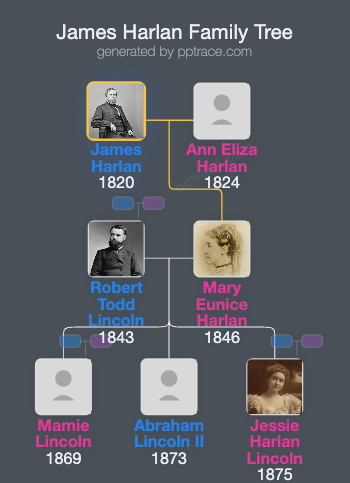
Family Tree
Tap  to expand more relatives
Introduction
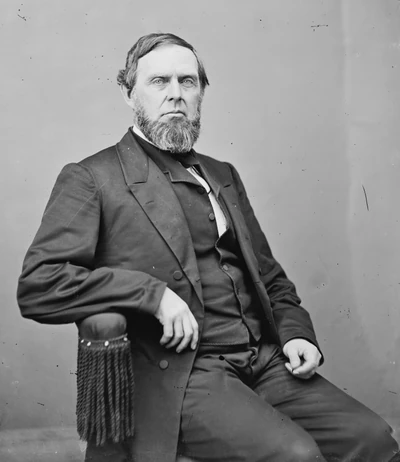
James Harlan (August 26, 1820 – October 5, 1899) was an American attorney, politician, and judge. He served as a United States Senator from Iowa, held the position of Secretary of the Interior under President Andrew Johnson, and was a Federal Judge.
Harlan was born in Clark County, Illinois, on August 26, 1820, and was raised in Indiana. His parents were Silas Harlan (1792–1868) and Mary (née Connolly) Harlan (1796–1896). He attended local schools and graduated from Indiana Asbury University (now DePauw University) in 1845.
In 1845, Harlan moved to Iowa City, Iowa, where he served as Superintendent of Schools. During this period, he studied law and was admitted to the bar in 1850. That same year, he became active in politics as a member of the Whig Party and declined the party’s nomination for Governor of Iowa. Between 1853 and 1855, he served as president of Iowa Wesleyan College in Mount Pleasant, Iowa.
Harlan was elected to the U.S. Senate in 1855 by the Iowa legislature as a candidate of the Free Soil Party. In 1857, the Senate declared his seat vacant due to irregularities in the legislative election, but he was subsequently re-elected by the legislature and seated as a Republican. He served in the Senate until 1865. In 1861, Harlan participated as a delegate in the Peace Conference aimed at preventing the American Civil War.
Following President Abraham Lincoln’s assassination, Harlan resigned from the Senate in 1865 after being appointed Secretary of the Interior under President Andrew Johnson, a position he held until 1866. During his tenure as Secretary, he initiated a departmental reform, dismissing staff members deemed disloyal, inefficient, or lacking proper conduct. Notably, he dismissed Walt Whitman from his role as a clerk upon discovering Whitman's poetry manuscript, "Leaves of Grass," which Harlan found morally offensive. Harlan publicly justified Whitman’s dismissal years later, claiming the services were unneeded.
Harlan also participated in the Southern Treaty Commission, which negotiated treaties with Indian tribes, such as the Cherokee and Choctaw. These treaties included provisions for the emancipation and citizenship of enslaved people within the tribes. He resigned from this role in 1866 due to disagreements with President Johnson’s policies.
He was elected again to the Senate in 1867, serving until January 1873. During this second tenure, he chaired several committees, including those on Public Lands, the District of Columbia, Education, and Indian Affairs. Harlan unsuccessfully ran for re-election in 1872 and for governor in 1895.
After leaving the Senate, Harlan repurposed his former residence into the Harlan House Hotel. From 1882 to 1886, he served as presiding judge for the Court of Commissioners handling Alabama claims cases, appointed by President Chester A. Arthur.
Harlan married Ann Eliza Peck on November 5, 1845. She was the daughter of James Peck and Eunice Knight Peck, both of whom died during the cholera epidemic of 1832. Their children included Mary Eunice Harlan, who married Robert Todd Lincoln, son of President Abraham Lincoln; William Aaron Harlan; and other children who died young.
Harlan died on October 5, 1899, at his hotel residence in Mount Pleasant. His residence, known today as the Harlan-Lincoln House, is listed on the National Register of Historic Places and serves as a museum. The Harlan House Hotel is also on the Register.
A statue of James Harlan was previously displayed in the Hall of Columns at the United States Capitol but was replaced in 2014 by a statue of Norman Borlaug, with Harlan’s statue currently displayed at Iowa Wesleyan College. The city of Harlan, Iowa, is named in his honor.