Takayoshi Kuki
| Name | Takayoshi Kuki |
| Title | Japanese politician |
| Gender | Male |
| Birthday | 1837-05-09 |
| nationality | Japan |
| Source | https://www.wikidata.org/wiki/Q11370516 |
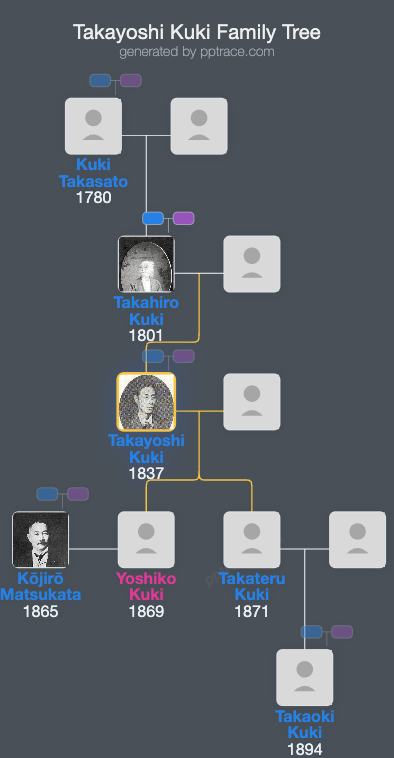
| pptrace | View Family Tree |
| LastUpdate | 2025-11-17T10:07:40.914Z |
Family Tree
Tap  to expand more relatives
Introduction
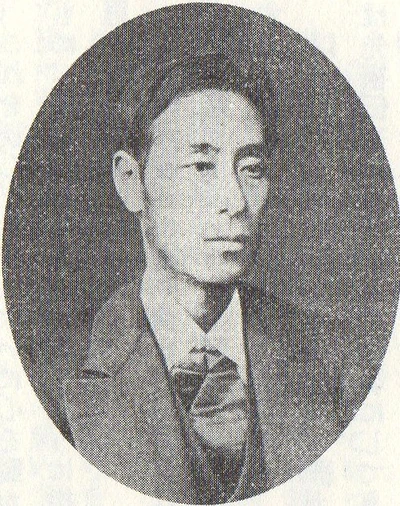
Takayoshi Kukki (1834 [the exact birth year is uncertain] – January 24, 1891) was the 13th (and last) daimyo of Mita Domain in Mutsu Province, Japan. He was the 25th head of the Kukki family, held the court position of Jūi-noGejo Nagato-noKami (lower official rank of Junior Fifth Rank, Lower Grade, of Nagato Province), and was awarded the kazoku title of Viscount. He also served as a member of the Imperial Diet and held the position of Gonnojo-yakusho (an official assisting the Imperial Household Agency). After his death, he was posthumously awarded the court rank of Senior Fourth Rank.
**Career and Family Background**
*Birth and Family Background*
Takayoshi Kukki was born as the third son of Taketsugu Kukki, the daimyo of Tamba Ayabe Domain. His childhood name was Keinosuke. His mother was a concubine named Saru. His foster mother was Okan, the seventh daughter of Junmasa Omura. His formal wife was the third daughter of Seiryū Kukki, Okan (Kaneko). His secondary wives included the daughter of Matsui Matsudaira Yaeyaku and the daughter of Sato Kazuaki.
*Assumption of Daimyo*
In the sixth year of Ansei (1859), following the sudden death of Seiryū Kukki and Ayabe Domain's family head, he was adopted as heir from Ayabe Domain and became the daimyo of Mita Domain on December 28th of the same year. After his accession, he implemented administrative reforms, including promoting low-ranking samurai such as Shirasu Taizō and Taitatsu Kotorihiro, and advancing the modernization of military equipment by introducing the Snider rifle and other Western-style military reforms.
**Personal Life and Character**
Records indicate he led a simple lifestyle; the "Han Clansmen's Cooperative Report" (No. 24) mentions he consumed tea and pickled radish (takuan) for breakfast and dinner and describes him as "like a student."
**Boshin War and Political Stance**
During the Boshin War in 1868, he initially sided with the new government immediately after the Battle of Toba–Fushimi. He was originally pro-shogunate but later shifted to supporting the imperial loyalists.
**Post-Meiji Restoration Activities**
After the Meiji Restoration, Takayoshi Kukki grew close to Yukichi Fukuzawa through Kawatamoto Yukimin. He advised on the enrollment of domain samurai into Keio University and provided guidance on the school's administration. On June 23, 1869 (Meiji 2), he was appointed domain governor after the Hanseki Hōkan (return of land and population). However, he was dismissed from his post on July 15, 1871, following the abolition of the han system.
**Development of Kobe City**
In 1872 (Meiji 5), he moved to Kobe. He bought and resold land reclaimed during the rerouting of the Ikuta River, profiting from these transactions. Using these funds, he established the Shima Sanshōkai in 1873, contributing to Kobe's development. His activities included real estate and finance, and he was involved in land improvement around Kobe Port, founding the forerunner of Kobe Jogakuin (Kobe Girls' School) and Kobe Home.
**Official Positions and Nobility Titles**
Starting in 1882 (Meiji 15), he served within the Imperial Household Ministry, specifically in the Kuge Bureau as a Gonnojo-yakusho. On July 8, 1884, he was elevated to the title of shishaku (Viscount). In 1886, he was transferred to Shibyō and Hamayōen. He was baptized as a Christian on April 24, 1887, but later renounced Christianity due to opposition from within Mita and local temples, reverting to Buddhism.
**Political Activity and Death**
On July 10, 1890 (Meiji 23), he was elected as a member of the House of Peers. He died on January 24, 1891 (Meiji 24) at the age of 55. His posthumous Buddhist name was Daiko-in, and he was buried at Mita Shingyakoin.
**Family**
His children include his eldest son, Takateru Kukki, his second son, Takanori Kukki, and his third son, Takayasu Kukki. His daughters include Yoshiko (married to Kōjiro Matsukata), Noriko (married to Toyojirō Terashima), and Mume (married to Seiichi Ueno). The eldest and second sons received baptismal names Maru and Arē, respectively, and both studied in the United States. They also accompanied Yuki Kukki, who served as Japan's envoy to the U.S., to America in 1884.
**Family Ties**
Yoshiko married Kōjiro Matsukata, the third son of the prominent statesman Matsukata Masayoshi.
**External References and Sources**
Further detailed information about Takayoshi Kukki can be found in historical romance travel histories and materials published on EO光 Channel Plus.
This summary highlights his main life events and family relationships.