Wolcott Gibbs
| Name | Wolcott Gibbs |
| Title | American theater critic, humorist and editor (1902-1958) |
| Gender | Male |
| Birthday | 1902-03-15 |
| nationality | United States of America |
| Source | https://www.wikidata.org/wiki/Q8029721 |
| pptrace | View Family Tree |
| LastUpdate | 2025-11-16T10:06:27.632Z |
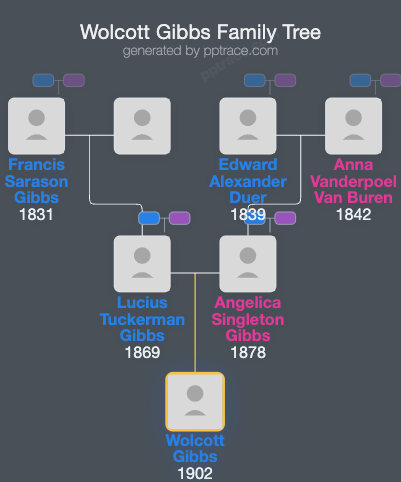
Family Tree
Tap  to expand more relatives
Introduction
Wolcott Gibbs (March 15, 1902 – August 16, 1958) was an American editor, humorist, theatre critic, playwright, and short story writer. He was employed by The New Yorker magazine from 1927 until his death in 1958. Gibbs is recognized for his 1936 parody of Time magazine, which critiqued the magazine's inverted narrative style; in this piece, he wrote, "Backward ran sentences until reeled the mind," concluding with, "Where it all will end, knows God!" Additionally, he authored the comedy "Season in the Sun," which was performed on Broadway for ten months during 1950–1951. This work was based on a series of stories that originally appeared in The New Yorker. Gibbs maintained a professional relationship with John O'Hara, serving as a friend and editor; O'Hara named his fictional town "Gibbsville, Pa." in Gibbs's honor.
**Early Life**
Wolcott Gibbs was born in New York City on March 15, 1902. His parents were Lucius Tuckerman Gibbs (1869–1909), a mechanical and electrical engineer educated at Cornell University, and Angelica Singleton Duer. His father worked for Otis Elevators and American Rheostat, receiving patents for motors, running gears, and heating systems. Gibbs had a sister, Angelica, born in 1908. His father died of lobar pneumonia in 1909. His paternal grandparents were Francis Sarason Gibbs and Eliza Gay (née Hosmer) Gibbs; his maternal grandparents were Edward Alexander Duer and Sarah Anna (née Vanderpoel) Duer. Gibbs was a descendant of those involved in notable American history, including mineralogist George Gibbs, chemist Oliver Wolcott Gibbs (with whom he shared his name but did not use "Oliver"), William Duer, a signer of the Articles of Confederation, President Martin Van Buren, Oliver Wolcott Sr., a signer of the Declaration of Independence and Secretary of the Treasury, as well as members of the Livingston and Schuyler families. Following his father's death and his mother's struggles with alcoholism, Gibbs and his sister were raised by his Uncle John Van Buren and Aunt Aline Duer.
**Education**
Gibbs attended several schools, including Horace Mann School, Riverdale Country Day School, The Hill School in Pottstown, Pennsylvania, and the Roxbury School. However, he was expelled or dismissed from nearly all of them due to rebellious behavior.
**Career**
After failing his school examinations, Gibbs held various unfulfilling jobs, such as timekeeper, chauffeur, draftsman, and coordinating freight for the Long Island Railroad, where his uncle was employed. His cousin, Alice Duer Miller, introduced him to journalism by providing work opportunities at their relative Lloyd Carpenter Griscom’s newspapers. Gibbs served as associate editor of the East Norwich Enterprise and later as reporter and editor for the North Hempstead Record. In 1927, he joined The New Yorker as a copyreader. When E. B. White temporarily left the magazine, Gibbs took over the "Talk of the Town" section. Although not a formal member of the Algonquin Round Table, he was associated with many of its members. In 1938, he succeeded Robert Benchley as the theatre critic at The New Yorker.
There is a common misconception that Gibbs was related to Alexander Woollcott, a prominent figure in the same circle; however, Gibbs was a cousin of Alice Duer Miller and was not related to Woollcott. Gibbs explicitly expressed strong dislike for Woollcott, criticizing his writing and personality. His profile of Woollcott purportedly contributed to Woollcott's estrangement from The New Yorker. Aside from his work at the magazine, Gibbs was the editor and publisher of "The Fire Islander," a weekly newspaper on Fire Island, where he owned a vacation home.
**Personal Life**
Gibbs married three times. His first marriage was to Helen Marguerite Galpin on July 24, 1926. His second marriage was to Elizabeth Ada Crawford in August 1929; she was a writer in The New Yorker’s promotion department. Elizabeth committed suicide by leaping from their apartment window less than a year after their marriage, on March 31, 1930. Subsequently, Gibbs engaged in a nearly three-year relationship with writer Nancy Hale, who was then married to Taylor Scott Hardin; Hale later divorced Hardin and married Charles Wertenbaker, and later Fredson Bowers. In 1933, Gibbs married his third wife, Elinor Mead Sherwin, daughter of architect Harold Sherwin of the Sherwin-Williams paint family. They had two children: Wolcott Gibbs Jr., known as "Tony," born in 1935, who later wrote about yachting and was an editor at The New Yorker in the 1980s; and Janet Gibbs, who married James Ward.
Gibbs was an alcoholic and a heavy smoker. He died of a heart attack while reading proofs of his upcoming book, "More in Sorrow," at his home on Ocean Beach, Fire Island, on August 16, 1958. He was buried at Ferncliff Cemetery in Hartsdale, New York. His widow died from burns suffered in a fire at her New York residence on July 30, 1963.
**Legacy**
In 2011, Bloomsbury USA published "Backward Ran Sentences: The Best of Wolcott Gibbs of The New Yorker," an anthology of his work, featuring a foreword by P.J. O'Rourke.