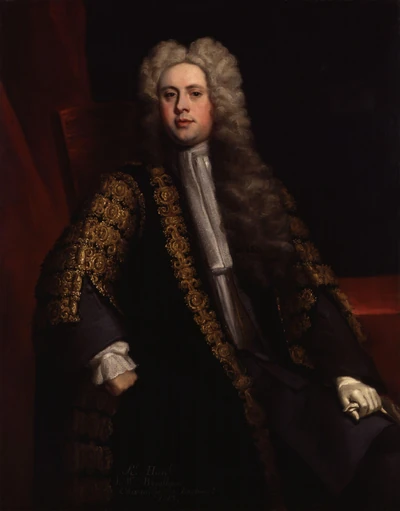
Sir William Wyndham, 3rd Baronet
| Name | Sir William Wyndham, 3rd Baronet |
| Title | politician, died 1740 |
| Gender | Male |
| Birthday | 1688-00-00 |
| nationality | Great Britain |
| Source | https://www.wikidata.org/wiki/Q3569043 |
| pptrace | View Family Tree |
| LastUpdate | 2025-11-26T23:23:29.842Z |
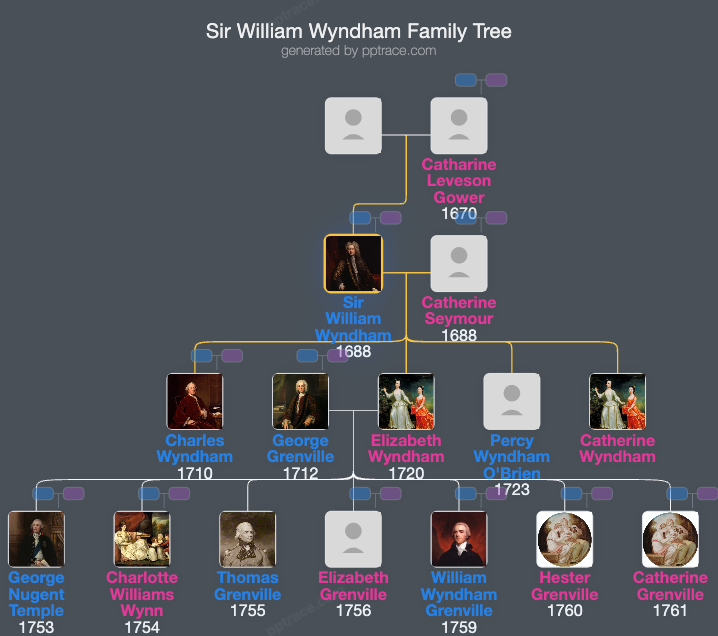
Family Tree
Tap  to expand more relatives
Introduction
Sir William Wyndham, 3rd Baronet (c. 1688 – 17 June 1740), was an English politician associated with the Tory party. He resided at Orchard Wyndham in Somerset and served as a Member of Parliament from 1710 until his death in 1740. Wyndham held the office of Secretary at War in 1712 and became Chancellor of the Exchequer in 1713 during Queen Anne's reign.
He was born around 1688 as the son and heir of Sir Edward Wyndham, 2nd Baronet (circa 1667 – 1695), of Orchard Wyndham. His mother was Katherine Leveson-Gower, the eldest daughter of Sir William Leveson-Gower, 4th Baronet. Wyndham was educated at Eton College and Christ Church, Oxford.
His lineage included familial ties to notable figures; his father, Sir Edward Wyndham, was a three-time Member of Parliament for Ilchester, Somerset. Wyndham’s family estate, Orchard Wyndham, is located in Somerset.
During his youth, Wyndham traveled on a Grand Tour to Rome, where a fortune teller warned him to "beware of a white horse." He interpreted this as a reference to the Saxon Steed in the coat of arms of the Elector of Hanover, the future King George I, a figure he would later oppose politically.
He entered Parliament as the MP for Somerset through a by-election on 26 April 1710 and was subsequently re-elected in the general election of that year. Early in his political career, Wyndham served as Secretary at War in Lord Townshend’s Tory ministry and was appointed Chancellor of the Exchequer in 1713.
Wyndham was closely associated with Lord Bolingbroke, a leading Tory figure and Jacobite sympathizer. Following Queen Anne’s death and the accession of King George I in 1714, Wyndham became a prominent Jacobite supporter, opposing the Hanoverian succession. He was involved in Jacobite plots, notably the 1715 uprising aimed at restoring the Stuarts to the throne.
In July 1715, Wyndham was implicated in a planned invasion to support the Jacobite Pretender. Although he initially attempted to flee, he was ultimately captured at Orchard Wyndham. He escaped punishment momentarily but surrendered to authorities, was imprisoned in the Tower of London, and his estate was confiscated. The king’s government offered a reward for his arrest, and he was publicly sought after as a traitor.
Despite these conflicts, Wyndham participated in public life as a founding governor of the Foundling Hospital, established in 1739 to care for abandoned children. This involvement was likely facilitated by his family’s connections, as his father-in-law, the 6th Duke of Somerset, also became a founding governor.
He married twice. His first wife was Lady Catherine Seymour, daughter of Charles Seymour, 6th Duke of Somerset. With her, Wyndham was the father of heirs including his eldest son who succeeded as the 2nd Earl of Egremont. His children included two sons who became earls, and a daughter, Elizabeth Wyndham, who was connected to the political figures George Grenville and William Wyndham Grenville through marriage and descent.
Wyndham died on 17 June 1740. His architectural contributions include the construction of the pier at Watchet harbour near Orchard Wyndham.