Mohammad Khamenei
| Name | Mohammad Khamenei |
| Title | Iranian cleric |
| Gender | Male |
| Birthday | 1935-12-25 |
| nationality | Iran |
| Source | https://www.wikidata.org/wiki/Q5952192 |
| pptrace | View Family Tree |
| LastUpdate | 2026-05-07T09:15:45.530Z |
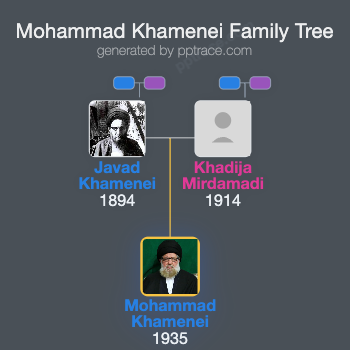
Family Tree
Tap  to expand more relatives
Introduction
Mohammad Khamenei (Persian: محمد خامنهای), born on 25 December 1935 in Mashhad, Iran, is an Iranian cleric and politician. He is the eldest son of Javad Khamenei and Khadijeh Mirdamadi. His family is of religious background, and his early education included studying religious sciences and Arabic under the tutelage of his father. At the age of 12, he began studying Tajweed, Quranic interpretation, and meanings at Nawab School in Mashhad, where he was taught by figures such as Ayatollah Mohammad Hadi al-Milani, Ayatollah Hashem Qazvini, and Ayatollah Mirza Javad Tehrani.
In 1955, Khamenei relocated to Qom to further his Islamic studies. During this period, he studied philosophy with Ayatollah Muhammad Husayn Tabatabai and expanded his knowledge under the guidance of Ayatollah Ruhollah Khomeini and Ayatollah Hossein Borujerdi. He completed his formal education with a degree from Tehran School of Law and Political Science in Criminal Justice in 1964.
Khamenei engaged in political activism beginning in the early 1950s, supporting the nationalization of the Iranian oil industry alongside clergy such as Abol-Ghasem Kashani. He was active in rallies and lectures during his student years at Nawab School. With the rise of Ruhollah Khomeini’s influence, Khamenei supported him and distributed his tapes across Qom, Tehran, and Mashhad.
During the 1970s, Khamenei was involved in clandestine activities opposing the Pahlavi regime. He was part of an 11-member secret group comprising notable figures including Ali Khamenei (his brother), Ali Meshkini, Ahmad Azari Qomi, Akbar Hashemi Rafsanjani, Mohammad-Taqi Mesbah-Yazdi, Hussein-Ali Montazeri, Abdulrahim Shirazi, Mehdi Haeri Tehrani, Ali Qoddusi, and Ebrahim Amini. His role involved drafting the group’s charter; he wrote it in Arabic as a security measure. The group was infiltrated by SAVAK, and some members were arrested.
After the 1979 Iranian Revolution, Khamenei participated in drafting the Constitution of the Islamic Republic of Iran as a member of the Assembly of Experts for the Constitution. He represented Razavi Khorasan during the first term and supported the clause on Velayat Faqih, casting one of 53 votes in favor. He was also involved in drafting the Algiers Accords that aimed to resolve the Iran hostage crisis and served as head of the Judicial Commissions in the Islamic Consultative Assembly during his initial term.
Khamenei opposed then-President Abolhassan Banisadr and during his second term, he was among the lawmakers critical of the Iran–Contra affair, questioning the credibility of Foreign Minister Ali Akbar Velayati. On 10 January 1982, he survived an assassination attempt; gunmen shot him in the back as he was leaving the assembly, resulting in his hospitalization and the deaths of his two bodyguards.
Following his political career, Khamenei dedicated himself to Islamic philosophy and sciences. He resigned from political activities after his second parliamentary term and became a founder of the Sadra Islamic Wisdom Foundation in 2000. He is actively involved in research, teaching at Allameh Tabataba'i University, the School of International Relations, Al-Zahra University, and Islamic Azad University.
He has authored and translated numerous works on Islamic philosophy, theology, and sciences, including titles such as "Secrets of the Earth in the Quran," "Insurance in Islamic Law," and "Mulla Sadra's Transcendent Philosophy." Additionally, Khamenei has conducted research into ancient Iran's history and philosophy, authoring "The Course of Wisdom in Iran and the World."
Currently, Mohammad Khamenei is the president of the Iranology Foundation and the Sadra Islamic Wisdom Foundation. In public statements, he has emphasized the cultural and philosophical contributions of ancient Iran, highlighting figures such as Cyrus the Great and their influence on monotheism and morality.