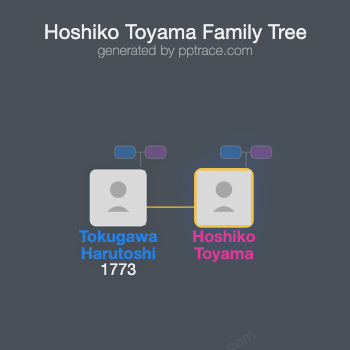
Hoshiko Toyama
| Name | Hoshiko Toyama |
| Title | Tokugawa Haruki's concubine |
| Gender | Female |
| Birthday | — |
| nationality | — |
| Source | https://www.wikidata.org/wiki/Q109236055 |
| pptrace | View Family Tree |
| LastUpdate | 2025-11-19T11:13:50.869Z |
Family Tree
Tap  to expand more relatives
Introduction
Eisō-in (Eisō-in, January 1, Tenmei 2 [February 12, 1782] – April 26, Meiji 8 [1875]) was a woman from the late Edo period to the Meiji era. She was a consort of the 7th feudal lord of Mito Domain, Tokugawa Haruki, and the mother of the 9th feudal lord, Tokugawa Nariaki. Her given name was Ei, and her pseudonym was Masuko. She is also known as Toyama Masuko.
Born in Kyoto, she was the daughter of Chōza Sō, a former monk of the Shōun-in Temple. Chōza Sō was the third son of the Court Official Karasuma Mitsutane. Eisō-in became the adopted daughter of her uncle, the Court Official Toyama Mitsutane.
In 1795 (Kansei 7), at the age of 14 according to the Japanese calendar, she became a consort to Tokugawa Haruki (later the lord of Mito). Haruki had lost his formal wife Kata-hime and daughters the previous year and had no legitimate heirs, so she was chosen as a substitute. After becoming his consort, she gave birth to a daughter and a son in 1796 (Kansei 8), a daughter in 1797 (Kansei 9), and in 1800 (Kansei 12) she bore a son, Keizo, and a daughter.
In 1816 (Bunka 13), following Haruki's death, she entered Buddhist priesthood and took the name Eisō-in. Her eldest son, the 8th feudal lord Haruki's successor, Tokugawa Nariaki's, was his son and heir. However, due to the lack of any children, in 1833 (Tenpō 4), Tokugawa Ieyoshi adopted Nariaki as the 9th lord. Nariaki's wife was Minee no Im Additionally, she was the daughter of the Shōgun Tokugawa Ienari, implying a close alliance, although her role was more maternal.
She moved to Mito in February 1833 (Tenpō 4). Under Nariaki’s educational policy, his children were moved from Edo to Mito and educated in the Green Room of Mito Castle. Eisō-in served as a grandmother figure to Nariaki’s children and gathered with them in the Green Room on the 1st, 15th, and 28th of each month, engaging in formal ceremonies.
There are also records in the "Mukumu-kai Hikki" about Eisō-in’s interactions with Tokugawa Yoshiki (Yoshinobu), especially a story about her reprimanding Yoshiki’s mischief while residing in the Green Room of Mito Castle. Although Yoshiki spoke rudely to her, she responded bravely, which apparently left a positive impression on him for her courageous personality.
After the Meiji Restoration and the abolition of the feudal domain system, she relocated in 1873 (Meiji 6) from Mito to her private residence in Kitayobacho, Tokyo (present-day Sumida Ward, Ishihara). On April 4, 1875 (Meiji 8), when Emperor Meiji visited the Main Residence of the Mito Tokugawa family, Komume Residence, Eisō-in was present. The "Diary of Emperor Meiji" notes that she was especially comforted and counseled as Haruki’s mother. She later fell ill and died at the age of 93.
Her works include the poetry collection "Masuko Ei-sō," which is included in Volume 3 of Matsuzawa Mitsu’s "The Great Collection of Women's Poems" (Nyonin Wakayaka Taikei). The preface was written by Mune-no-miya Kōji, and it contains 426 waka poems.
Her children included her primary wife, Kata-hime (ranked Second Third, Kita-no-miya, 1796–1861), her daughter-in-law from the Mimaya domain, Matsudaira Yoriyoshi (1797–1823), and her son, Tokugawa Nariaki (1800–1860), who became the 9th lord of Mito.