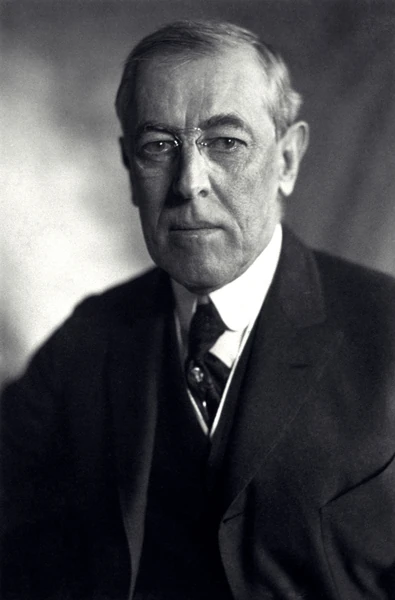
Woodrow Wilson
| Name | Woodrow Wilson |
| Title | president of the United States from 1913 to 1921 |
| Gender | Male |
| Birthday | 1856-12-28 |
| nationality | United States of America |
| Source | https://www.wikidata.org/wiki/Q34296 |
| pptrace | View Family Tree |
| LastUpdate | 2025-11-17T06:42:57.755Z |
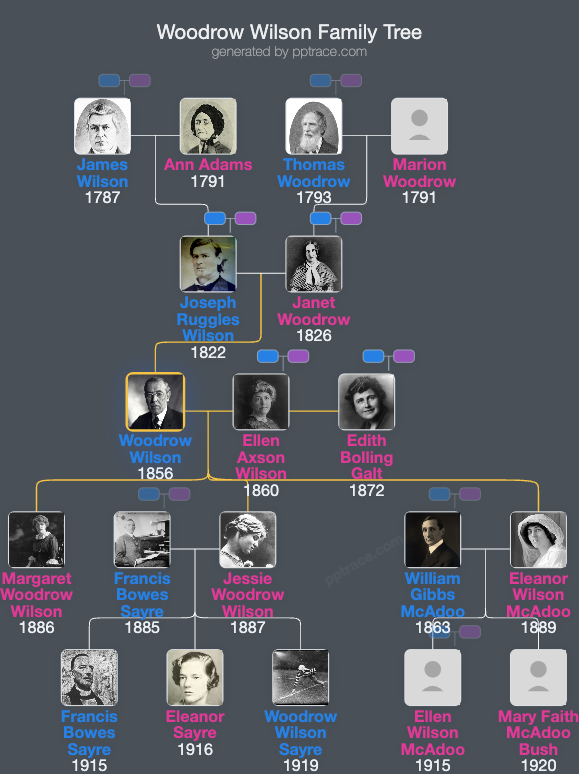
Family Tree
Tap  to expand more relatives
Introduction
Thomas Woodrow Wilson was born on December 28, 1856, in Staunton, Virginia. His paternal grandparents immigrated from Strabane, County Tyrone, Ireland, and settled in Ohio, while his maternal grandfather was originally from Paisley, Scotland, and later moved to Ohio. Wilson's father, Joseph Ruggles Wilson, was a Presbyterian minister and a supporter of the Confederacy during the American Civil War. His mother was Jessie Janet Woodrow. The family moved to Augusta, Georgia, shortly after Wilson's birth, and lived there until 1870. Between 1870 and 1874, Wilson's family resided in Columbia, South Carolina, where his father was a theology professor.
Wilson attended Davidson College in North Carolina during the 1873–74 academic year before transferring to the College of New Jersey (now Princeton University). At Princeton, he studied political philosophy and history, participated in the Phi Kappa Psi fraternity, and was active in debating and literary societies. After graduating in 1879, he enrolled at the University of Virginia School of Law but withdrew due to health issues. He then studied independently and was admitted to the Georgia bar, briefly practicing law in Atlanta.
In late 1883, Wilson began doctoral studies at Johns Hopkins University in Baltimore, completing his Ph.D. in history and government in 1886. His dissertation, "Congressional Government," examined the functioning of the U.S. federal government, and it was published in 1885.
Wilson married Ellen Louise Axson in 1885. She was a trained artist who initially worked in portraiture; she learned German to assist Wilson with translating academic literature. The couple had three children: Margaret (born 1886), Jessie (born 1887), and Eleanor (born 1889). Margaret and Eleanor later married, with Jessie becoming the wife of Francis Bowes Sayre Sr.
Wilson's academic career included teaching positions at Bryn Mawr College from 1885 to 1888 and later serving as the president of Princeton University, where he became a prominent advocate for progressive reforms in higher education. He served as the governor of New Jersey from 1911 to 1913, during which he implemented several progressive policies and challenged party bosses.
In the 1912 presidential election, Wilson was the Democratic candidate, defeating incumbent President William Howard Taft and former President Theodore Roosevelt, leader of the Progressive Party. Wilson's election marked him as the first Southerner to become U.S. president since 1848. His presidency lasted from 1913 to 1921 and was characterized by significant domestic policy changes, including the implementation of the Revenue Act of 1913, which introduced the modern income tax, and the Federal Reserve Act, establishing the Federal Reserve System.
During his first term, Wilson authorized racial segregation within the federal bureaucracy and was opposed to women's suffrage, policies that faced criticism. His administration focused on progressive economic reforms and maintaining U.S. neutrality during the early years of World War I. After re-election in 1916, Wilson sought to keep the United States neutral but requested a declaration of war against Germany in April 1917 due to its unrestricted submarine warfare policies.
Wilson participated in the Paris Peace Conference after World War I, advocating for the League of Nations, which was incorporated into the Treaty of Versailles. He signed the treaty but rejected a Republican-led compromise that would have allowed the U.S. to join the League. In October 1919, Wilson suffered a stroke, which incapacitated him during a crucial period of his presidency. His health decline led to limited involvement in policymaking until his death on February 3, 1924, at the age of 67.
Wilson's legacy includes his leadership during World War I, his advocacy for the League of Nations, and his influence on American domestic and foreign policy, though historical assessments have also criticized his support for racial segregation and his expansion of federal power.