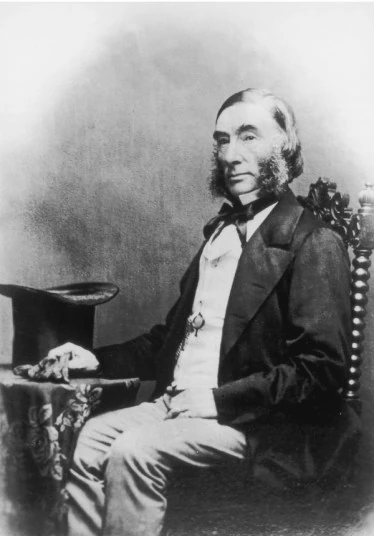
William Cavendish-Scott-Bentinck, 5th Duke Of Portland
| Name | William Cavendish-Scott-Bentinck, 5th Duke Of Portland |
| Title | British politician (1800-1879) |
| Gender | Male |
| Birthday | 1800-09-12 |
| nationality | United Kingdom of Great Britain and Ireland |
| Source | https://www.wikidata.org/wiki/Q334530 |
| pptrace | View Family Tree |
| LastUpdate | 2025-11-26T23:25:36.170Z |
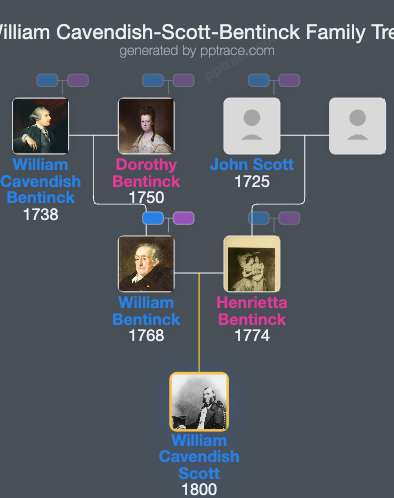
Family Tree
Tap  to expand more relatives
Introduction
William John Cavendish-Scott-Bentinck, 5th Duke of Portland (17 September 1800 – 6 December 1879), was a British aristocrat known for his private lifestyle and eccentric behaviors. He was born in London as the second son of William Bentinck, 4th Duke of Portland, and Henrietta Scott. His baptism took place at St George's Church, Hanover Square, on 30 September 1800. He was one of nine children in his family and was commonly known by his second Christian name, John. His older brother was William Henry Bentinck, and he had a sister, Charlotte Denison, who became the wife of Evelyn Denison, 1st Viscount Ossington.
Educated privately at home, he entered military service in 1818 as an ensign in the Foot Guards. He subsequently transferred to the 7th Light Dragoon Guards in 1821, reaching the rank of captain, and served in the 2nd Life Guards in 1823. His health was described as delicate, suffering from lethargy, short-term memory loss, and sciatica. In 1824, following the death of his elder brother, he was styled as Marquess of Titchfield and became a Tory Member of Parliament for King's Lynn, a seat held by his family. He served in Parliament until 1826, when he resigned due to health issues, and he also held a captaincy in the Royal West India Rangers from 1824 to 1834, a regiment disbanded in 1819 and maintained as a sinecure.
He succeeded his father as the 5th Duke of Portland on 27 March 1854. Although entitled to a seat in the House of Lords, he did not take his seat until 5 June 1857, showing little interest in active political engagement. He supported the Whigs and Robert Peel and served as Deputy Lord Lieutenant of Nottinghamshire from 1859 until his death.
The Duke resided at Welbeck Abbey in Nottinghamshire, where he undertook extensive building and landscape modifications. These projects employed many local workers and included elaborate grounds with kitchen gardens extending over 22 acres, surrounded by high walls. An enormous riding house, measuring 396 by 108 feet with gas lighting, was built; he also installed a skating rink near the estate lake. The main house was stripped of much of its furniture and furnishings, rendering most of it sparsely furnished and in disrepair by 1879.
A notable feature of his estate was an elaborate underground tunnel and chamber system, constructed using timber from his father's tree-planting efforts due to concerns over oak shortages. These tunnels, totaling approximately 15 miles, connected key estate buildings and included a 1,000-yard tunnel linking the house to the riding house, as well as a 1.25-mile tunnel extending to the south lodge. The subterranean chambers included a large hall intended as a chapel but converted into a gallery and ballroom, a library, an observatory, and a billiards room. The underground network was reputed to have inspired Kenneth Grahame's character Mr. Badger.
The Duke was characterized as highly introverted and reclusive. He preferred to avoid personal contact and employed hundreds of workers without allowing them to acknowledge him; all correspondence and business were conducted through written communication. His only permitted personal contact was with his valet. Despite his social withdrawal, he maintained correspondence with prominent politicians such as Benjamin Disraeli and Lord Palmerston. He rarely engaged in social activities or entertained visitors and was known to walk outside mainly at night, often accompanied by a servant with a lantern, and dressed in a manner that concealed his identity. When in London at Harcourt House in Cavendish Square, he avoided public view by hastening directly into his study, and he maintained unusual routines such as having a chicken roasted at all hours.
Evidence suggests that he had at least one illegitimate daughter, Fanny (later Fanny Lawson), and possibly two sons, William and Joseph, all of whom were believed to be illegitimate. Fanny Lawson had two sons, George and Bertram Lawson, who served in the military during World War I. The Duke's relationships were discreet; a medical diagnosis in his youth suggested infertility, which modern assessments consider unlikely based on current medical knowledge.
William John Cavendish-Scott-Bentinck died on 6 December 1879 at Harcourt House in London. He was buried in Kensal Green Cemetery. Following his death, as his younger brother Henry William had died without male heirs in 1870, his cousin William Cavendish-Bentinck inherited the dukedom. The department of Manuscripts and Special Collections at the University of Nottingham holds a collection of papers related to the 5th Duke, including personal and political documents from the Portland (Welbeck) Collection.