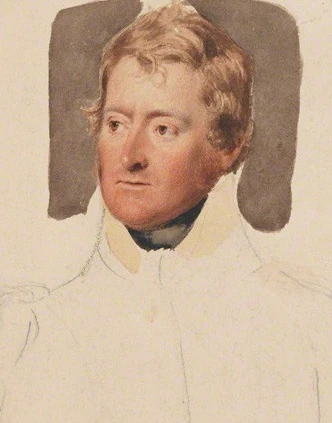
Frederick Cavendish Ponsonby
| Name | Frederick Cavendish Ponsonby |
| Title | British Army officer |
| Gender | Male |
| Birthday | 1783-07-06 |
| nationality | United Kingdom of Great Britain and Ireland |
| Source | https://www.wikidata.org/wiki/Q5497504 |
| pptrace | View Family Tree |
| LastUpdate | 2025-11-26T23:28:10.263Z |
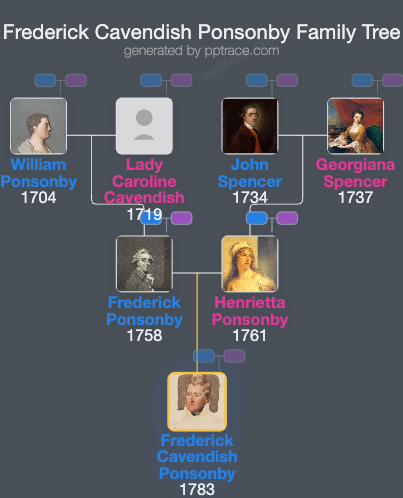
Family Tree
Tap  to expand more relatives
Introduction
Major-General Sir Frederick Cavendish Ponsonby (6 July 1783 – 11 January 1837) was a British Army officer. He was born in 1783 and died in 1837. Ponsonby was the second son of Frederick Ponsonby, Viscount Dungannon, who became the 3rd Earl of Bessborough in 1793, and his wife Henrietta, née Spencer, Countess of Bessborough. His siblings included John Ponsonby, 4th Earl of Bessborough; William Ponsonby, 1st Baron de Mauley; and Lady Caroline Lamb, who married Prime Minister Viscount Melbourne.
He received education at Harrow School. Ponsonby joined the British Army as a cornet in January 1800 and served in the 10th Light Dragoons. He was promoted to lieutenant in June 1800 and to captain on 20 August 1803. In April 1806, he transferred to the 60th Regiment of Foot and served on the staff of the Duke of Bedford, then Lord Lieutenant of Ireland, and briefly in this role for his successor, the Duke of Richmond. He was promoted to major on 25 June 1807 and on 6 August 1809, exchanged to the 23rd Light Dragoons, serving in the Peninsular War.
During the Peninsular War, Ponsonby fought at Talavera. He was promoted to lieutenant colonel on 15 March 1810, and served as assistant adjutant-general at the battles of Buçaco and Barrosa, notably directing a charge by the 2nd Regiment of Hussars (King's German Legion) against French dragoons. On 11 June 1811, he was appointed commander of the 12th Light Dragoons. Following the fall of Badajoz, he distinguished himself at the Battle of Villagarcia (or Llerena) on 11 April 1812, where he temporarily commanded Anson’s brigade and successfully delayed French cavalry under Charles Lallemand until reinforcements arrived.
Ponsonby led the 12th Light Dragoons during the Battle of Salamanca, dispersing French infantry after the victory at Badajoz, and was wounded while covering the withdrawal from Burgos. At Vitoria, his regiment participated in the force under Sir Thomas Graham that blocked the retreat of French forces towards Bayonne. He also took part in the Battle of the Pyrenees and subsequent fighting in southern France.
At the time of Napoleon's abdication, Ponsonby was in Paris, and he rode through the night to deliver the news to Wellington. Wellington famously reacted to this intelligence at an inn after the Battle of Toulouse, with a gesture described as a "triumphal pastiche of a flamenco dance."
During the Waterloo campaign, Ponsonby’s unit, the 12th Light Dragoons, was attached to Sir John Vandeleur’s light cavalry brigade. At the Battle of Waterloo, the 12th and 16th Light Dragoons initially charged down the slope to support the Union Brigade of heavy cavalry but advanced too far, a move later described as excessive. During the battle, Ponsonby was wounded in both arms, knocked off his horse by a sabre cut, and subsequently stabbed in the back by a French lancer, who remarked, "Tu n'es pas mort, coquin" ("You're not dead, you rascal"). A French skirmisher robbed him but was later replaced by a captain from the Imperial Guard Dragoons who treated him kindly. Another skirmisher used Ponsonby as a shield and fired over his body. Toward the battle’s end, he was ridden over by Prussian cavalry. After the battle, during the night, he was assaulted by a Prussian soldier seeking plunder, and he was found crawling by a wounded soldier of the Royal Dragoons. He was eventually rescued by a soldier of the 40th Foot, who guarded him until he could be transported to Brussels. Despite multiple severe wounds and loss of considerable blood—roughly 120 imperial fluid ounces—Ponsonby survived the injuries sustained in the battle.
Following his recovery, Ponsonby went on half-pay on 26 August 1820 and was appointed inspecting field officer in the Ionian Islands on 20 January 1824. He was promoted to major-general on 27 May 1825 and commanded troops in the Ionian Islands. On 22 December 1826, he was appointed Governor of Malta, serving in that role for over eight years. In 1827, he met Baron de Laussat, who had earlier assisted him at Waterloo. During his governorship, he was awarded GCMG in 1828, and in 1831, he received the titles KCB and KCH. He left the governorship in May 1835, remaining de jure governor until 30 September 1836. On 4 December 1835, he became colonel of the 86th Regiment of Foot, and later, on 31 March 1836, was transferred to the colonelcy of The Royal Dragoons. Throughout this period, he maintained a keen interest in cavalry tactics and corresponded with the Duke of Wellington.
Ponsonby died suddenly on 11 January 1837 at the Wellesley Arms inn near Basingstoke. He was buried in the crypt of St Nicholas' Church in Hatherop, Gloucestershire. In 1838, a column was erected in Valletta in his honor, known as Ponsonby's Column; it was destroyed by lightning in 1864.
He married Lady Emily Charlotte Bathurst on 16 March 1825. She was the youngest daughter of Henry Bathurst, 3rd Earl Bathurst. They had three sons—Sir Henry Frederick Ponsonby, Alberta Victoria Ponsonby, and John Ponsonby—and three daughters.