Charles Greville
| Name | Charles Greville |
| Title | English diarist and an amateur cricketer (1794-1865) |
| Gender | Male |
| Birthday | 1794-04-02 |
| nationality | United Kingdom of Great Britain and Ireland |
| Source | https://www.wikidata.org/wiki/Q3532211 |
| pptrace | View Family Tree |
| LastUpdate | 2025-11-26T23:22:26.052Z |
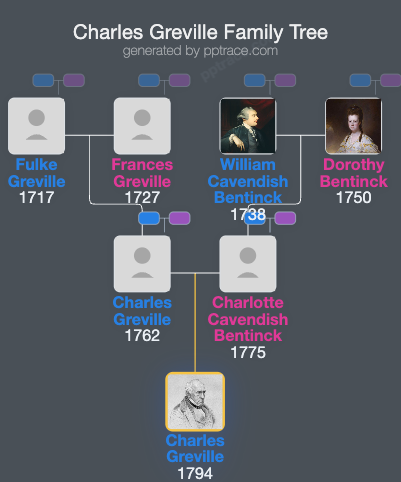
Family Tree
Tap  to expand more relatives
Introduction
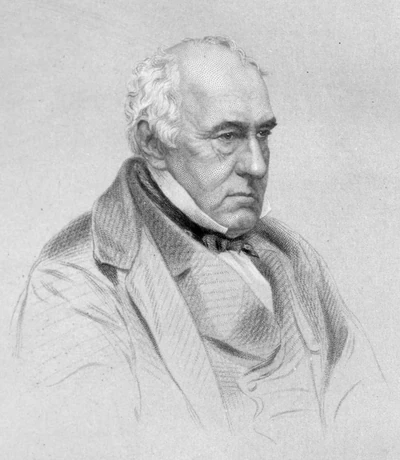
Charles Cavendish Fulke Greville (2 April 1794 – 17 January 1865) was an English diarist and amateur cricketer. He participated in first-class cricket matches between 1819 and 1827.
Born in England, Greville was the son of Charles Greville, who was a second cousin of the 1st Earl of Warwick. His mother was Lady Charlotte Bentinck, a daughter of the 3rd Duke of Portland, a prominent political figure who served as leader of the Whig party and Prime Minister. Greville spent much of his childhood at Bulstrode, the residence of his maternal grandfather.
He held the position of Pages of Honour to King George III during his youth. He was educated at Eton College and Christ Church, Oxford, but left university early after being appointed private secretary to Earl Bathurst before reaching the age of twenty. Greville was also appointed Secretary of the Island of Jamaica, a sinecure office that was managed by a deputy, with the reversion of the clerkship of the council.
His family background was marked by personal associations that reportedly caused distress; notably, his mother was widely believed to have been the mistress of the Duke of Wellington. This relationship may have influenced Greville's often adversarial attitudes toward Wellington.
In his cricket career, Greville was mainly associated with Marylebone Cricket Club (MCC). He made five known first-class appearances and played for the Gentlemen team in the series known as Gentlemen v Players. His brother was Algernon Greville.
Greville entered public service as a Clerk of the Council in ordinary in 1821, a position he retained until his retirement in 1859. During his tenure, he served under three monarchs: George IV, William IV, and Queen Victoria. While not involved in political or confidential duties, his role frequently placed him in contact with influential political figures. Greville maintained a lifestyle typical of a man of fashion—well-born and well-bred—engaging occasionally in public transactions and private affairs.
He was involved in horse racing and succeeded in winning 9,000 pounds in 1837 with his horse Mango at the St Leger Stakes. He was an active member of the turf until 1855 when he sold his stud. Greville trained racehorses with notable figures such as Lord George Bentinck and the Duke of Portland.
Greville died in Mayfair, London. He is chiefly known for the posthumous publication of diaries and journals that he kept throughout his life. These writings were entrusted to his friend Henry Reeve shortly before Greville’s death, with instructions for publication after his passing.
The journals, covering the reigns of George IV and William IV from 1817 to 1837, were published nearly ten years after Greville’s death and garnered significant public interest. They provide detailed accounts of public events and private motives behind historical developments, emphasizing personal impressions and observations. Greville's aim was to offer materials for understanding the era, focusing on the causes of events and the personalities involved, rather than scandalous private matters.
His diaries were published in multiple volumes, with the first part released in 1874. Some content was censored or recalled due to controversial passages. The early publication prompted criticism from Queen Victoria and Prime Minister Benjamin Disraeli, who expressed strong disapproval of Greville’s candid remarks about royalty and public figures.
In addition to his diaries, Greville authored a volume on the Past and Present Policy of England in Ireland, advocating for the payment of Roman Catholic clergy, published anonymously in 1845. He also authored several pamphlets relating to contemporary events.
His brother, Henry William Greville, who served as an attaché in Paris and kept his own diary, saw parts of his writings published posthumously.
Sources of information about Greville include the 1911 edition of the Encyclopædia Britannica, the Dictionary of National Biography, and other scholarly references.